
Last updated: 2026-09-21
Why Are Carpal Tunnel Symptoms Worse at Night?
If your thumb through middle finger goes numb every night and wakes you up, carpal tunnel syndrome, in which the median nerve is compressed inside the wrist, is the first condition to consider. Plenty of office workers in their 40s describe it this way: during the day, typing brings only an occasional tingle in the fingertips, but by dawn the fingers burn with numbness and only settle after they shake their hands hard.
On the inner side of the wrist is the carpal tunnel, a narrow passage enclosed by bones and ligaments. Tendons that bend the fingers and the median nerve pass through it together. While you sleep, if the wrist bends deeply inward, the space inside the tunnel narrows, pressure rises, and the nerve gets compressed (Wipperman Jennifer et al., 2016)(Padua Luca et al., 2022).
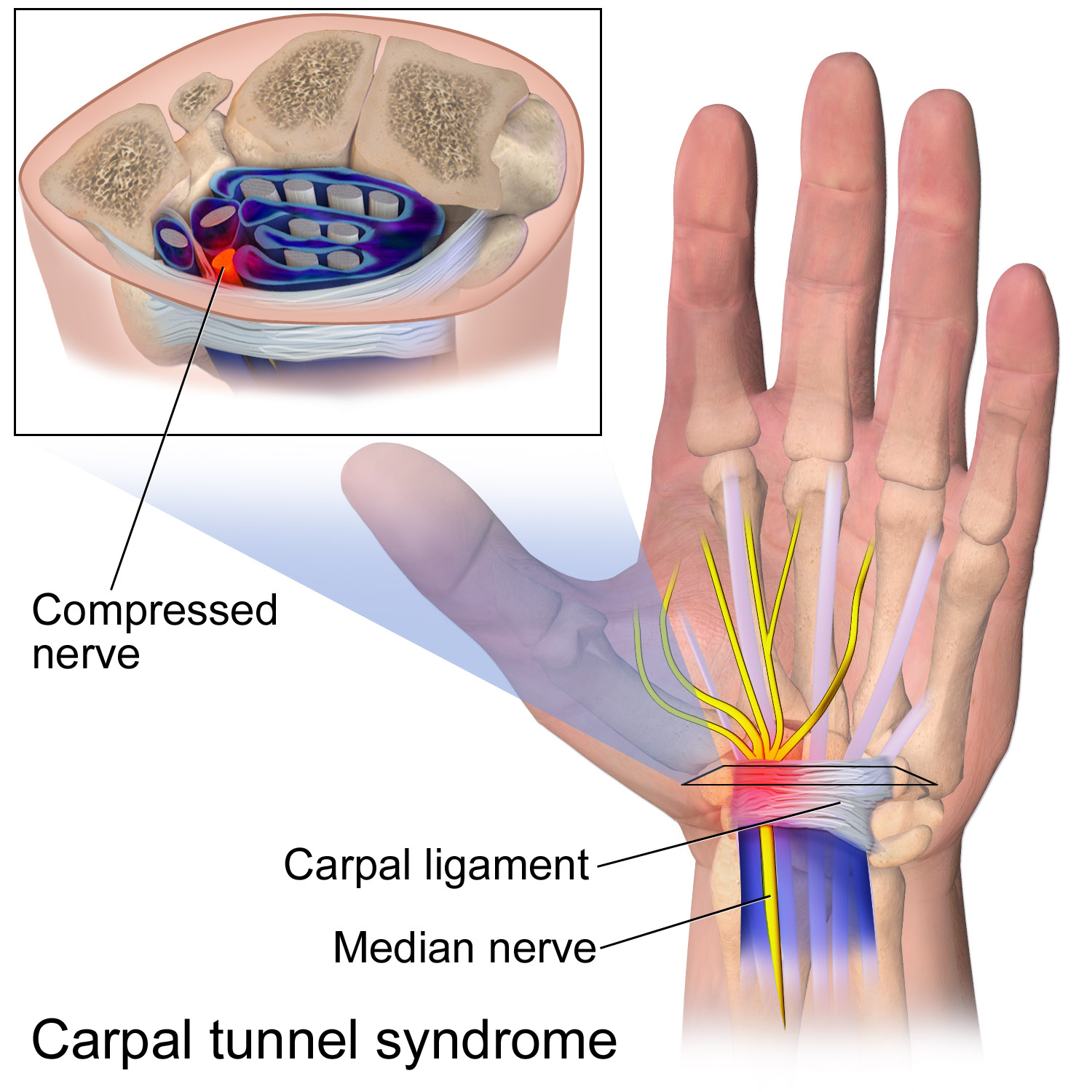
Location where the median nerve is compressed in the wrist tunnel (Blausen.com staff, Medical gallery of Blausen Medical 2014, CC BY 3.0)
Fluid movement during sleep also intensifies nighttime numbness. During the day, when you are upright and moving, fluid tends to settle in the lower body. When you lie down at night, fluid spreads back into the upper body and arms, and the tissues inside the wrist tunnel become more prone to swelling. When blood flow in the tiny vessels around the nerve stagnates and pressure is added, numbness builds to the point of waking you up. Shaking or rubbing the hand in your sleep briefly restores blood flow in the tunnel and eases the numbness; this hand movement is called the flick sign (Wipperman Jennifer et al., 2016). In clinical practice, it is one of the clues that lead clinicians to suspect a median nerve problem.
Which Movements Put Pressure on the Carpal Tunnel?
Pressure inside the carpal tunnel rises and falls with how far the wrist is bent, how hard the hand grips, and how often and how long a movement is repeated. When you grip an object hard with the wrist bent back or sharply flexed, the tendons are pulled taut and press on the median nerve that runs among them. For office workers who use a keyboard and mouse, holding the wrist bent for long periods gradually raises pressure inside the tunnel. Grip force and how rest time is spread out, rather than computer work itself, determine the load (Wipperman Jennifer et al., 2016).
At home and in caregiving, the load on the carpal tunnel concentrates when you repeatedly lift a child, wring out mops and dish towels with your wrists, or lift a heavy frying pan with one hand. On construction sites and in manufacturing, gripping heavy equipment tightly or working with vibrating tools is also an occupational exposure that compresses the nerve (Wipperman Jennifer et al., 2016). Personal health status also has an effect. Women, whose carpal tunnels are narrow, have a higher rate of the condition, and obesity, pregnancy, diabetes, and hypothyroidism cause the tissues inside the tunnel to swell and disrupt the pressure balance. In rare cases, systemic disease such as amyloidosis narrows the tunnel through deposits in connective tissue, so we ask about both the work environment and the underlying health status (Padua Luca et al., 2022).
How Is It Different from Cervical Disc or Cubital Tunnel Numbness?
Numbness in carpal tunnel syndrome follows the territory of the median nerve. On the palm side, sensation in the thumb, index finger, middle finger, and the thumb-side half of the ring finger becomes dull or tingles. The little finger is not supplied by the median nerve, so intact sensation there is the typical pattern. Because nerve course and distribution vary from person to person, finger boundaries alone do not settle where the problem is (Wipperman Jennifer et al., 2016).
Finger numbness does not always originate at the wrist. In cervical disc disease, an abnormality of the cushion-like tissue between the vertebrae in the neck (the disc) compresses a nerve root, and fingertip numbness is also common. When the C6 nerve root is irritated, the numbness travels down toward the thumb, overlapping the area affected by carpal tunnel syndrome. In these cases, tilting the head back or turning it from side to side can bring radiating pain, a tingling shock that shoots down through the shoulder and arm. Cubital tunnel syndrome, in which the ulnar nerve is compressed at the inner elbow, causes numbness in the little finger and the outer half of the ring finger. Symptoms worsen when the elbow stays bent, such as when resting the chin on a hand or talking on the phone for a long time (Wipperman Jennifer et al., 2016). We examine which fingers are numb, how the numbness changes with neck and elbow movement, and sensation and muscle strength to tell where the nerve is actually compressed.
How Does THE WELLS Nowon Confirm the Diagnosis?
Diagnosis starts with an examination in the clinic room. The Phalen test has you press the backs of both hands together and hold the wrists bent at 90 degrees for one minute, checking whether numbness reproduces in the median nerve area. The Tinel sign checks whether a tingling, electric-shock-like sensation runs through when the nerve area on the inside of the wrist is tapped lightly with a fingertip or instrument. We also perform a compression test, pressing directly on the area around the nerve with the fingers. A single provocation test alone does not confirm the diagnosis (Wipperman Jennifer et al., 2016).
Next, we perform a musculoskeletal ultrasound. It measures the cross-sectional area of the median nerve at the entrance and exit of the carpal tunnel, and checks in real time whether the nerve is locally swollen and whether inflammation in the surrounding tendons has thickened the tissue (Padua Luca et al., 2022). When the symptoms and exam findings are atypical, or when marked hand weakness means surgery needs to be discussed, we refer the patient to an outside facility for a nerve conduction study, which measures the speed of nerve conduction and the extent of damage (Wipperman Jennifer et al., 2016). If the hand numbness may have started in the neck, we check the alignment of the spine with a cervical X-ray and measure the flexibility of each segment with the Sigma spinal segmental stiffness test. The spinal tests serve as reference indicators of bone and joint movement, while nerve root compression is determined from the distribution of numbness and the physical examination.
In What Order Is Treatment Given, and When Is Surgery Discussed?
In the early stage when nerve compression is mild, or when it is moderate, treatment starts with conservative care. To keep the wrist from bending during sleep and raising pressure inside the carpal tunnel, a brace holds the wrist in a straight, neutral position (Wipperman Jennifer et al., 2016). At THE WELLS Nowon, we give Prolozone injections, which combine prolotherapy with ozone, while using ultrasound to watch the area around the nerve, the wrist ligaments, and the tendons. The standard schedule is 4 to 6 sessions in total, given 0.5 to 1 time per week, and we adjust each session based on changes in numbness and ultrasound findings. For perineural injections, a study of 49 people found that a single ultrasound-guided 5% dextrose injection improved pain, functional disability, and median nerve cross-sectional area through 6 months (Wu Yung-Tsan et al., 2017). In a study comparing 54 people, perineural dextrose injection outperformed triamcinolone injection for pain and function at 4 to 6 months (Wu Yung-Tsan et al., 2018). Both studies report results for the dextrose component.
Alongside the injections, we loosen fascia that has become stiff and hardened in the wrist and forearm using WINBACK radiofrequency (RF). This step frees adhesions, where tissues stick to each other, to restore the wrist's range of motion. If cervical disc problems or misalignment of the cervical spine are also tensing the nerve, we restore movement in stiff joints around the neck with cranial nerve relaxation correction therapy and Sigma Tapping correction. This correction eases tension coming down from the neck and upper body, reducing the load on the wrist nerve.
Occupation-specific work adjustments run alongside treatment. Office workers adjust their keyboard support to keep the wrist level and prevent it from bending back, and they take short breaks during typing. In housework and caregiving, heavy items are carried by splitting the load between both hands, and the twisting motion used to wring out a mop is replaced with a tool. Field workers use anti-vibration gloves with vibrating tools and adjust their work order so grip strength is not overused. Return to work is staged: we raise the load step by step, watching whether nighttime waking from numbness decreases and how much hand work the hand can tolerate.
There are also studies comparing treatment with surgery. In a Cochrane analysis pooling 14 randomized studies with 1,231 people, surgery led to a higher rate of long-term clinical improvement than the splint-wearing group, but the differences in symptom and function scores did not reach the minimal clinically important difference. Of the splint group, 44% later moved on to surgery (Lusa Vieda et al., 2024). If symptoms still interfere with daily life after 4 to 6 months of conservative treatment, or if any of the following appear, we discuss surgery rather than extending the conservative treatment period: visible wasting of the thick muscle at the base of the thumb, where the muscle sinks in; weakness when lifting the thumb; or persistent loss of sensation (Wipperman Jennifer et al., 2016).
Sungjin Park · Medical Director · THE WELLS Nowon
References
- Wipperman Jennifer, Goerl Kyle (2016). Carpal Tunnel Syndrome: Diagnosis and Management.. Am Fam Physician. PMID: 28075090
- Padua Luca, Cuccagna Cristina, Giovannini Silvia (2022). Carpal tunnel syndrome: updated evidence and new questions.. Lancet Neurol. PMID: 36525982
- Wu Yung-Tsan, Ho Tsung-Yen, Chou Yu-Ching (2017). Six-month Efficacy of Perineural Dextrose for Carpal Tunnel Syndrome: A Prospective, Randomized, Double-Blind, Controlled Trial.. Mayo Clin Proc. PMID: 28778254
- Wu Yung-Tsan, Ke Ming-Jen, Ho Tsung-Yen (2018). Randomized double-blinded clinical trial of 5% dextrose versus triamcinolone injection for carpal tunnel syndrome patients.. Ann Neurol. PMID: 30187524
- Lusa Vieda, Karjalainen Teemu V, Pääkkönen Markus (2024). Surgical versus non-surgical treatment for carpal tunnel syndrome.. Cochrane Database Syst Rev. PMID: 38189479
Frequently Asked Questions
Q. Can carpal tunnel syndrome occur in both hands at the same time?
It can occur in both hands at the same time, and the severity of numbness and the timing of onset may differ between the two sides. We do not decide that the cause is a neck nerve problem based on numbness in both hands alone. Instead, we identify the cause from each hand's symptoms and examination findings.
Q. Can hand numbness that began during pregnancy persist after delivery?
Numbness often improves as swelling goes down after delivery, but it does not always disappear entirely right away. If the numbness continues or hand strength weakens, do not assume it is only a temporary symptom of pregnancy. See a doctor for an examination to distinguish the cause.
Q. Is it okay to keep exercising when I have carpal tunnel syndrome?
You can continue exercising as long as it does not cause hand numbness. If the numbness gets worse during or after exercise, stop that movement and reduce the intensity and duration. Also, do not push through pain when doing wrist stretches.
Q. Do the results of the dextrose injection studies also apply to Prolozone injections?
The two studies in the main text report results from a single injection of 5% dextrose given under ultrasound guidance. The Prolozone injection at THE WELLS Nowon pairs prolotherapy with ozone and is given over several sessions, so the next session is decided based on changes in numbness and ultrasound findings at each visit.