
Last updated: 2026-09-30
Waking Up With a Finger Stuck in a Bent Position
If your finger catches in a bent position every morning and only clicks free when you straighten it with your other hand, you are experiencing the characteristic locking of trigger finger syndrome. These symptoms appear because the flexor tendon catches as it passes through the A1 pulley at the base of the finger. Homemakers in their 50s and workers on job sites often come to see us because they wake up with their middle or ring finger frozen in a fist-like curl. They cannot straighten it on their own, and it springs straight only when they push it hard with the other hand. This is not simply poor circulation or temporary fatigue. It is a sign of physical friction at the entrance of the tunnel the tendon passes through.
The flexor tendon, the thick tendon that bends the finger, runs along the palm side of the finger. A band-like tissue wraps around it to keep it from lifting away from the bone, forming a tunnel-like structure called a pulley. The A1 pulley sits just below the base knuckle of the finger. When repeated friction thickens it, or when inflammatory swelling develops in the tendon itself, the space inside the tunnel narrows. As a result, the flexor tendon cannot glide smoothly through the narrowed entrance of the pulley and catches on it, like snagging on a ledge (Gil Joseph A et al., 2020). During the night, while the hand stays still at rest, fluid collects around the tendon and the swelling worsens. That is why the locking is most pronounced when you wake up in the morning.
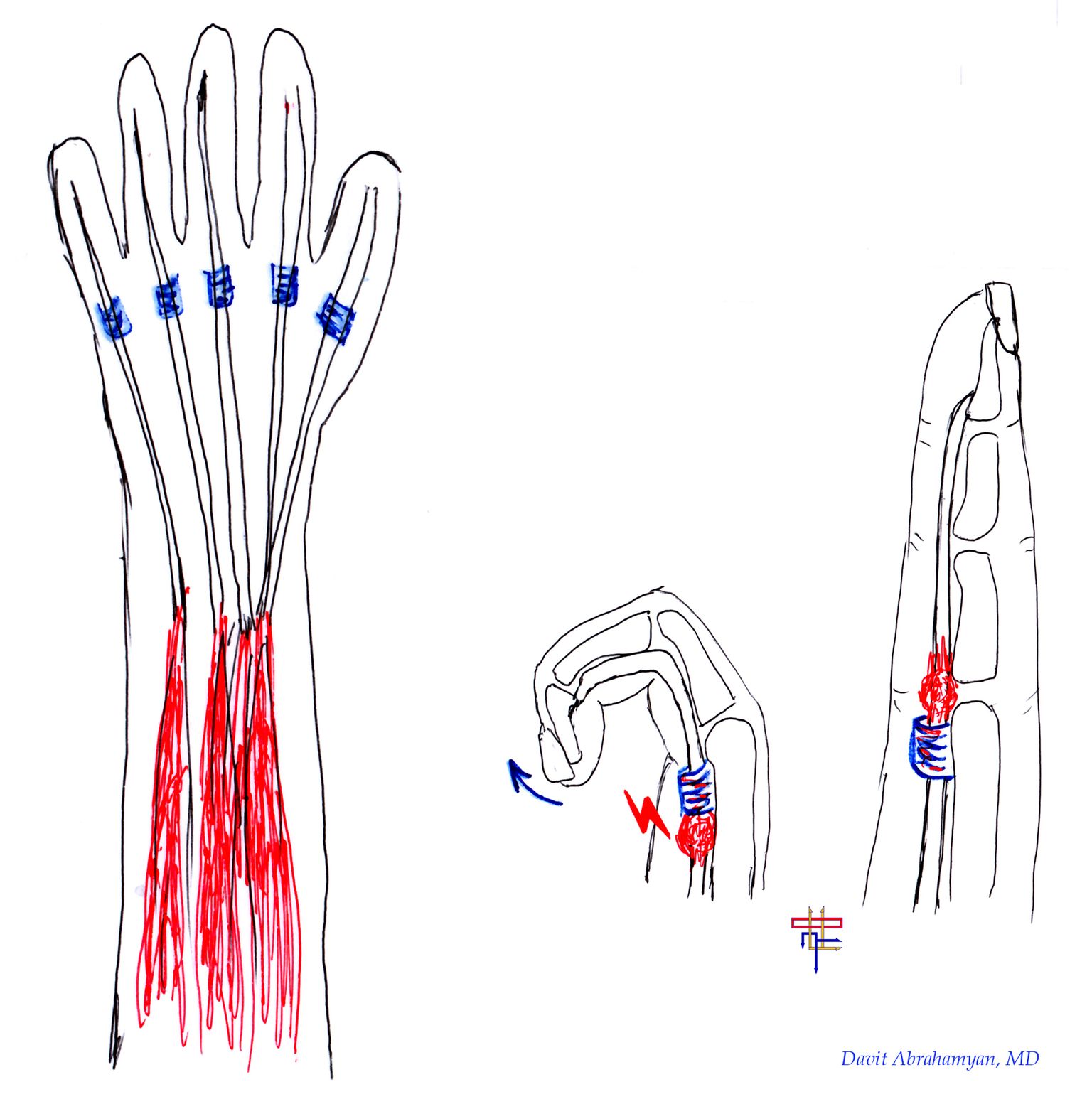 Thickened flexor tendon (red) catching on the pulley (blue) at the base of the finger, stopping the finger in a bent position (Davplast, CC BY-SA 4.0)
With this condition, even before the finger fully locks, you feel sharp tenderness when you press firmly with a fingertip on the base joint where the finger meets the palm. As the condition progresses, a small pea-sized nodule can sometimes be felt in the palm when you bend and straighten the finger, and each time the tendon passes this nodule, you feel a jolting resistance. Trigger finger is a common cause of functional impairment that gets in the way of fine hand movements (Gil Joseph A et al., 2020).
Hand Tasks That Strain the Tendons: Chopping, Wringing Out Rags, and Gripping Tools
When you repeatedly bend and straighten your fingers while gripping a handle hard, constant shear force and pressure act on the contact surface where the flexor tendon meets the A1 pulley. As this back-and-forth movement builds up under such conditions, micro-damage accumulates in the fibrous tissue of the pulley. In particular, when you keep a strong grip while a hard object presses against your palm, micro-inflammation develops in the tendon sheath that protects the tendon, and the tissue gradually thickens.
In daily life, wringing out a rag or wet laundry with both hands to remove water, or walking for a long time with the handles of a heavy shopping bag hooked over the base of your fingers, puts a heavy load on the hand. When cooking in restaurants or at home, the flexor tendons tighten sharply while you chop hard ingredients one after another, or at the moment you grip and lift a heavy wok or frying pan by its handle. At manufacturing and equipment sites, friction at the pulley entrance increases when you press hard to turn a screwdriver, hold the grip of a vibrating power tool for long periods, or keep cutting thick electrical wire with scissors or pliers.
In an epidemiological study of 665 workers at a meat-processing plant, the overall prevalence of trigger finger was 14%. When 454 of them were followed over a period of time, the incidence among workers who continuously used hand tools reached 12.4 cases per 100 person-years, compared with only 2.6 among those who did not use them (Gorsche R et al., 1998). Workers who repeatedly gripped hand tools had a 4.7-fold higher relative risk than non-users, which shows that work environments requiring a strong grip on handles directly affect tendon injury (Gorsche R et al., 1998).
Beyond this mechanical strain, the body's metabolic environment and sex-related characteristics also raise the risk. Trigger finger occurs more often in women than in men, and it is far more common in people with diabetes whose blood sugar is hard to control (Gil Joseph A et al., 2020). This is because high blood sugar causes glycation of the collagen fibers that make up the tendon, which makes the tissue prone to stiffening and thickening.
When It Only Hurts, When It Clicks, When You Have to Straighten It by Hand
Trigger finger syndrome is not a condition in which a finger suddenly becomes completely stiff one day. It progresses in stages, depending on how much friction there is between the tendon and the pulley. Severity is graded by the pattern of catching and by whether the finger can still be actively straightened. In Stage 1, the early phase of the disease, the finger does not catch, but there is clear pain when you press on the palm side at the base of the finger, and the finger feels stiff when you wake up in the morning. At this point, the movement becomes smoother for a while after you clench and open your hand a few times, so it is easy to dismiss.
As the disease progresses to Stage 2, a clicking sound or resistance occurs as you bend and straighten the finger, but you can still straighten it all the way on your own. In the Quinnell classification widely used in the medical literature, this condition is defined as a stage of clear catching in which active extension is possible (Donati Danilo et al., 2025). At this stage, when you let go of an object you were gripping, the finger straightens a beat late, or you keep feeling it snap at the finger joint.
By Stage 3, the finger catches on the edge of the pulley while bent toward the palm, and it will not straighten no matter how hard you try with that finger's own strength. Only when you grasp the tip of the caught finger with the other hand and pull firmly does it snap straight with a click, a state of passive extension (Donati Danilo et al., 2025). At this stage, the locking repeats every single morning. As a result, you experience serious functional impairment: during the day, while cutting with a knife or working with a power tool in hand, a finger suddenly stops and you have to halt the task.
In Stage 4, the most severe stage, the tendon becomes completely trapped at the pulley entrance, or the surrounding soft tissue stiffens, so the finger stays fixed and does not fully straighten even when you pull it hard with the other hand (Donati Danilo et al., 2025). At this point, the flexor tendon is not only physically caught; the muscles and joints of the finger itself also stiffen, raising the risk that the joint's range of motion becomes permanently restricted.
Why We Start by Measuring Tendon and Pulley Thickness with Ultrasound
When you visit us with suspected trigger finger, we carefully palpate the tender point on the palm side at the base of the finger and check whether a nodule can be felt along the tendon. In the detailed examination that follows, we use musculoskeletal ultrasound to look at morphological changes in the tendon and the surrounding tunnel structures. To diagnose trigger finger accurately and plan treatment, the thickness of the flexor tendon and the A1 pulley that surrounds it must be measured directly.
During musculoskeletal ultrasound, we place the transducer firmly against the base joint on the palm side and examine the tendon at high resolution in both long-axis and short-axis views. A healthy pulley appears as a thin line, but an A1 pulley affected by trigger finger syndrome shows hypoechoic thickening on ultrasound, appearing darker than normal because of fibrous thickening (Donati Danilo et al., 2025). According to the literature, an A1 pulley thickness greater than 0.62 mm serves as a meaningful reference point for judging pathological thickening (Donati Danilo et al., 2025). Beyond the pulley itself, we also check for swelling of the flexor tendon running through it and for inflammatory effusion within the tendon sheath that surrounds the tendon.
The greatest clinical advantage of musculoskeletal ultrasound is that it lets us observe dynamically how the tendon moves while the patient clenches and opens the hand. As the finger slowly straightens, ultrasound shows us directly how the thickened nodule of the flexor tendon fails to squeeze through the narrowed entrance of the A1 pulley, catches on its edge, and stops. We then compare whether the instant the flexor tendon overcomes strong resistance and snaps out of the pulley matches exactly the clicking trigger sensation the patient feels.
Through this dynamic examination, we connect the exact anatomical location of the tenderness in the palm, the thickness of the A1 pulley, and the lesion that resists movement into a single three-dimensional picture. This process clearly distinguishes whether the source of pain is simply a problem in the finger joint itself or mechanical friction between the tendon and the pulley, and it lays the foundation for setting specific targets for nonsurgical treatment.
Treatment and Hand Care When You Cannot Take Time Off Work
At the stage where you can still straighten your fingers on your own, you can recover hand function by combining work modifications that reduce the strain of repetitive gripping with nonsurgical conservative treatment. If the locking becomes frequent enough that the finger straightens only when you push it with your other hand, or if the finger stiffens, treatment intensity should be increased based on how often it locks and how much function has declined. If you must keep using your hands to earn a living, it is realistically difficult to stop using them and rest completely.
The starting point for work modification is changing to grip tools with handles sized to fit your hand. Gripping a thin tool handle or knife handle forces the base knuckle of the finger to bend excessively, and the contact pressure of the flexor tendon against the A1 pulley rises sharply. Slipping a rubber tube over the handle or wrapping it with a cushioning pad to thicken the grip lets you hold it securely with less grip strength. Wearing work gloves with cushioning on the palm side to spread out tool vibration and direct pressure is also useful. In addition, you should spread the work by alternating hands so that force does not concentrate on particular fingers, and plan your work schedule so that in the middle of continuous tasks you open your hands and let the tendons rest.
To promote recovery of the narrowed pulley and the damaged flexor tendon, we perform extracorporeal shockwave therapy once or twice a week. Shockwave energy delivers acoustic waves to the thickened pulley and the area around the tendon attachment, promoting microcirculation and improving the chronic inflammatory response. In a randomized study of 40 patients with trigger finger who could still straighten their fingers on their own, both the shockwave group and the conventional steroid injection group showed significant improvement in pain and finger catching at the 1-, 3-, and 6-month follow-ups. No statistically significant difference in outcomes was observed between the two groups (Yildirim P et al., 2016). In addition, in a double-blind randomized study of 60 patients with Quinnell grade 2 trigger finger, the group that received high-energy shockwave therapy once a week for 4 weeks maintained markedly lower pain scores and hand disability scale scores at 6 months than the control group that received sham treatment (Chen Yu-Pin et al., 2021).
To restore chronically degenerated tendons and loosened supporting structures, we perform Prolozone therapy, which combines prolotherapy injections that induce regeneration of ligaments and tendons with medical ozone gas, while checking the lesion site with musculoskeletal ultrasound. This regenerative injection therapy improves the local environment around the narrowed pulley and helps the tendon fibers recover their elasticity. We usually outline a course of one session every 1 to 2 weeks, for a total of 4 to 6 sessions. Alongside this, we add WINBACK radiofrequency fascia therapy as an adjunctive physical therapy. Radiofrequency energy delivers deep heat to the fascia of the palm and the forearm flexor muscles, loosening adhered, stiffened soft tissue and widening the active range of motion of the joints.
Among the general conservative treatments described in the medical literature, a systematic review has reported a method that reduces pain by immobilizing a single finger joint with a splint or similar device for 6 to 10 weeks, limiting the tendon's flexion movement (Lunsford Dale et al., 2019). Injecting a steroid preparation into the pulley to quickly suppress the inflammatory response is also commonly discussed. The literature describes the effect of repeated injections, up to three times, but the response to injection varies with the number of affected fingers and the severity of symptoms (Gil Joseph A et al., 2020).
If finger catching does not improve despite long-term conservative treatment and a structured course of shockwave and injection therapy, or if the finger has reached the Stage 4 fixed state in which it stays bent and cannot be fully straightened, you should discuss A1 pulley release, which widens the narrowed tunnel entrance. In open release, a small skin incision is made and part of the thickened A1 pulley is cut lengthwise, permanently securing gliding space for the tendon. For this reason, it is recognized as the standard surgical procedure for patients with chronic, severe trigger finger who do not respond to conservative treatment (Gil Joseph A et al., 2020).
Sungjin Park · Medical Director · THE WELLS Nowon
References
- Gil Joseph A, Hresko Andrew M, Weiss Arnold-Peter C (2020). Current Concepts in the Management of Trigger Finger in Adults.. J Am Acad Orthop Surg. PMID: 32732655
- Gorsche R, Wiley J P, Renger R (1998). Prevalence and incidence of stenosing flexor tenosynovitis (trigger finger) in a meat-packing plant.. J Occup Environ Med. PMID: 9636936
- Donati Danilo, Ricci Vincenzo, Boccolari Paolo (2025). Trigger Finger: A Narrative Review of Dynamic Ultrasound and Personalized Therapies.. J Clin Ultrasound. PMID: 40119539
- Yildirim P, Gultekin A, Yildirim A (2016). Extracorporeal shock wave therapy versus corticosteroid injection in the treatment of trigger finger: a randomized controlled study.. J Hand Surg Eur Vol. PMID: 26763271
- Chen Yu-Pin, Lin Chia-Yu, Kuo Yi-Jie (2021). Extracorporeal Shockwave Therapy in the Treatment of Trigger Finger: A Randomized Controlled Study.. Arch Phys Med Rehabil. PMID: 34029555
- Lunsford Dale, Valdes Kristin, Hengy Shelby (2019). Conservative management of trigger finger: A systematic review.. J Hand Ther. PMID: 29290504
Frequently Asked Questions
Q. When my finger catches, is it okay to force it straight with my other hand or to keep doing fist-clenching exercises?
You should avoid forcing a caught finger straight and avoid fist-clenching exercises that repeatedly provoke the catching. Move the finger slowly within a range that causes no pain or catching, and if it does not straighten even with gentle help, do not apply more force; have it examined by a doctor.
Q. Should a trigger finger splint be worn only at night?
Night wear is the baseline, but if locking keeps recurring during the day as well, we adjust the wearing time according to your work and the type of splint. If numbness or a change in skin color develops after you put it on, you should take the splint off and check its size and how tightly it is fastened.
Q. If finger locking comes with swelling, warmth, and fever, how soon do I need to see a doctor?
If swelling and warmth are accompanied by fever as well, you should see a doctor the same day to check for infection. If the redness spreads quickly, or the pain worsens sharply along with chills, get emergency care immediately.
Related Articles
- Wrist Tenosynovitis: The Criteria That Separate Thumb Pain from Hand Numbness
- Related medical information: Trigger Finger — Linkare Knowledge