
Last updated: 2026-10-15
When Your Waistband Starts Feeling Tight Even Though You Eat the Same Amount
If your waistband starts feeling tight even though you are eating the same amount as before, this kind of change has also been observed in research on the menopausal transition. In a 4-year follow-up study, women's body fat increased as they reached menopause even though their calorie intake had decreased compared with before.(Lovejoy J C et al., 2008)
If you have kept your dinner portions exactly the same and have not added snacks, yet fat is building up only around your belly and waist while your arm and leg muscles are shrinking, the cause is not simple overeating. It is because fat distribution and energy expenditure are changing around menopause. For example, a 51-year-old woman may come to the clinic because, over the past year, her waistband has grown tight and the area around her navel has started to stick out, even though she still eats the same amount at dinner as before. During this period, many women also find that as their periods become irregular, heat rushes to their face and they sleep poorly at night.
One observational study followed 156 healthy women for 4 years, all of whom were premenopausal when the study began. In this study, the participants were actually eating fewer calories around menopause than they had 3 to 4 years before menopause.
Menopausal belly fat appears even though you are not eating more because the changes that come with age and the physiological transition of menopause work together.
When Estrogen Falls, Fat Gathers Deep Inside the Belly
Around menopause, the waistline in particular disappears and the belly sticks out because, as the female hormone estrogen declines, the very place where fat is stored changes. Estrogen and its receptors are directly involved in the differentiation of fat cells and regulate glucose and lipid metabolism in the body.(Lizcano Fernando et al., 2014)
Before menopause, estrogen's influence causes fat to accumulate mainly under the skin of the buttocks and thighs. But as estrogen secretion declines around menopause, the main site where fat accumulates shifts from the buttocks and lower body to the abdomen.
Abdominal fat is divided into subcutaneous fat, which lies just under the skin, and visceral fat, which builds up around the organs deep inside the abdomen. In the 4-year follow-up study mentioned earlier, abdominal subcutaneous fat increased with age in all women regardless of menopausal status. Visceral fat, however, increased significantly only in the women who reached menopause during the follow-up period.(Lovejoy J C et al., 2008)
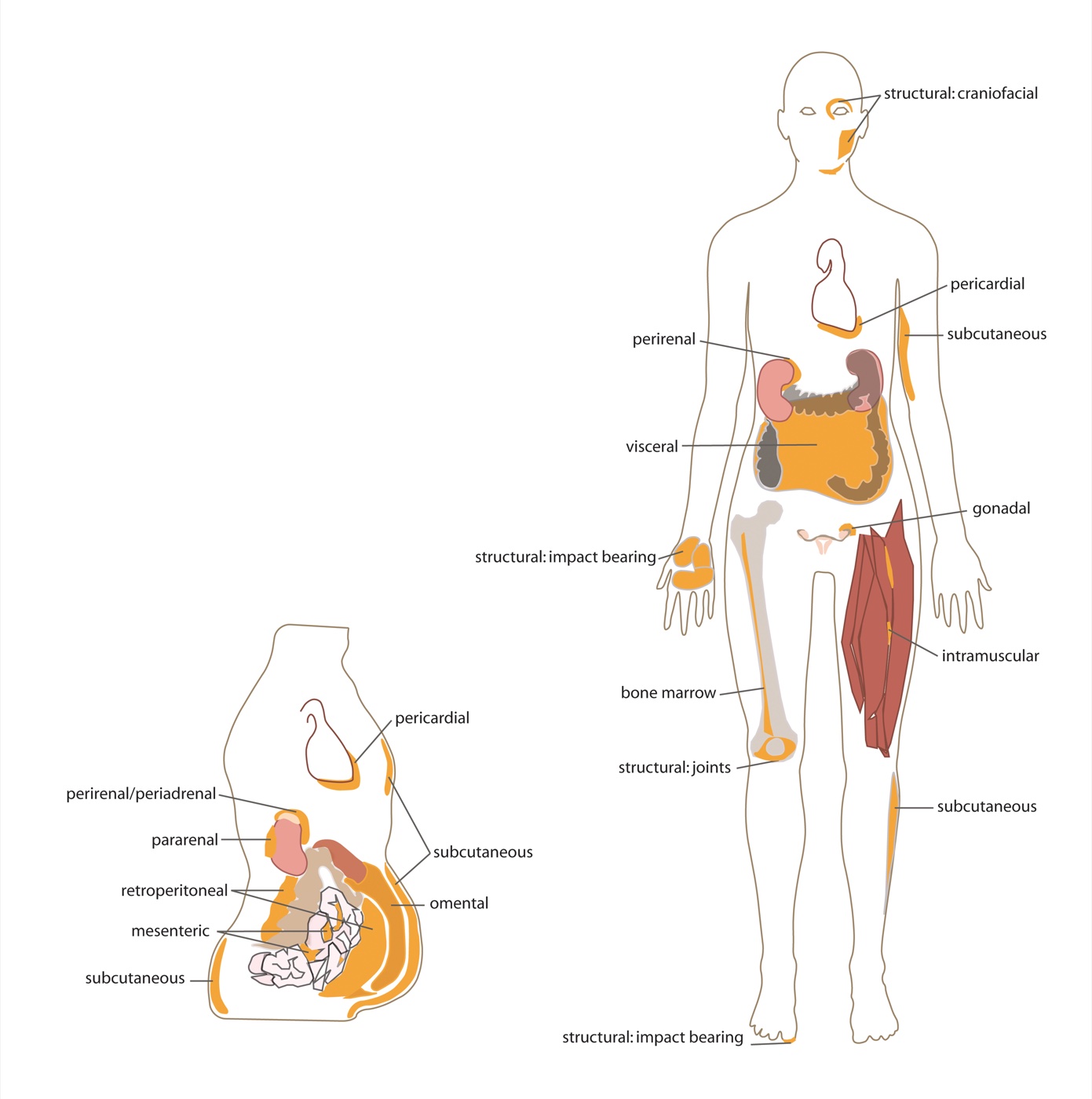 Where white fat accumulates in the body: visceral fat (visceral·omental·mesenteric) around the abdominal organs and subcutaneous fat just under the skin (Cook·Cowan, StemBook, CC BY 3.0)
The Korean Society for the Study of Obesity defines abdominal obesity in Korean women as a waist circumference of 85 cm or more.
Around Menopause, Muscle Shrinks While Fat Builds Up Twice as Fast
If your belly is growing while your arms and legs get thinner, or your body feels heavier than it used to, you are going through a period when muscle loss and a slowing metabolism overlap. According to the large SWAN cohort study, once the menopausal transition began, the rate at which women gained fat mass roughly doubled. At the same time, lean mass, which includes muscle, began to decline as women entered the menopausal transition. This faster fat gain and lean mass loss did not level off until about two years after the final menstrual period.(Greendale Gail A et al., 2019)
When muscle is declining, the energy the body uses at rest and its capacity to burn fat drop as well. A subgroup analysis that measured energy expenditure in women going through the menopausal transition found that the drop in energy expenditure during sleep was 5.3% in women who remained premenopausal but larger, at 7.9%, in women who reached menopause. In the same study, fat oxidation fell by 32% in the women who reached menopause, and their usual physical activity also began to decline about two years before menopause and then stayed low.(Lovejoy J C et al., 2008) The body burns fewer calories during sleep, and a smaller share of its energy comes from burning fat. So even if you eat and move exactly as before, the leftover calories build up in your abdomen.
When muscle loss is added to this, a chain of changes follows in blood sugar and lipid metabolism as well. Skeletal muscle is the main tissue that takes up and processes the glucose that enters the bloodstream after a meal. The loss of muscle and gain of abdominal fat around menopause are closely linked to insulin resistance. According to a related review, during this period insulin resistance rises as abdominal fat increases, and blood LDL cholesterol and triglycerides go up while HDL cholesterol goes down.(Carr Molly C, 2003) When, along with abdominal obesity, several of the risk factors of blood pressure, blood sugar, triglycerides, and HDL cholesterol meet the diagnostic criteria, the condition is called metabolic syndrome. Menopausal belly fat serves as a signal of these metabolic changes.
That said, not all abdominal swelling should be attributed to menopausal change alone. If your abdomen expands rapidly within just a few weeks rather than gradually over months or years, and this comes with bloating, a loss of appetite, and unintended weight loss, you should see a doctor to check whether there is another condition in the abdomen or pelvis.
Sit-Ups Alone Won't Get Rid of Belly Fat
If your belly is sticking out and you do nothing but sit-ups every day, it is easy to be disappointed when your waist does not shrink as much as you hoped. Abdominal strength exercises put load on the abdominal muscles and make them firmer, but reducing abdominal fat that has already built up requires bringing the whole body's energy balance into line rather than moving one specific area.
A meta-analysis pooling 101 randomized controlled trials involving 5,697 postmenopausal women found that exercise training improved muscle-related measures overall and reduced body fat, waist circumference, and visceral fat. Aerobic exercise and combined exercise produced larger improvements in fat-related measures such as body fat and visceral fat, while resistance exercise and combined exercise produced clearer improvements in muscle-related measures such as muscle mass and strength.(Khalafi Mousa et al., 2023)
So a way to lose fat and keep muscle at the same time is to make up for the drop in energy expenditure and fat oxidation with aerobic exercise such as brisk walking or cycling, while also doing resistance exercise that uses large major muscles such as those of the legs and back. If you have knee or lower back pain, avoid straining movements and start by finely adjusting the exercises and load to your current pain level and ability.
Cutting calories too severely to shrink your belly in a short time actually raises the risk of losing muscle while you lose weight. Instead of eating extremely little, including protein foods such as lean meat, fish, tofu, and eggs evenly in every meal is the way to steadily supply the nutrition needed to maintain muscle.
How Does THE WELLS Jamsil Manage Menopausal Belly Fat?
Even when you try to adjust your diet and start exercising, if your body feels heavy as lead and the fatigue does not lift, you end up stopping partway. At THE WELLS Jamsil, we see body shape changes around menopause not as a simple cosmetic problem but as an imbalance in metabolism and muscle.
First, we use blood and nutritional tests to check markers related to vitamins, minerals, and antioxidants in the body, and we look at overall metabolic status and changes in insulin resistance. When the results show that metabolism has slowed and individualized care is needed, we use NAD+ and mitochondrial care to support cellular energy metabolism. NAD+ is a substance directly involved in the body's cellular energy metabolism. So when your energy is low and it is hard to increase your daily activity, it helps with metabolic recovery.
To protect muscle that is being lost and restore muscle strength balance, we provide EMS muscle strengthening and WINBACK core care as supplementary care. EMS is a method that induces muscle contraction with small electrical impulses. One randomized controlled trial applied whole-body EMS for 20 minutes once a week over 6 months to 75 women aged 70 and older with sarcopenic obesity. In this trial, the skeletal muscle mass index increased by about 2.0 to 2.5% in the two EMS intervention groups, while it decreased by about 1.2% in the control group.(Kemmler W et al., 2016) These results were observed under study conditions in which older women received whole-body EMS for 6 months. Still, they show that when it is hard to do high-intensity strength training on your own, using electrical stimulation to induce muscle contraction can serve as a way to support muscle care.
In addition, people who often wake at night because of menopausal hot flashes or changes in the autonomic nervous system easily fall into a vicious cycle in which ongoing sleep loss increases daytime fatigue and ultimately reduces daily activity. For patients like this, who sleep poorly and also report autonomic discomfort, we add TMJ cranial nerve manual therapy, which addresses the alignment of the upper cervical spine, the TMJ, and the thoracic spine, to lower physical tension and build a foundation in the body for keeping up exercise and diet management in daily life.
Jumin Kim · Medical Director · THE WELLS Jamsil
References
- Lovejoy J C, Champagne C M, de Jonge L, Xie H, Smith S R (2008). Increased visceral fat and decreased energy expenditure during the menopausal transition.. Int J Obes (Lond). PMID: 18332882
- Lizcano Fernando, Guzmán Guillermo (2014). Estrogen Deficiency and the Origin of Obesity during Menopause.. Biomed Res Int. PMID: 24734243
- Greendale Gail A, Sternfeld Barbara, Huang MeiHua, Han Weijuan (2019). Changes in body composition and weight during the menopause transition.. JCI Insight. PMID: 30843880
- Carr Molly C (2003). The emergence of the metabolic syndrome with menopause.. J Clin Endocrinol Metab. PMID: 12788835
- Khalafi Mousa, Habibi Maleki Aref, Sakhaei Mohammad Hossein, Rosenkranz Sara K (2023). The effects of exercise training on body composition in postmenopausal women: a systematic review and meta-analysis.. Front Endocrinol (Lausanne). PMID: 37388207
- Kemmler W, Teschler M, Weissenfels A, Bebenek M (2016). Whole-body electromyostimulation to fight sarcopenic obesity in community-dwelling older women at risk. Results of the randomized controlled FORMOsA-sarcopenic obesity study.. Osteoporos Int. PMID: 27289534
Frequently Asked Questions
Q. Do the changes in fat and muscle also stop once two years have passed since my last period?
When the curve of change flattens about two years after the last period, it means that the pace of change, which had sped up around menopause, has slowed. Body composition keeps changing afterward with age, activity level, and diet, so it is a good idea to keep recording changes in your waist circumference and muscle strength, not just your weight.
Q. Where is the 85 cm waist circumference, the cutoff for abdominal obesity in women, measured?
It is the circumference measured at the midpoint between the lowest rib and the top of the pelvic bone. Measure while standing, after breathing out comfortably, with the tape measure level with the floor and without pressing into the skin. This point can differ from the level of your navel or your pants size, so you should measure repeatedly at the same spot.
Q. How is the daily protein intake for managing muscle during menopause decided?
The daily protein target is set based on body weight, age, amount of exercise, usual food intake, and kidney function. If you have kidney disease, you should check whether a restriction is needed before increasing your intake. Rather than packing the set amount into one meal, spread it over several meals, and calculate your total intake including any supplements.
Q. How should I start strength training if I have knee or lower back pain?
First identify which movements bring on the pain, then start with light resistance within a range of motion that does not make the pain worse. If the pain clearly increases during exercise or the next day, reduce the weight and repetitions and adjust the movement. If a joint swells, or if numbness or weakness appears in your arms or legs, stop exercising and have the cause examined by a doctor.