
Last updated: 2026-09-21
What's the Difference Between Taking Vitamin C by Mouth and Getting It Through an IV?
People looking into high-dose vitamin C IV therapy because fatigue lingers even after rest tend to circle back to one question: they're already taking vitamin C, so is there any reason to put it into a vein? Many people turn to IV therapy because their exhaustion doesn't lift even with steady intake from meals and tablets. The difference between oral intake and IV administration comes down to the absorption route and the blood concentration it produces. High-dose vitamin C IV therapy is a way of reaching, in a short time, a high blood concentration that oral intake cannot reach, and it may be used for immunity and fatigue in people who test as deficient or who have high vitamin C turnover.
In a pharmacokinetic study of 17 healthy adults, giving the same 1.25g dose produced a peak plasma concentration of 134.8 µmol/L by mouth versus 885 µmol/L by IV. Vitamin C taken orally passes through intestinal transporters that limit how much is absorbed, and it is also cleared quickly by the kidneys, which keeps blood concentration regulated within a certain range. Even in a model assuming continuous intake of 3g every 4 hours, peak plasma concentration reached only about 220 µmol/L (Padayatty Sebastian J et al., 2004).
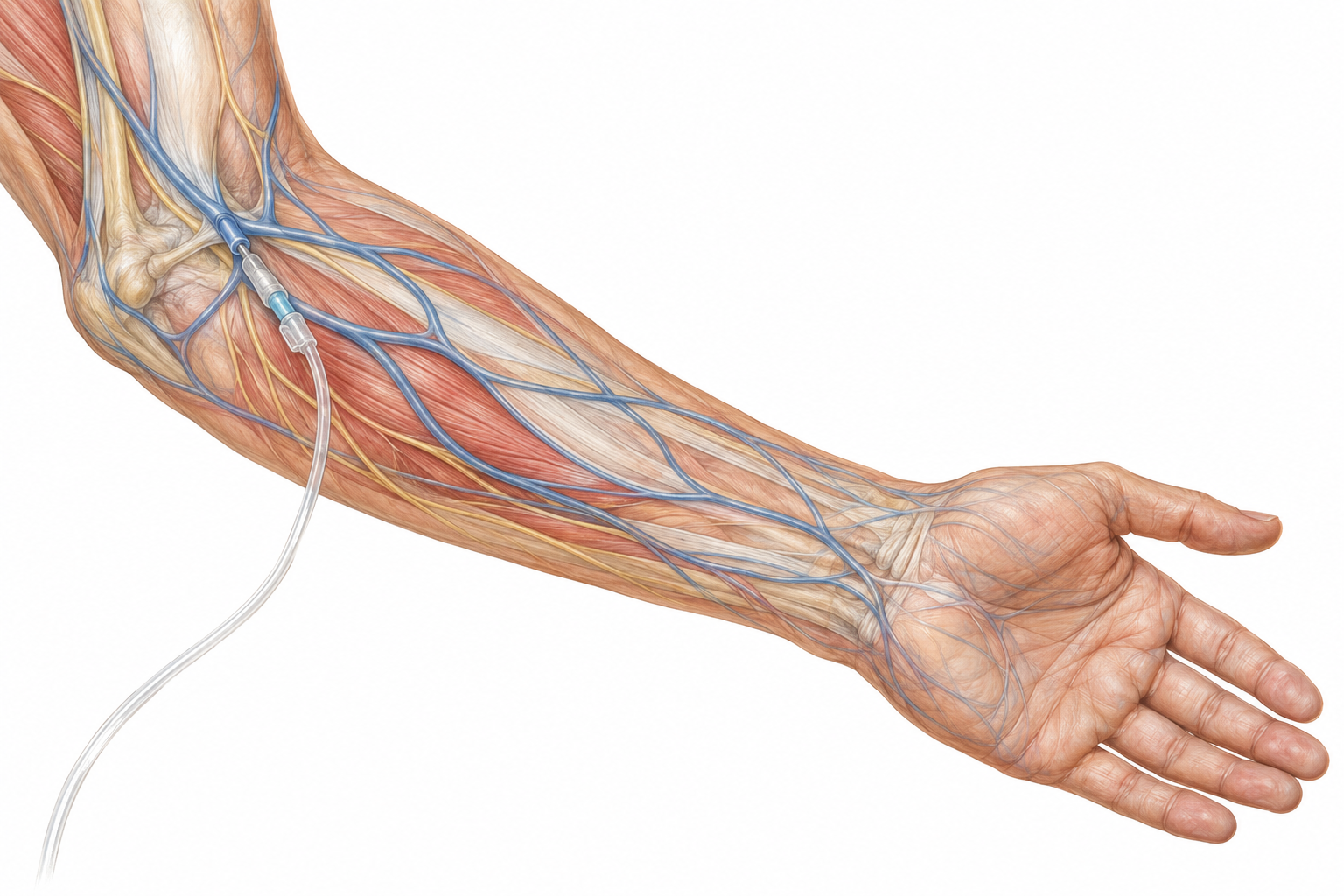
IV fluid entering a vein in the arm — AI-generated medical illustration
How Does Vitamin C Work for Immunity and Fatigue?
Vitamin C acts as an antioxidant and serves as a cofactor for enzymes required for collagen synthesis and neurotransmitter production. In immune function, it helps maintain the epithelial barrier of the skin and mucous membranes, and it supports the defense process in which neutrophils—a type of white blood cell—migrate to sites of infection to engulf and break down microbes. When the body's vitamin C level drops, immune cell activity and barrier function decline, and once an infection develops, the resulting rise in inflammatory response and metabolic demand rapidly depletes blood vitamin C (Carr Anitra C et al., 2017).
The same review distinguishes between the amount needed for everyday prevention and the amount needed after an infection has already set in. For routine immune maintenance, an intake of 100–200mg per day is enough, while for an existing infection, much higher gram-level doses are used to meet the increased inflammatory and metabolic demands.
A Cochrane meta-analysis summarized the effects of oral vitamin C on infection. Regular intake in the general population did not reduce the risk of catching a cold. In groups under extreme physical stress—such as marathon runners, skiers, and soldiers undergoing polar training—cold incidence dropped by nearly half, and regular intake shortened the duration of colds in adults by an average of 8% (Hemilä Harri et al., 2013). The benefit shows up not in everyone, but in people who are deficient or facing heavy physiological demand.
In What Conditions Is High-Dose Vitamin C IV Therapy Used?
People whose fatigue doesn't resolve even with adequate rest, who catch frequent minor illnesses like colds, or whose condition has declined due to irregular meals are the main group who consult about immune care IV therapy. This also includes those who feel their recovery has slowed due to heavy workload and stress.
A double-blind randomized controlled trial of 141 Korean office workers shows the effect of intravenous administration on fatigue. After a single intravenous infusion of 10g of vitamin C, fatigue scores at 2 hours and at 1 day were lower than in the saline group, plasma vitamin C rose, and oxidative stress decreased. Fatigue decreased only in the subgroup with low baseline blood vitamin C; there was no difference in the group with high baseline levels (Suh Sang-Yeon et al., 2012). This study followed results only up to one day after a single administration.
Because of this result, testing comes first. People with low blood vitamin C responded, while those who already had sufficient levels did not. If fatigue persists for more than several weeks along with unexplained weight loss, persistent low-grade fever, or night sweats, a medical evaluation should come before IV therapy. The underlying conditions that cause fatigue—such as chronic infection, endocrine disorders, or autoimmune disease—should be identified first.
What Does THE WELLS Jamsil Check Before Administering an IV Drip?
Fatigue causes and metabolic imbalances differ from person to person, so THE WELLS Jamsil starts with a consultation about the patient's condition. We ask when the fatigue began and how it has progressed, along with sleep quality, recovery speed, and eating habits. Next, we draw blood for a nutritional test and check vitamin levels, minerals, and antioxidant markers. Without knowing what's actually deficient, an infusion would only end up supplying components the patient doesn't need.
The IV drip is chosen based on the test results. If replenishing substances involved in cellular energy metabolism is the priority, we use an NAD+ IV drip; if restoring antioxidant balance and supporting immunity is needed, we use an immune care IV drip that combines high-dose vitamin C with antioxidant components; and if vitamin B-complex and mineral deficiencies stand out, we use a fatigue-recovery IV drip.
The type of IV drip, the infusion order, and the dosing interval are designed one-on-one, taking both vital signs and nutritional test markers into account. Afterward, we compare the trend across follow-up tests to adjust the next dosing cycle, and we also provide guidance on daily nutritional management to help fill nutrient gaps through diet.
Who Should Avoid This, and What Should You Disclose Beforehand?
Before choosing which IV formula to use, safety screening to identify high-risk patients comes first. Before a high-dose vitamin C infusion, we ask about and test for reduced kidney function, a history of kidney stones, and G6PD deficiency, an inherited enzyme defect. If kidney function is reduced or there is a history of stones, oxalate—a metabolite of vitamin C—can accumulate in the kidneys and cause acute kidney injury or stone recurrence, so the infusion is not given until this evaluation is complete. If high-dose vitamin C is given intravenously to someone with G6PD deficiency, it may cause acute hemolytic anemia, so administration is avoided in that case.
In a survey of U.S. complementary and alternative medicine practitioners, 101 of 9,328 patients with available data on IV administration reported adverse reactions, and most were mild—lethargy, altered mental status, or phlebitis at the infusion site. In patients with clear risk factors, such as kidney disease or G6PD deficiency, the literature has reported serious adverse events including renal failure and acute hemolysis (Padayatty Sebastian J et al., 2010).
Let us know in advance about any medications and supplements you are taking. If you are on anticoagulants, we check your bleeding tendency and how the drug may interact. If you have diabetes, we check your blood glucose monitoring method, because high-concentration vitamin C can interfere with the electrochemical reaction in some self-monitoring blood glucose meters and produce falsely elevated readings. If a risk factor is identified, the infusion is withheld or discontinued.
Jumin Kim · Medical Director · THE WELLS Jamsil
References
- Padayatty Sebastian J, Sun He, Wang Yaohui (2004). Vitamin C pharmacokinetics: implications for oral and intravenous use.. Ann Intern Med. PMID: 15068981
- Carr Anitra C, Maggini Silvia (2017). Vitamin C and Immune Function.. Nutrients. PMID: 29099763
- Hemilä Harri, Chalker Elizabeth (2013). Vitamin C for preventing and treating the common cold.. Cochrane Database Syst Rev. PMID: 23440782
- Suh Sang-Yeon, Bae Woo Kyung, Ahn Hong-Yup (2012). Intravenous vitamin C administration reduces fatigue in office workers: a double-blind randomized controlled trial.. Nutr J. PMID: 22264303
- Padayatty Sebastian J, Sun Andrew Y, Chen Qi (2010). Vitamin C: intravenous use by complementary and alternative medicine practitioners and adverse effects.. PLoS One. PMID: 20628650
Frequently Asked Questions
Q. Can I get a high-dose IV drip for fatigue even if my vitamin C level is normal?
In a study of office workers, fatigue improved only in those whose baseline blood vitamin C was low; people who already had sufficient levels showed no difference. So we first distinguish the cause of the fatigue — such as lack of sleep or another underlying condition — and decide on the IV drip when testing confirms a deficiency.
Q. If I already had a standard blood test, does that cover G6PD testing?
Standard blood panels often do not include a G6PD enzyme activity test. We check whether your existing test results include this item; if not, we test for it separately before a high dose is given.
Q. If I've had a kidney stone removed in the past, can I still get a high-dose vitamin C infusion?
Even if the stone has already been removed, your stone history still matters when deciding whether to give the infusion. We do not administer it until we confirm the type of stone you had at the time, whether it has recurred, and your current kidney function. If you have past test results or treatment records, feel free to bring them with you.
Q. If I have diabetes, should I check my glucose meter before an IV?
High-dose vitamin C can make some home glucose meters read higher than your actual blood sugar. Check how your device measures glucose and review the manufacturer's precautions, and don't raise your insulin dose on your own based solely on an elevated reading taken after an infusion.