
Last updated: 2026-09-18
How many TMS sessions for insomnia before sleep actually changes?
Hearing that an unfamiliar device will stimulate your head makes it hard to picture how many visits you'll actually need. TMS (transcranial magnetic stimulation) for insomnia isn't a one-time procedure; it's a process of adjusting the excitability of brain nerve cells over a series of sessions spaced at set intervals. Knowing the overall visit schedule and when interim evaluations happen from the start is the first step in treatment planning.
At THE WELLS Nowon, patients typically come in 2–3 times per week for treatment. The initial benchmark of around ten sessions isn't the finish line where sleep problems disappear completely; it's an interim checkpoint where the clinic reviews the brain's response and everyday changes based on sleep logs. Reaching ten sessions at 2–3 visits per week takes roughly 4–5 weeks, and the overall plan generally runs about 4–6 weeks depending on how the patient responds and progresses. This schedule is adjusted to each person's adaptation.
Before treatment begins, people with insomnia are asked to record, every night, how long it takes to fall asleep, how many times they wake during the night or early morning, and how long they stay awake after waking. After roughly ten sessions, the clinic compares the pre-treatment sleep log with records kept during treatment to conduct an interim evaluation. If there's no clear change by this point, or if issues such as scalp discomfort arise, the clinic doesn't simply add more sessions; it re-examines the underlying causes of the insomnia and the stimulation parameters before deciding whether to continue.
A review pooling multiple studies of repetitive transcranial magnetic stimulation (rTMS) in insomnia patients found that group-level improvements in sleep quality measures grew progressively larger as treatment duration extended from 10 to 20 to 30 days. Notably, this analysis also found significant symptom improvement in the sham (fake) stimulation group (Jiang Binghu et al., 2019). This is a reminder that factors like psychological expectation and attention to sleep habits contribute alongside the number of sessions itself.
Another meta-analysis reviewing 36 randomized controlled trials involving 2,357 participants found that rTMS significantly improved overall sleep quality compared with sham stimulation (Sun Nianyi et al., 2021). However, stimulation frequency, target location, pulses per session, and evaluation timing varied considerably across studies. This is why treatment progress is tracked against each patient's own sleep measures within a defined schedule, rather than against a fixed universal number.
Which area of the head is stimulated, and how?
During TMS for insomnia, the patient sits comfortably in a chair while a specialized electromagnetic coil is placed against the outside of the head. Rapid electrical current changes in the device generate magnetic field pulses that pass through the skull, inducing small electrical currents on the surface of the cerebral cortex (the brain's outer layer) that modulate nerve cell excitability. The coil is typically positioned over the prefrontal cortex, which is involved in emotion regulation, sleep-wake cycle control, and cognitive function; the exact target is determined based on the patient's sleep disorder pattern and neurological evaluation.
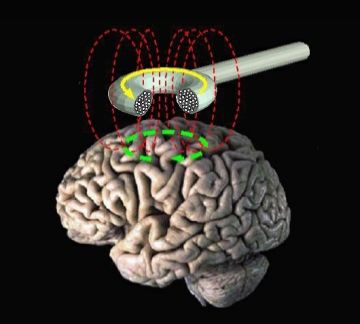 A butterfly-shaped coil placed outside the head sends magnetic field pulses (red lines) that stimulate the cerebral cortex beneath it (green). Diagram illustrating the principle of TMS. (Eric Wassermann, M.D., Public domain)
Insomnia research mainly uses low-frequency stimulation (1Hz, one pulse per second). Low-frequency stimulation lowers excitability in the targeted cortical area and strengthens inhibitory signaling. In chronic insomnia, the brain's neural networks often stay excessively active at night instead of settling down. Low-frequency pulses are meant to gradually calm this hyperarousal: not like flipping a switch off, but more like gently guiding the neural network toward stability.
A randomized controlled trial in insomnia patients taking sleep medication applied 1Hz low-frequency stimulation to the left dorsomedial prefrontal cortex (DMPFC) and tracked sleep measures (Lin Wei-Chen et al., 2023). The group receiving low-frequency stimulation showed meaningful improvement in nighttime wake time and sleep efficiency compared with baseline. That said, some measures didn't differ clearly when compared directly against the sham stimulation group.
In practice, treatment doesn't start by assigning stimulation sites from a preset chart. Clinicians ask detailed questions: Is it difficulty falling asleep that takes hours in bed? Is it frequent early-morning waking, three or four times a night? Or is daytime anxiety or pain interfering with sleep? These sleep patterns, together with any accompanying neurological symptoms, are used to determine the specific prefrontal target area and stimulation intensity for that individual.
Many patients ask whether the device has FDA (U.S. Food and Drug Administration) clearance. TMS devices used clinically are FDA-cleared for major depressive disorder. Their use for insomnia is a non-drug modulation approach based on the clinical research described above. Insomnia itself is not an FDA-cleared indication for the device; treatment decisions are based on the neuromodulation principles established in research together with each patient's actual sleep response.
What happens with sleep medication?
People who have struggled with insomnia for a long time and are already taking prescribed sleeping pills or sedative-hypnotics often worry most about what to do with their existing medication once TMS is suggested. Common concerns include whether to reduce or stop the medication abruptly, and whether it's safe to receive head stimulation while still on medication. Starting TMS does not mean stopping or changing current medication right away. The standard approach is to keep the existing prescription unchanged while adding TMS.
Medication and TMS work through very different mechanisms and timeframes. Sleep medications bind directly to neurotransmitter receptors in the brain, rapidly suppressing central nervous system activity on the night they're taken to help induce sleep. TMS works by repeatedly applying magnetic stimulation to gradually rebalance the excitability of an overactive neural network, which requires cumulative time for brain cells to adapt to a new signal balance. Because of this, cutting back on medication too quickly early in TMS treatment can risk withdrawal symptoms or rebound insomnia, potentially making sleep worse.
A recent meta-analysis pooling 19 studies and 23 randomized controlled trials (1,690 participants total) in insomnia patients found that the group receiving rTMS alongside medication showed significantly greater improvement on the Pittsburgh Sleep Quality Index (PSQI) than the group on medication alone (Cao ZhiGang et al., 2026). This evidence suggests that adding TMS to ongoing medication may have a positive effect on sleep quality improvement, though decisions are made individually in clinic based on each patient's underlying conditions and medication response.
For people who have taken sleep medication long-term and are increasingly concerned about tolerance, daytime drowsiness, or dependence, TMS can serve as a combined treatment option. As treatment progresses, if sleep logs show reduced time to fall asleep and more stable nighttime awakenings, the prescribing physician reviews daytime fatigue along with medication type and dosage to decide whether to taper gradually. Starting TMS by itself is not a reason to reduce medication. The safest approach is to adjust medication gradually, and only after sleep logs show real improvement, under the prescribing physician's judgment.
What is the treatment sequence at THE WELLS Nowon?
On the day of TMS treatment at THE WELLS Nowon, the process isn't limited to head stimulation alone; it includes preparatory steps that check overall body balance and nerve tension. Upon arrival, patients undergo a baseline evaluation and an X-ray exam. This checks cervical spine (neck) alignment, particularly the position of the upper cervical vertebrae (C1–C2). The clinic examines the structure and tension around the cervical spine, through which major nerve pathways connecting the brain and body pass, and performs a basic neurological evaluation to confirm the patient is in suitable condition to begin treatment.
After imaging and neurological evaluation, cranial nerve relaxation correction and Sigma Tapping treatment are performed before the TMS procedure itself. The correction addresses tension in tissue around the neck and head, while Tapping applies rhythmic stimulation, both intended to relieve overall bodily tension before the procedure.
Depending on the patient's daily fatigue level and overall recovery status, supportive IV treatments such as customized vitamin IV or NAD+ IV may also be offered as adjuncts. These are selected based on clinical judgment to support energy levels when chronic insomnia has led to exhaustion. The research studies cited above evaluated the magnetic stimulation effect of TMS itself; IV treatments are a separate, supportive addition.
Total time at the clinic on treatment days, including preparation and post-procedure rest, is roughly 20–40 minutes. The actual TMS stimulation with the coil against the head takes about 10 to 20 minutes. It's a non-invasive procedure requiring no incision or anesthesia; patients hear a clicking sound from the coil and feel a light tapping sensation on the scalp. Once the set stimulation is complete, patients can generally return directly to daily activities without needing separate recovery time.
For safety, before treatment the clinic thoroughly asks about any history of seizures or epilepsy, any metal implants in the head or neck area, and the presence of electronic medical devices such as pacemakers. During stimulation, some people feel scalp tightness, and mild headache may briefly follow the procedure, usually resolving within a few hours. Seizures have very rarely been reported, so stimulation intensity is adjusted according to safety protocols. Having implants or devices in the body doesn't necessarily rule out treatment (it can often still proceed safely depending on the type and location), so please share accurate information about any medical devices you have during consultation beforehand.
Sungjin Park · Medical Director · THE WELLS Nowon
References
- Jiang Binghu, He Dongmei, Guo Zhiwei, Mu Qiwen, Zhang Liwen (2019). Efficacy and placebo response of repetitive transcranial magnetic stimulation for primary insomnia. Sleep medicine. PMID: 31600660
- Sun Nianyi, He Yu, Wang Zhiqiang, Zou Wenchen, Liu Xueyong (2021). The effect of repetitive transcranial magnetic stimulation for insomnia: a systematic review and meta-analysis. Sleep medicine. PMID: 32830052
- Lin Wei-Chen, Chen Mu-Hong, Liou Ying-Jay, Tu Pei-Chi, Chang Wen-Han, Bai Ya-Mei (2023). Effect of low-frequency repetitive transcranial magnetic stimulation as adjunctive treatment for insomnia patients under hypnotics: A randomized, double-blind, sham-controlled study. Journal of the Chinese Medical Association : JCMA. PMID: 36998170
- Cao ZhiGang, Shi Qun, Shi ZhengRong, Yuan DanYang, Zeng Sha (2026). Efficacy of repetitive transcranial magnetic stimulation for insomnia disorder: a systematic review and meta-analysis of randomized controlled trials. Frontiers in neuroscience. PMID: 42305778
Frequently Asked Questions
Q. If I miss one treatment day, do I have to restart the entire schedule?
Missing a single visit does not automatically mean restarting the whole schedule from the beginning. The clinic reviews how long treatment was interrupted and any changes in sleep, then adjusts the remaining treatment dates and interim evaluation timing accordingly.
Q. Do I need to be asleep during TMS treatment?
TMS is not a treatment that requires you to be asleep; it's generally performed while you're awake, without anesthesia. If you feel any discomfort during stimulation, simply let the staff know right away. Mayo Clinic information
Q. What happens if my scalp hurts or I get a headache during treatment?
If you experience scalp pain or headache, don't try to tolerate it; tell your medical team the location and severity of the discomfort. Based on your symptoms, they may adjust the stimulation intensity or pause treatment temporarily. NHS information
Q. Can I know in advance how long sleep improvements will last after treatment ends?
It's difficult to predict, at the point treatment ends, how long an individual's sleep improvements will be maintained. Continuing to record how long it takes to fall asleep and how often you wake at night after treatment helps your medical team assess whether the improvement is holding and whether further treatment may be needed.