
Last updated: 2026-11-12
Less Hair Is Falling Out, But It Still Feels Thin
Many women in their 30s who are six months past giving birth worry that even though less hair collects in the drain than before, their hair feels thinner than it did before childbirth when they tie it back, and their part looks wider. At this stage, the scalp needs to be examined under high magnification to tell whether this is a normal delay in recovery, in which hair volume comes back on its own with more time, or whether another type of hair loss has started alongside it. If short new hairs are sprouting evenly across the scalp, this is a normal recovery process, but if the hair around the crown and part has become noticeably thin, androgenetic alopecia may have overlapped.
It's common for hair to feel less full than before around six months postpartum. In a study surveying 331 women who responded 10 to 18 months after giving birth, 91.8% reported experiencing postpartum hair loss. On average, hair shedding began at 2.9 months postpartum, peaked at 5.1 months, and stopped around 8.1 months (Hirose A et al., 2023). Shedding itself ends around the 8-month mark on average. However, it takes several more months after that for the new hairs growing from the emptied follicles to grow long enough to restore overall volume and the fullness felt when hair is tied back.
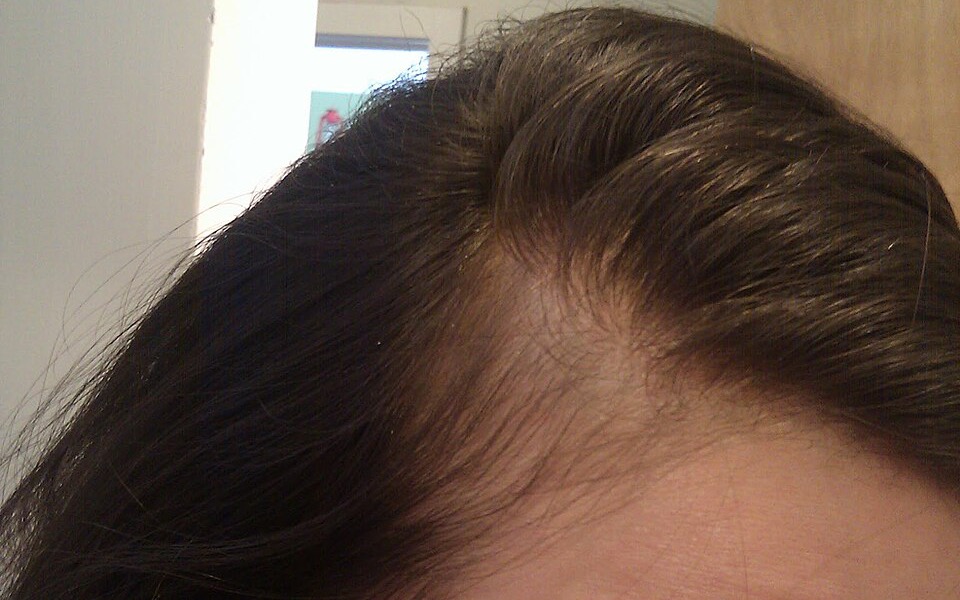
Comparing whether magnified views of the scalp show many short new hairs with pointed tips, or whether hair thickness varies unevenly even within a single area, makes it possible to clearly distinguish simple delayed recovery from a coexisting hair loss condition.
Why Does Shed Hair Take So Long to Grow Back?
Hair cycles through three phases in order: a growth phase, when it grows actively; a transition phase, when growth stops; and a resting phase, when the hair sits in the follicle before shedding naturally. During pregnancy, female hormone levels stay elevated, so hair that would normally have moved into the resting phase stays in the growth phase longer. After delivery, hormone levels drop sharply, and the hair that had been held back from shedding all enters the resting phase at once. That is why hair sheds heavily within 3 to 6 months after giving birth.
A study comparing the hair cycles of 116 women found that the proportion of resting-phase hair at 4 months postpartum was markedly higher than in late pregnancy (Gizlenti S et al., 2014). The same study found no difference in hair cycle between women who breastfed and those who did not by 1 year postpartum. Once a hair sheds, its follicle immediately starts growing a new hair in the growth phase. But hair grows only about 1 cm a month. So even after the daily amount of shedding drops noticeably, it still takes several months for the new growth to reach below the ears and for tied-back hair to regain the thickness and length it had before childbirth.
How quickly hair recovers, and the pattern of hair loss, are also tied to the mother's physical condition around childbirth and how long she breastfeeds. A survey-based study found that postpartum hair loss was more common among women who breastfed for a long time or who had a preterm birth (Hirose A et al., 2023). In addition, during breastfeeding, ingredients from oral or topical medications can pass to the baby through breast milk, which limits the hair loss treatments that can be used while nursing. If resting-phase hair loss (telogen effluvium) that began after delivery continues past 6 months without stopping, it is no longer regarded as a typical postpartum change; it is classified as chronic telogen effluvium, and the cause needs to be reassessed.
When Another Type of Hair Loss Is Hiding Behind Postpartum Hair Loss
When skin or hair changes that appeared during pregnancy last longer than expected after delivery, clinicians reassess the condition with three possibilities in mind: a normal physiological change that is resolving more slowly than it does in others, a different condition that was never a pregnancy change to begin with, or a separate, newly developed condition that was assumed to be caused by childbirth (Anzelc MJ et al., 2023). These three situations can easily overlap when a woman experiences telogen effluvium after delivery as well.
One study examined 200 women who sought care for postpartum hair loss, using clinical examination and magnified scalp examination. In this study, only 9.5% of patients had telogen effluvium alone. Androgenetic alopecia accompanied the telogen effluvium in 56.0% of patients, traction alopecia accompanied it in 6.5%, and both androgenetic alopecia and traction alopecia were present together in 28.0% (Galal SA et al., 2024). Hair loss in which the follicles gradually shrink had been progressing quietly since before delivery, and when postpartum hair loss makes a large amount of hair fall out at once, this hidden hair loss comes to the surface.
In female androgenetic alopecia, the frontal hairline stays relatively intact while hair at the crown and around the part gradually thins until the scalp shows through. Traction alopecia, by contrast, tends to develop when a woman often pulls her hair back tightly while caring for her child. In this case, hair falls out along the frontal hairline and at the temples, the areas that bear the most pulling tension.
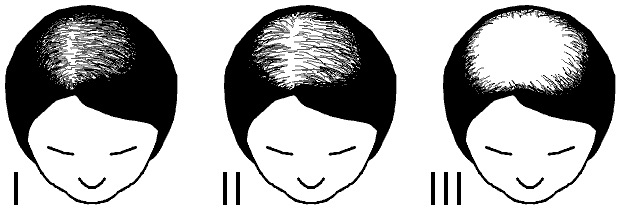
If hair falls out in sharply demarcated, coin-shaped patches, if the scalp becomes red and swollen with oozing or pus, or if the skin in the bald patches turns smooth and shiny with no visible pores, a woman should see a doctor without delay. Thyroid dysfunction occurring after delivery can also cause hair loss. If hair loss comes with tiring more easily than usual and heart palpitations, or if weight suddenly goes up or down with no change in diet, she should first see an internal medicine doctor to check her overall health.
If Short New Hairs Appear on the Magnified Screen
If hair loss has worsened after childbirth, a hair loss and scalp consultation at THE WELLS is needed. We use a close-up scalp camera to magnify the scalp and check the condition of the hair follicles along with scalp heat and inflammation. We also look at hair thickness to tell whether telogen (resting-phase) recovery is simply delayed or whether androgenetic alopecia has overlapped with it. During the magnified examination, we photograph the crown and front of the head, where hair loss is noticeable, side by side with the back of the head for comparison. Because the hair follicles at the back of the head are less affected by androgenetic alopecia, they serve as a reference point for estimating the patient's original hair thickness and density.
A study analyzing women with postpartum hair loss found that in cases of pure telogen effluvium, short new hairs with pointed tips were observed at the crown in all patients. In cases where androgenetic alopecia had also developed, these short new hairs appeared together with an additional finding of hair thickness variation exceeding 20% (Galal SA et al., 2024). In addition, in women with androgenetic alopecia, the hair at the front was noticeably thinner than at the back of the head. The proportion of hairs thinner than 0.03 mm in diameter was 20.9%, twice the rate seen in chronic telogen effluvium (10.4%). By comparing hair thickness across different areas of the scalp and combining it with magnified findings, the study distinguished the two types of hair loss with 98% specificity (Rakowska A et al., 2009).
Based on this evidence, if magnification shows many short new hairs standing straight up and the surrounding hairs are even in thickness, we classify it as a case where follicle function is intact and telogen recovery is delayed. Conversely, if thin, weak hairs are clustered among thicker hairs at the crown and part, we judge that androgenetic alopecia has overlapped. In addition, when traction alopecia from tightly tied hair is also present, hair thickness variation is commonly observed along the frontal hairline or temples, together with empty follicles where hair has fallen out and vellus hairs that never thickened.
What Treatment Follows the Diagnosis?
At THE WELLS, hair loss care starts with a precise scalp diagnosis and then proceeds in order through scalp environment care, follicle regeneration, and regular scalp analysis. We first check for inflammation and the degree of follicle shrinkage with a magnified scalp exam, and based on those findings, we apply care that clears the scalp surface and treatments that act directly on the hair roots separately. Especially when a patient is breastfeeding, the possibility that drug components pass into breast milk and reach the baby has to be considered. For this reason, we evaluate safety individually according to whether the patient is currently breastfeeding before setting the treatment plan (Needle CD et al., 2025).
If the magnified scalp exam shows redness, warmth, and itching around the follicles, or pores clogged with dead skin cells and sebum, we recommend Head Spa. Head Spa begins with deep cleansing, using nano-oxygenated water and oil to gently lift away waste that has built up deep in the follicles. This is followed by scalp drainage and a carbonated detox to support scalp circulation, then a scalp pack and ampoule application to soothe and nourish the scalp. Each session takes about 30 minutes and is done once a week. This process tidies up the underlying environment of the scalp so that newly growing hair can come up without being hindered by inflammation or waste.
If hair at the crown or along the part has thinned, we add scalp injections that deliver ingredients such as placenta, growth factors, and exosomes into the scalp. Scalp injections directly stimulate regeneration in shrunken hair roots. Exosome components, in particular, help stem cells in the bulge region of the follicle become active again. Even after treatment begins, we analyze the scalp regularly and follow progress by comparing the density of newly emerging hair and changes in the thickness of existing hair against the initial findings.
If Hair Loss Continues Even a Year After Childbirth
If hair shedding that began after childbirth doesn't stop and continues for a year, this goes beyond the scope of acute postpartum hair loss, and the possibility of chronic telogen effluvium or early-stage androgenetic alopecia should also be considered. Chronic telogen effluvium is a condition in which shedding continues for more than six months even after the cause has resolved. It mainly occurs in women between 30 and 60 years of age, and hair falls out evenly across the entire scalp rather than from one specific area (Whiting DA, 1996).
Unlike acute telogen effluvium, chronic telogen effluvium fluctuates over several years, with the amount of shedding increasing and then decreasing repeatedly. However, even when the shedding period is long, it does not progress to complete baldness, and it tends to gradually subside over time (Whiting DA, 1996).
Note that chronic telogen effluvium and early androgenetic alopecia are hard to tell apart based on the amount of visible shedding alone. A systematic review that compiled 1,628 reported cases of chronic telogen effluvium found that 97.5% of all cases were women. The researchers pointed out that many of the cases given this diagnosis may actually be early female pattern hair loss (female androgenetic alopecia), or telogen effluvium arising from medical or environmental causes that have not yet been identified (Daunton A et al., 2023).
So to tell the two types of hair loss apart a year after childbirth, you need to check whether the hair in the same area is gradually getting thinner over time. During treatment, we also use regular scalp analysis to recheck changes in the scalp and hair so that the recovered hair is maintained over the long term.
References
- Hirose A, Terauchi M, Odai T, Fudono A, Tsurane K, Sekiguchi M, Iwata M, Anzai T, Takahashi K, Miyasaka N (2023). Investigation of exacerbating factors for postpartum hair loss: a questionnaire-based cross-sectional study.. Int J Womens Dermatol. PMID: 38323220
- Gizlenti S, Ekmekci TR (2014). The changes in the hair cycle during gestation and the post-partum period.. J Eur Acad Dermatol Venereol. PMID: 23682615
- Anzelc MJ, Bechtel MA (2023). Considerations for cutaneous physiologic changes of pregnancy that fail to resolve postpartum.. Int J Dermatol. PMID: 35132624
- Galal SA, El-Sayed SK, Henidy MMH (2024). Postpartum Telogen Effluvium Unmasking Additional Latent Hair Loss Disorders.. J Clin Aesthet Dermatol. PMID: 38779373
- Rakowska A, Slowinska M, Kowalska-Oledzka E, Olszewska M, Rudnicka L (2009). Dermoscopy in female androgenic alopecia: method standardization and diagnostic criteria.. Int J Trichology. PMID: 20927234
- Needle CD, Brinks AL, Kearney CA, Rachko G, Bieber AK, Shapiro J, Nachtigall M, Lo Sicco KI, Majerson D (2025). Alopecia Treatments in Breastfeeding: Safety and Clinical Considerations.. Int J Dermatol. PMID: 40629555
- Whiting DA (1996). Chronic telogen effluvium.. Dermatol Clin. PMID: 9238330
- Daunton A, Harries M, Sinclair R, Paus R, Tosti A, Messenger A (2023). Chronic Telogen Effluvium: Is it a Distinct Condition? A Systematic Review.. Am J Clin Dermatol. PMID: 37052778
Frequently Asked Questions
Q. How is incomplete regrowth different from shedding that continues past 6 months?
If the amount of hair you're losing has decreased but your hair still looks thin, take into account the time new hair needs to grow long enough. If shedding is still ongoing, separate how much time has passed since delivery from how long the heavy shedding actually lasted, and it's a good idea to tell your doctor when the hair loss started and how long it has continued.
Q. Can a widening part still occur while short, fine hairs (baby hairs) are growing in?
Yes, this can happen when new hair growth and the thinning of existing hair occur at the same time. Rather than judging recovery only by whether baby hairs are present, we compare photos taken with the same part and the same lighting, and record changes in hair thickness and density through regular scalp exams.
Q. Do I need to stop breastfeeding because of postpartum hair loss?
There is no need to stop breastfeeding because of postpartum hair loss itself. If treatment is needed, let us know whether you are currently breastfeeding, and we decide the type of treatment and when to start it based on the medication or injection ingredients to be used.
Medical review: Sungjin Park · Medical Director · THE WELLS Nowon