
Last updated: 2026-09-18
Why does my neck stay stiff when the scan looks normal?
If your neck feels stiff and heavy even though your X-ray came back normal, the discomfort may come from muscle tension that doesn't show up on bone imaging. A plain X-ray mainly evaluates bone shape, fractures, and the spacing and alignment between vertebrae. Tension and micro-stiffness within the muscles, tendons, and ligaments surrounding the neck don't appear as shadows on the film. So even after hearing that your bones look fine, the heaviness and stiffness you feel every day is still real.
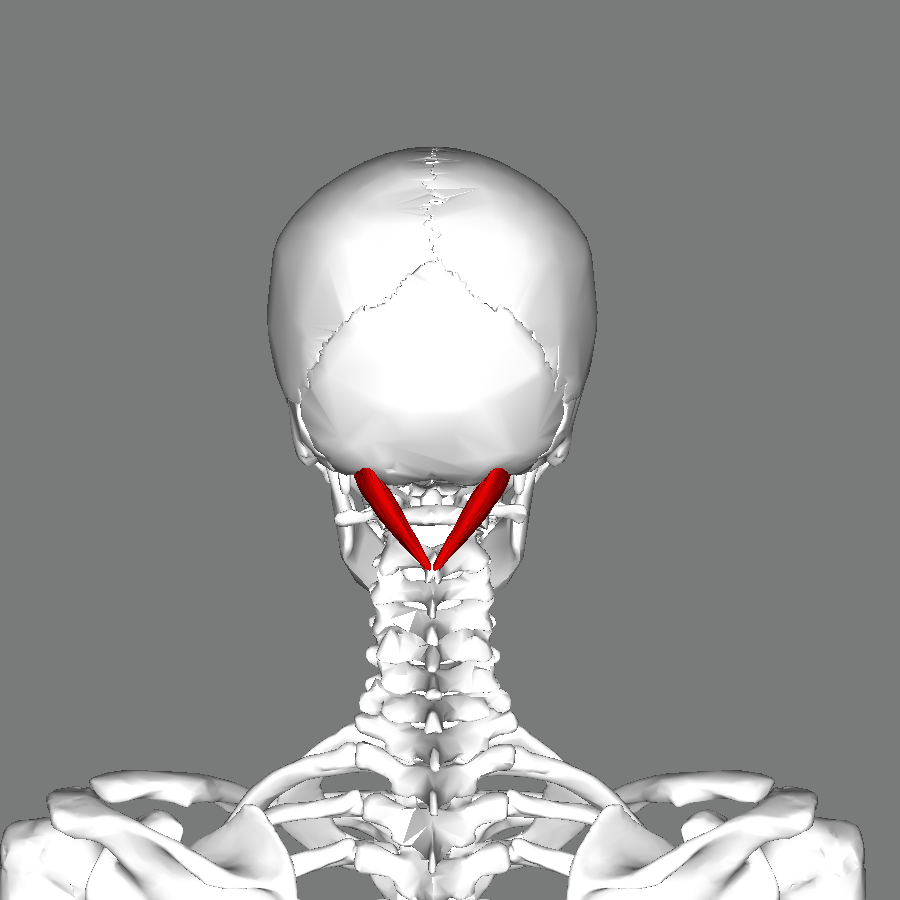 Head and neck viewed from behind. The small muscle marked in red is the rectus capitis posterior major, one of the suboccipital muscles that connects the first and second cervical vertebrae to the skull and controls fine head movements. (Anatomography, CC BY-SA 2.1 jp)
Many people notice their neck growing heavier as the afternoon wears on, with a tight, catching sensation at the base of the neck when tilting the head back. Massaging the area brings brief relief, but the heavy tightness returns before long, and even after a full night's sleep, the neck still feels stiff and unrefreshed in the morning. Massage mainly helps blood flow near the skin surface for a short while. The deep tension that builds up from supporting the cervical spine stays behind.
At the center of this discomfort is the suboccipital muscle group, a set of small muscles just below the base of the skull. These muscles tightly connect the skull to the first and second cervical vertebrae, keeping the gaze level and fine-tuning small head movements. Holding a forward head posture for long periods (from looking at a monitor or smartphone) shifts the head's center of gravity forward, forcing the suboccipital muscles to contract continuously to keep the head from dropping. Under this sustained load, fatigue byproducts build up inside the muscle and the fascia stiffens, settling into chronic neck pain and heaviness regardless of what the bones look like.
What does the jaw joint have to do with neck pain?
The upper cervical spine (the first and second cervical vertebrae at the very top of the neck) is a key segment that supports the head and accounts for roughly half of all head rotation. When this upper neck segment loses mobility or stiffens, the balance of head movement is disrupted, which in turn affects the jaw joint (temporomandibular joint). The temporomandibular joint is where the jawbone meets the skull during chewing and speaking; when the head tilts forward or the upper neck joints stiffen, the position of the lower jaw and the path it follows when opening and closing shift subtly. The two regions are linked as a single functional chain.
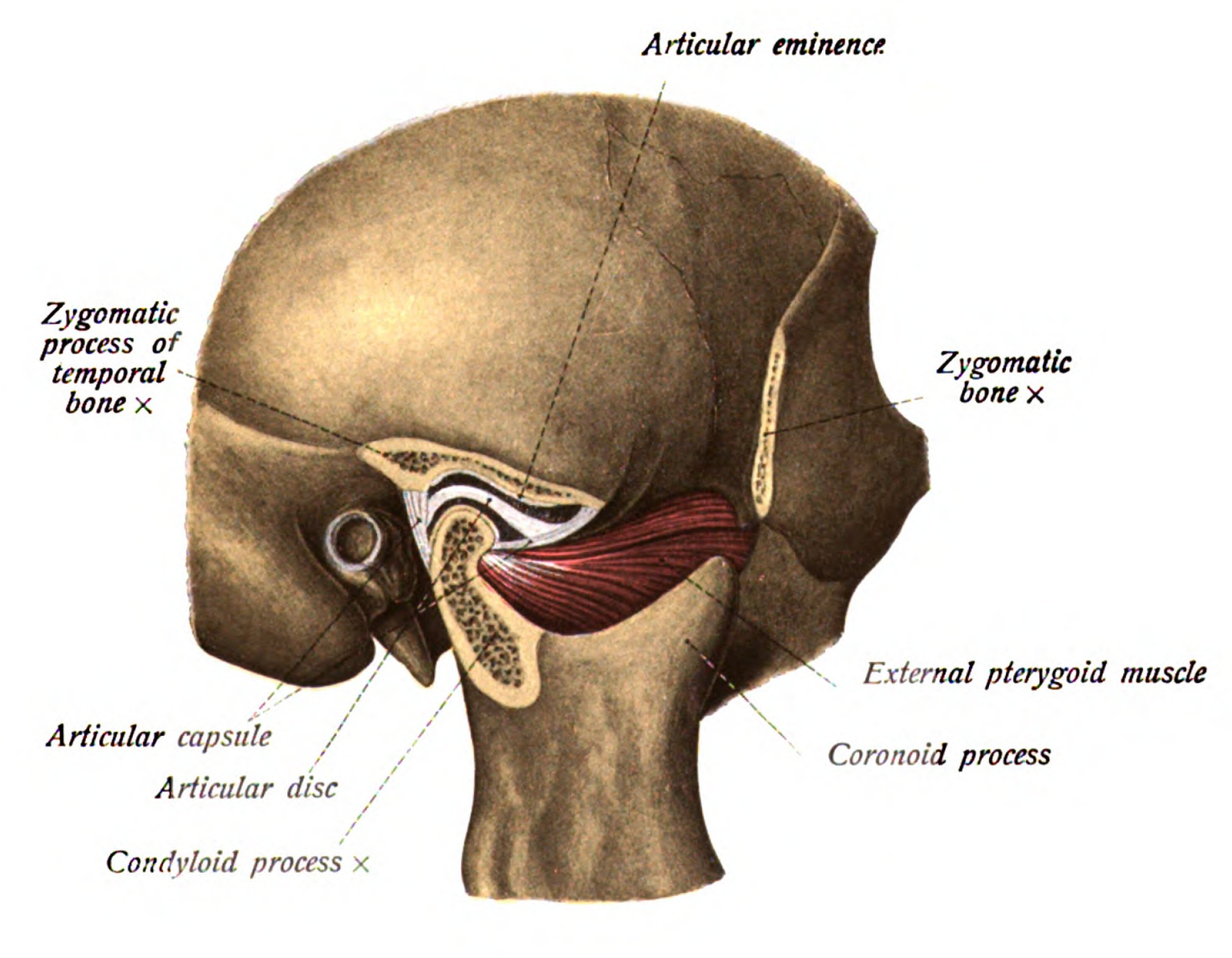 Jaw joint viewed from the side. The head of the mandible rests in a concave socket of the skull, with a joint disc in between. Because the trigeminal nerve, which handles sensation in this joint, connects with sensory nerves from the upper cervical spine, jaw tension can become intertwined with neck pain. Sobotta anatomical plate. (Dr. Johannes Sobotta, Public domain)
A meta-analysis combining 21 studies on the link between temporomandibular disorders and the neck found that people with temporomandibular disorders had significantly lower cervical extensor endurance, more limited upper cervical rotation, and higher neck disability index scores compared to healthy controls (de Oliveira-Souza Ana Izabela S et al., 2020). There was no clear difference between the two groups in the visible static angle of head and neck posture. This suggests that functional measures like muscle endurance and actual joint rotation range matter as much as visible postural tilt.
Anatomically, the trigeminal nerve, which carries sensation from the jaw area, and the sensory nerves from the upper cervical spine exchange signals at the same nerve nucleus in the brainstem: the spinal trigeminal nucleus. This creates a neural pathway through which tension or pain signals around the jaw joint can travel to the upper cervical nerve pathways, and conversely, neck tension can be felt as tightness around the jaw.
People who unconsciously clench their jaw under work stress, or who have been told they grind their teeth heavily during sleep, often also report neck pain. Some also notice clicking sounds in the jaw joint when opening the mouth, along with tightness reaching down into the neck. A clicking sound alone isn't considered a temporomandibular disorder; clinicians look at whether it occurs together with limited jaw opening and pain.
How is this distinguished from a disc problem or headache?
Beyond muscle fatigue, if a herniated or ruptured disc (the cushion between vertebrae) compresses a cervical nerve root, neck pain can be accompanied by sharp, radiating numbness or weakness spreading along the nerve pathway into the shoulder, arm, and fingertips. If tilting the head back and slightly rotating it toward the painful side reproduces an electric, shooting pain down the arm, this is an important clue suggesting nerve root irritation. Even without current arm numbness, a disc problem should still be checked separately.
If neck pain occurs together with headaches, it's worth reviewing the pattern for signs of cervicogenic headache. Cervicogenic headache typically begins as a dull ache in the upper neck or back of the head and spreads to the side of the head, temple, or around the eyes, worsening with certain neck movements or joint compression. Heaviness that builds in the neck by afternoon, or eye strain and blurred vision, are also common with muscle tension or fatigue. If headache is the main symptom disrupting daily life, a broader neurological workup covering causes such as migraine or tension-type headache should come first.
Warning signs that fall outside musculoskeletal causes need to be ruled out carefully. New or progressively worsening weakness or numbness in the arms or legs, loss of balance or stumbling while walking, or a sudden change in bladder or bowel control should raise suspicion of central nervous system compression and call for immediate thorough evaluation. Unexplained fever, unexplained weight loss, severe night pain that wakes you from sleep, and neck pain following a clear trauma such as a recent fall or car accident are also signs that shouldn't simply be observed just because the X-ray looks normal.
Everyday work environment and smartphone habits also add to neck strain. A systematic review of adults found that forward head posture was significantly correlated with neck pain and disability (Mahmoud Nesreen Fawzy et al., 2019). A meta-analysis examining the relationship between smartphone overuse and neck pain reported an odds ratio of 2.34 for neck pain in the overuse group (Chen Yan-Jyun et al., 2025). These figures reflect the strength of association between groups.
How are posture, X-rays, and the jaw joint examined?
At THE WELLS Jamsil, a static image alone isn't the whole picture; we assess whole-body alignment and actual joint movement step by step. First, while the patient stands upright, we look at the balance between the skull and upper cervical spine, the height of both shoulders, and the left-right level of the pelvis. Next, we observe which direction the trunk's central axis shifts while sitting in a chair or walking, and whether weight-bearing is symmetrical between both feet. This process visually identifies the body's tendency toward imbalance.
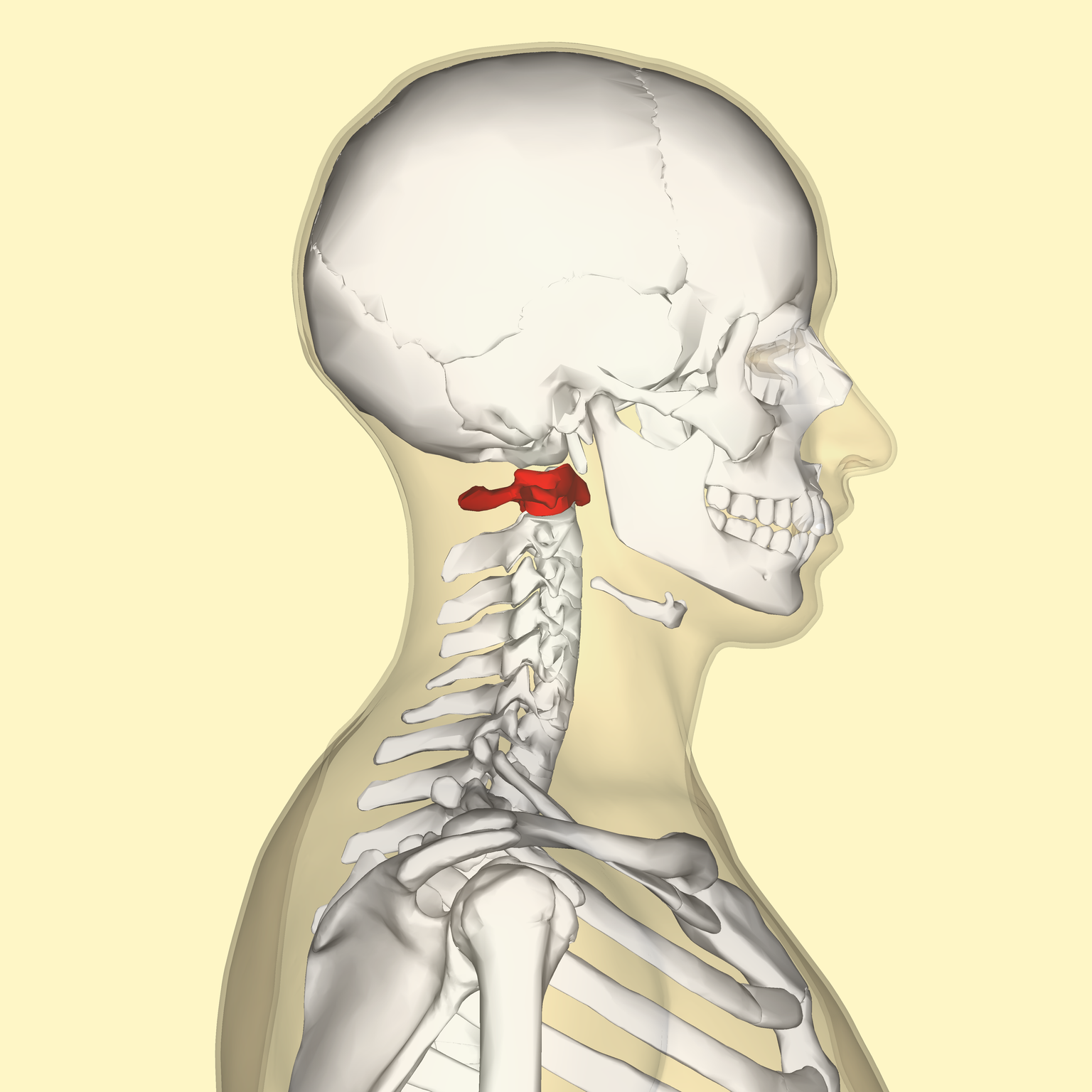 Head and cervical spine viewed from the side. The first cervical vertebra, the atlas, marked in red, supports the head just below the skull and, together with the second cervical vertebra, accounts for most of the head's rotation. (Anatomography, CC BY-SA 2.1 jp)
Cervical X-rays are read to assess the alignment of the skull and upper cervical spine down through the first and second vertebrae, the gentle curve formed by the whole cervical spine, and the alignment of each vertebral segment. Differences in bone alignment seen on the image become the patient's structural baseline. We then compare this baseline alignment against the discomfort the patient actually feels while moving the head.
For the jaw joint evaluation, we measure maximum mouth-opening distance in millimeters using calipers or a ruler, and check whether the lower jaw deviates to one side or moves in a zigzag path while opening and closing. We ask in detail about habits such as unconscious jaw clenching or chewing tough foods only on one side, and palpate the muscles used to close the jaw (the masseter and temporalis) to locate tender points.
During the neck exam, we first measure the full range of left-right head rotation, then flex the head forward to lock the lower cervical spine and repeat the rotation to isolate restrictions specific to the upper cervical segment. We place a hand just below the base of the skull to check the tension and tenderness of the suboccipital muscles, and press gently to see whether this reproduces the same heavy tightness the patient has been describing in the neck.
If numbness spreading into the arm or fingers, or weakening grip strength, suggests a nerve problem during the exam, we don't rush into postural assessment or manual therapy. We first check arm strength, sensory changes, and tendon reflexes at the relevant spinal level to rule out nerve damage, and refer for specialized neurological evaluation if clear abnormalities are found. Rather than focusing only on the surface symptom of neck pain, THE WELLS Jamsil looks at how the upper cervical spine and jaw joint influence each other's movement and alignment, and how that affects overall function.
What does treatment start with?
If the exam confirms restricted movement in the upper cervical spine and jaw joint, we begin cranial nerve-focused manual therapy for the jaw joint. This isn't forceful joint manipulation or twisting; it starts with gentle, small-amplitude mobilization within a pain-free, comfortable range of motion. The range of joint movement is gradually expanded based on the patient's muscle tension and pain response.
Manual therapy is followed by Winback radiofrequency treatment to address stiff soft tissue tension around the neck and shoulders. This physical therapy delivers radiofrequency energy to deep tissue to support blood flow and ease the discomfort of stiff neck muscles. We then add customized rehabilitation exercises to activate the deep neck flexors responsible for cervical stability and strengthen the muscles around the shoulder blades, building the strength needed for the spine to support itself.
A systematic review of patients with non-specific neck pain reported that manual therapy including joint mobilization, combined with active exercise therapy, may help relieve pain and restore function (Hidalgo Benjamin et al., 2017). A meta-analysis of physical therapy targeting the suboccipital region also found that combining joint mobilization with myofascial treatment in patients with tension-type headache was associated with short-term pain relief and improved cervical range of motion (Jiang Wenbin et al., 2019). A Cochrane systematic review reported that outcomes of cervical manipulation and mobilization varied depending on the type of comparison treatment (Gross Anita et al., 2015). High-velocity, low-amplitude manipulation that forcefully and quickly moves a joint carries different risks than slow, gentle joint mobilization, and THE WELLS Jamsil starts with the latter approach.
If neck discomfort during treatment radiates sharply into the arm or fingers, or if new numbness appears that wasn't there before, the manual treatment is stopped immediately. Strength, sensation, and reflexes are re-checked right away to determine whether nerve compression is present.
Changes in the intensity of everyday stiffness serve as a guide for adjusting treatment intervals and exercise intensity.
Jumin Kim · Medical Director · THE WELLS Jamsil
References
- de Oliveira-Souza Ana Izabela S, de O Ferro Josepha Karinne, Barros Manuella M M B, Oliveira Daniella A de (2020). Cervical musculoskeletal disorders in patients with temporomandibular dysfunction: A systematic review and meta-analysis.. Journal of bodywork and movement therapies. PMID: 33218570
- Mahmoud Nesreen Fawzy, Hassan Karima A, Abdelmajeed Salwa F, Moustafa Ibraheem M, Silva Anabela G (2019). The Relationship Between Forward Head Posture and Neck Pain: a Systematic Review and Meta-Analysis.. Current reviews in musculoskeletal medicine. PMID: 31773477
- Chen Yan-Jyun, Hu Ching-Yuan, Wu Wen-Tien, Lee Ru-Ping, Peng Cheng-Huan, Yao Ting-Kuo, Chang Chia-Ming, Chen Hao-Wen, Yeh Kuang-Ting (2025). Association of smartphone overuse and neck pain: a systematic review and meta-analysis.. Postgraduate medical journal. PMID: 39764644
- Hidalgo Benjamin, Hall Toby, Bossert Jean, Dugeny Axel, Cagnie Barbara, Pitance Laurent (2017). The efficacy of manual therapy and exercise for treating non-specific neck pain: A systematic review.. Journal of back and musculoskeletal rehabilitation. PMID: 28826164
- Jiang Wenbin, Li Zhe, Wei Ning, Chang Wenli, Chen Wei, Sui Hong-Jin (2019). Effectiveness of physical therapy on the suboccipital area of patients with tension-type headache: A meta-analysis of randomized controlled trials.. Medicine. PMID: 31083183
- Gross Anita, Langevin Pierre, Burnie Stephen J, Bédard-Brochu Marie-Sophie, Empey Brian, Dugas Estelle, Faber-Dobrescu Michael, Andres Cristy, Graham Nadine, Goldsmith Charles H, Brønfort Gert, Hoving Jan L, LeBlanc Francis (2015). Manipulation and mobilisation for neck pain contrasted against an inactive control or another active treatment.. The Cochrane database of systematic reviews. PMID: 26397370
Frequently Asked Questions
Q. If my neck is stiff when I wake up, should I change my pillow first?
Pillow height should be adjusted so the head and torso align naturally, but if morning stiffness keeps recurring, causes beyond sleep posture should also be checked. NHS guidance
Q. If my jaw only clicks without pain, do I still need treatment?
If there's only clicking without pain and no difficulty opening the mouth or chewing, treatment generally isn't needed. However, if pain develops or the jaw locks and won't open properly, a clinical evaluation is needed. NIDCR guidance
Q. Can I forcefully crack my neck to relieve stiffness?
Forcefully bending or twisting the neck to its limit to relieve stiffness should be avoided. This is different from the small-range, gentle joint mobilization described above, and you should not apply strong force to your own neck at home trying to imitate it.
Q. Can I keep doing neck exercises on days when it hurts?
Mild pain doesn't mean all neck movement needs to stop; you can move slowly within a range that doesn't worsen the discomfort. If pain clearly increases during exercise, reduce the range of motion and repetitions, and stop the movement entirely if it still hurts after reducing intensity. NHS exercise guidance
Related Reading
- Manual therapy should start with the jaw joint's cranial nerves and the upper cervical spine
- Jamsil Neurology: From the Causes of Chronic Headache to Treatment
- Related medical information: Definition and Classification of Causes of Neck Pain (Linkare Knowledge)
Jumin Kim · Medical Director · THE WELLS Jamsil