
Last updated: 2026-10-23
I Wash My Hair in the Morning, but by Afternoon I'm Scratching Again
If you wash your hair in the morning but find yourself scratching again by the afternoon, you may be caught in a vicious cycle of scalp inflammation in which itching and scratching each make the other worse. When itching, flaking, and a burning sensation recur every time you wash your hair, the shape of the flakes on the scalp and the location of the lesions can help distinguish seborrheic dermatitis from psoriasis, contact dermatitis, and folliculitis, and checking whether the follicular openings are preserved can help determine whether the condition is progressing toward permanent hair loss.
Some office workers in their 30s wash their hair thoroughly in the morning before work, yet by lunchtime their crown and the area behind their ears start itching, and their hand reaches up without thinking. After scratching those itchy spots all afternoon, they may find white flakes on their shoulders by evening, and when they wash their hair again at night, water touching the scratched areas can sting. This kind of scalp itching that disrupts daily life is a symptom commonly seen in dermatology clinics (Vázquez-Herrera Norma Elizabeth et al., 2018).
Repeatedly scratching the scalp because the itch is unbearable damages the skin's protective barrier, and inflammatory mediators released from that damage make the itching even worse, creating an itch-scratch cycle. Simply switching shampoos or washing your hair more often is unlikely to break this cycle once the scalp surface is already damaged and inflamed.
Why Are Oily Flakes, Silvery-White Scales, and Round Scaly Patches Different?
When flaking and a burning sensation keep recurring every time you wash your hair, you can narrow down the underlying cause by comparing the appearance of the flakes that come off, where the redness spreads, and anything that has recently touched your scalp (Vázquez-Herrera Norma Elizabeth et al., 2018). Common dandruff and seborrheic dermatitis lie on a continuum of the same condition, which affects areas where sebum production is high (Borda Luis J et al., 2015). Mild dandruff produces flaking alone without inflammation, but once it progresses to seborrheic dermatitis, redness and a burning sensation accompany the flakes. The condition arises from an interplay of sebum production, Malassezia (a yeast that normally lives on the skin), and an individual's susceptibility to it. As a result, oily, yellowish flakes tend to appear mainly on the crown, the hairline, and behind the ears.
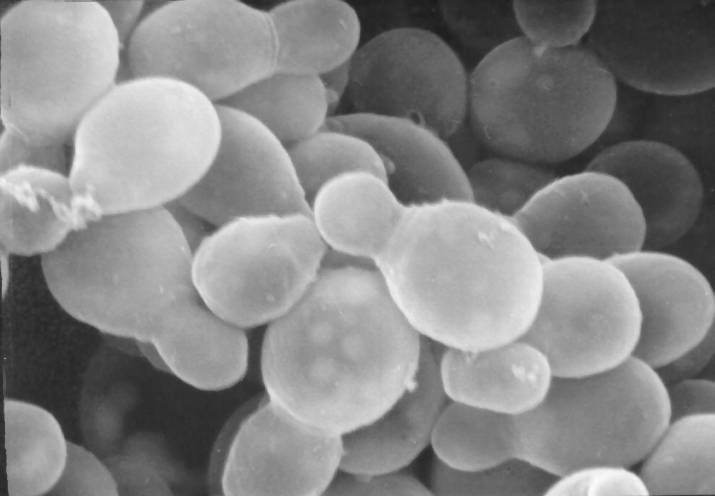 Malassezia furfur fungus seen under an electron microscope. This yeast normally lives on sebum-rich skin and is involved in seborrheic dermatitis and dandruff (Public domain)
Scalp psoriasis, by contrast, builds up thick, dry, silvery-white scales in layers on red plaques with sharp borders against the surrounding skin. The lesions can extend past the hairline onto the forehead, the nape, or around the ears. If thick scaling also shows up on the elbows or knees, or pitting appears on the nail surface along with the scalp changes, that is a clue for distinguishing it from seborrheic dermatitis.
If itching and burning began after dyeing your hair or switching to a new hair product, allergic contact dermatitis should be suspected. Delayed itching, redness, and blistering appear some time after exposure to the substance responsible. Symptoms tend to concentrate where the product actually runs down and touches the skin, such as the hairline, behind the ears, or the nape. Para-phenylenediamine (PPD), widely used in permanent hair dyes, is in particular a leading cause of allergic contact dermatitis (Thyssen Jacob Pontoppidan et al., 2008).
Infectious conditions can also cause scalp itching and flaking. Tinea capitis is an infection of the scalp and hair by dermatophyte fungi, and it occurs not only in children but also in adults (Hill Rachel C et al., 2024). A hallmark feature is hair breaking off short and brittle at patches where the scales have risen in a round shape. Adults are more susceptible if they have had contact with an infected child or pet. Folliculitis is a condition in which bacteria or other organisms invade the hair follicles, producing red bumps and yellow pustules centered on the follicles, along with throbbing pain when pressed. Beyond this, habits such as washing your hair with hot water or shampooing several times a day strip moisture from the scalp, leaving it dry and causing fine, dry white flakes to shed without any accompanying inflammation.
Does Hair Sometimes Not Grow Back Where You Scratched?
If scratching an itchy scalp leads to hair loss and you're worried about balding, the first step is to tell apart two different things: temporary shedding, where the hair follicle itself stays intact, and scarring (cicatricial) alopecia, where scar tissue replaces the follicle (Vázquez-Herrera Norma Elizabeth et al., 2018). Even if hard scratching snaps the hair shaft partway through, or severe inflammation causes temporary hair loss, new hair grows back once the inflammation settles down, as long as the follicle structure beneath the scalp remains intact. Hair loss linked to seborrheic dermatitis, allergic contact dermatitis, or a dry scalp generally falls into this category, where the follicle itself is preserved.
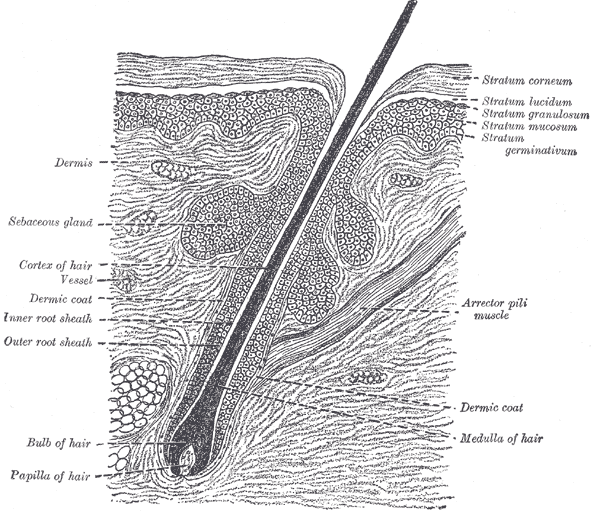 Cross-section of skin. Beneath the epidermis, within the dermis, is a hair follicle enclosing the hair; a sebaceous gland and arrector pili muscle are attached beside the follicle (Henry Vandyke Carter, Public domain)
But if inflammation reaches deep enough to destroy the hair follicle stem cells in the skin, the follicle is replaced by fibrous scar tissue, and the hair loss becomes permanent. A scratch wound with a bacterial infection on top causes mild folliculitis. By contrast, folliculitis decalvans, which destroys the follicle itself and keeps recurring, or a severely pus-filled, inflammatory type of tinea capitis, can leave scarring alopecia behind if diagnosis and treatment come too late (Hill Rachel C et al., 2024). As scarring alopecia progresses, the follicle openings in the affected area disappear, and the scalp surface turns shiny and smooth. Hair does not grow back from a follicle once it has been lost, so treatment focuses on quickly bringing the inflammation and disease progression under control to keep the surrounding hair from being lost as well (Waśkiel-Burnat Anna et al., 2025).
So seek an early medical evaluation without delay if pus and oozing spread widely across the scalp, if the scalp swells up soft and boggy along with fever, if hair snaps off short and falls out in a round, coin-shaped patch, or if the skin in a bald area starts turning smooth. Also, if swelling spreads beyond the scalp to the forehead, face, and eyelids after dyeing your hair, that signals a severe PPD allergic reaction, and you should get care the same day (Thyssen Jacob Pontoppidan et al., 2008). If facial swelling comes with difficulty breathing, go to the emergency room right away.
What a Magnified View of the Scalp Reveals
To pinpoint the cause of scalp itching, doctors work through a stepwise process: taking a history, visual inspection, palpation, magnified examination with equipment, and, when necessary, specimen testing (Vázquez-Herrera Norma Elizabeth et al., 2018). During history-taking, they ask about the timing between when symptoms first began and events such as hair dyeing, perming, or starting a new shampoo, and they check the time of day when itching worsens, seasonal changes, and any contact with pets or infected children.
When treating patients with an oily, itchy scalp or recurring inflammation, THE WELLS Nowon checks for accompanying scalp heat through history-taking and examination, and magnifies the hair follicles and inflammatory findings using a close-up scalp camera. Even scaling and redness that look similar to the naked eye can be clearly distinguished on a magnified screen — the character of the scales, the distribution of redness, pus or discharge around the follicles, and whether any hairs are short and broken off. Most importantly, this makes it possible to check whether the follicle openings are still intact, which helps gauge whether scarring alopecia is present.
According to a systematic review that pooled 58 studies on inflammatory scalp conditions, trichoscopy — magnified examination of the scalp and hair — is useful for differentiating between conditions (Golińska Joanna et al., 2022). For example, regularly spaced, dot-like twisted vessels seen under magnification point to scalp psoriasis, while branching, tree-like vessels together with yellowish scaling point to seborrheic dermatitis. If broken hairs are seen on magnification and tinea capitis (scalp ringworm) is suspected, scale or shed hair samples are collected for a potassium hydroxide (KOH) test and fungal culture to directly confirm fungal infection (Hill Rachel C et al., 2024).
Inflammation Treatment and Scalp Care: Which Comes First?
Scalp itch is treated differently depending on which condition is causing it (Vázquez-Herrera Norma Elizabeth et al., 2018). Seborrheic dermatitis is treated with an antifungal shampoo that suppresses Malassezia overgrowth together with a topical medication that calms scalp inflammation (Borda Luis J et al., 2015). Scalp psoriasis is treated with a topical medication matched to the thickness and extent of the silvery-white scales. If contact dermatitis develops from hair dye or a hair product, the first step is to stop using that product immediately, while bacterial folliculitis is managed with a topical or oral antibacterial agent depending on how far the infection around the hair follicles has spread and how severe it is. Tinea capitis, on the other hand, is not treated with topical medication alone, because the fungus burrows into the hair shaft itself, so an oral antifungal is used as the core treatment (Hill Rachel C et al., 2024).
Whatever the underlying condition, THE WELLS Nowon treats the inflammation first while it is still active on the scalp surface — redness, oozing, or pus. Forcibly removing flakes or applying irritating treatments can aggravate a scalp barrier that is already damaged, so THE WELLS Nowon carries out scalp care and scalp injections only after the acute inflammation has subsided.
For people who still have scalp heat, itching, clogged pores, and excess oil even after the acute phase has passed, THE WELLS Nowon recommends a head spa. The head spa at THE WELLS Nowon begins with a deep-cleansing step that uses nano-oxygenated water and oil to gently clear waste products and oxidized sebum out of the hair follicles, followed in order by scalp drainage to support lymphatic circulation, a carbonated detox, and a soothing scalp pack and ampoule application. A single session takes about 30 minutes and is done once a week.
If hair thinning caused by repeated inflammation remains even after the itching and inflammation have settled, THE WELLS Nowon adds scalp mesotherapy and exosome scalp injections. Scalp mesotherapy delivers PDRN and placenta-derived ingredients directly into the scalp to stimulate regeneration in weakened hair roots, while exosome scalp injections help the stem cells in the hair follicle bulge region become active again. Because these are injection procedures, the injection sites may be temporarily sore or swollen. Even after treatment and care are finished, THE WELLS Nowon continues to check, through regular scalp analysis with the close-up scalp camera, whether inflammation is returning and whether the thinned hair is recovering its thickness.
References
- Vázquez-Herrera Norma Elizabeth, Sharma Divya, Aleid Nouf Mohammed, Tosti Antonella (2018). Scalp Itch: A Systematic Review.. Skin Appendage Disord. PMID: 30197900
- Borda Luis J, Wikramanayake Tongyu C (2015). Seborrheic Dermatitis and Dandruff: A Comprehensive Review.. J Clin Investig Dermatol. PMID: 27148560
- Thyssen Jacob Pontoppidan, White Jonathan M L (2008). Epidemiological data on consumer allergy to p-phenylenediamine.. Contact Dermatitis. PMID: 19076884
- Hill Rachel C, Gold Jeremy A W, Lipner Shari R (2024). Comprehensive Review of Tinea Capitis in Adults: Epidemiology, Risk Factors, Clinical Presentations, and Management.. J Fungi (Basel). PMID: 38786712
- Waśkiel-Burnat Anna, Starace Michela, Iorizzo Matilde, Katoulis Alexandros, Apalla Zoe, Asfour Leila (2025). Management of folliculitis decalvans: The EADV task force on hair diseases position statement.. J Eur Acad Dermatol Venereol. PMID: 40230058
- Golińska Joanna, Sar-Pomian Marta, Rudnicka Lidia (2022). Diagnostic Accuracy of Trichoscopy in Inflammatory Scalp Diseases: A Systematic Review.. Dermatology. PMID: 34265772
Frequently Asked Questions
Q. If my scalp is itchy, is it okay to wash my hair every day?
When sebum and sweat build up heavily, wash once a day in lukewarm water, using your fingertips rather than your nails to cleanse gently. If pulling or stinging sensations worsen after washing, avoid products with strong cleansing power and adjust how often you wash. For medicated shampoos, follow the frequency specified on the product label or by your prescription.
Q. Can seborrheic dermatitis and scalp psoriasis occur together?
The two conditions may occur together, or may appear as sebopsoriasis, a form in which features of both conditions overlap. THE WELLS Nowon examines not only the scalp but also lesions on the face and around the ears, scaling on the elbows and knees, and changes in the fingernails and toenails together to determine the treatment direction.
Q. Does recurring scalp itching after hair dye require an allergy test?
If itching and redness recur every time you dye your hair, a patch test to identify an allergy to the dye's ingredients may be considered. Before the test, organize the ingredient list of the products you used and note when the symptoms started, and stop using the suspected product. A patch test applies substances to the skin and reads the reaction over time.
Q. If someone develops tinea capitis, should family members use separate combs or hats?
Tinea capitis can spread when people share items that touch the scalp, such as combs or hats, so towels and pillows should also be kept separate. Clean used items according to their material, and if a family member develops scaling or broken hairs, check them for infection. If a pet has hair loss or skin lesions, a veterinary visit is also needed.
Medical review: Sungjin Park · Medical Director · THE WELLS Nowon