
Last updated: 2026-10-08
My Head Feels Like It's Being Squeezed by a Band Every Afternoon
If your head feels squeezed like a band and your neck stiffens every afternoon, the pressure on the sides and back of your head can make it hard to concentrate as the workday goes on. As your neck and shoulders tighten into hard knots and the area around your temples grows achy, even keeping your eyes on the text on the monitor can become a struggle.
This discomfort is commonly called a tension headache, and medically it is classified as a tension-type headache. Its hallmark is mild-to-moderate pressing pain on both sides of the head (Ashina S et al., 2021). Unlike migraine, in which the head pounds and throbs or the stomach turns queasy, tension-type headache does not suddenly worsen with everyday activity such as walking or climbing stairs. It also typically does not come with nausea or vomiting (Ashina S et al., 2021).
Because this heavy, foggy-headed feeling tends to recur so often, many people simply write it off as ordinary fatigue. In fact, a study of 1,507 Korean adults found that the one-year prevalence of tension-type headache reached 30.8% (Kim BK et al., 2012). In that survey, it was a common headache that roughly one in three adults experienced, with no notable differences by age or sex (Kim BK et al., 2012).
Why Does Tension Headache Get Worse in the Afternoon Than in the Morning?
A study tracked pain changes in 31 patients with tension-type headache over one week using electronic devices (Kikuchi H et al., 2012). According to this study, headache intensity was lowest in the morning and peaked as the day moved into late afternoon (Kikuchi H et al., 2012). Sudden flare-ups of pain also clustered in the hours after noon (Kikuchi H et al., 2012).
When tension-type headache develops, the peripheral stimulus pathways that carry signals from tissue around the head and neck to the nervous system play an important role (Ashina S et al., 2021). When the thin muscle fascia covering the skull and the soft tissue around the nape of the neck stay persistently tense, the pain signals generated in that area stimulate the nervous system (Ashina S et al., 2021).
Office workers sit all day, so from the moment they start work in the morning, they hold the same posture for long stretches while looking at a screen. When they work for hours with the head held in a fixed position, strain gradually builds up in the soft tissue that supports the head and neck as well. The muscle fatigue and micro-tension that build up over the morning reach their limit by late afternoon. As a result, pain signals start reaching the brain in earnest, and the tightening, pressing sensation in the head grows even stronger.
When Your Head Drifts Toward the Monitor and You Clench Your Back Teeth
When you're absorbed in work, your head can gradually drift toward the monitor without your noticing. Forward head posture (turtle neck) is a condition in which the head sits forward of the trunk's normal center line. A study comparing 20 patients with chronic tension-type headache to 20 headache-free controls found that the headache group showed a significantly greater forward head angle than the controls, both sitting and standing (Fernández-de-las-Peñas C et al., 2006). The further forward the head posture, the more frequent the headaches (Fernández-de-las-Peñas C et al., 2006).
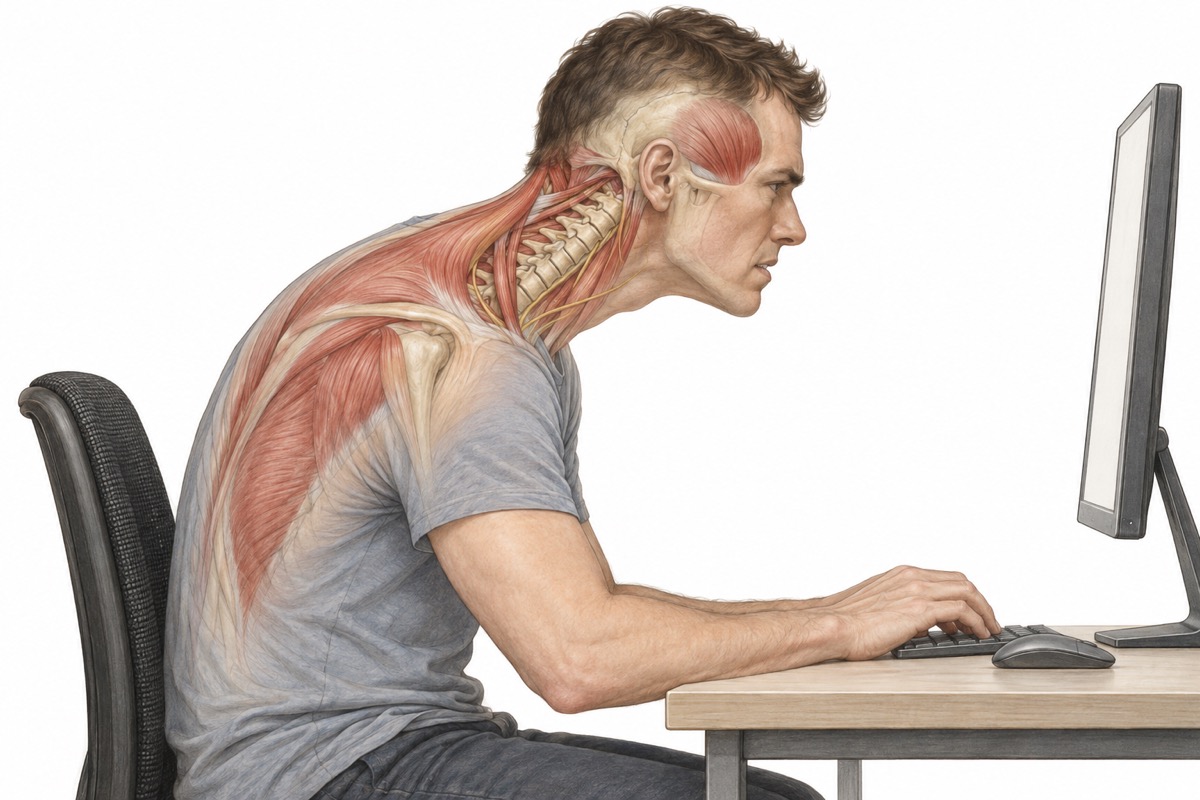 Neck and shoulder muscles tensing in a forward head posture toward the monitor, along with the temporalis muscle at the temple (AI-generated illustration)
This study also assessed the suboccipital muscles, located just below the back of the skull, alongside the postural changes. Active trigger points in these muscles were found in 65% of the chronic tension-type headache patients (Fernández-de-las-Peñas C et al., 2006). The more tightly these trigger points had knotted within the muscle, the greater the headache intensity patients reported, and the more days they experienced headache (Fernández-de-las-Peñas C et al., 2006).
When solving a complex problem or concentrating on work under tension, people often clench their back teeth tightly without realizing it. Clenching the back teeth forcefully contracts the temporalis muscle. The temporalis is a chewing muscle that spreads broadly across the temples on both sides of the head. A literature review published in 2024 found that daytime teeth clenching is significantly associated with tension-type headache, and when temporomandibular joint dysfunction overlaps with this habit, existing headaches may worsen more frequently (Voß LC et al., 2024).
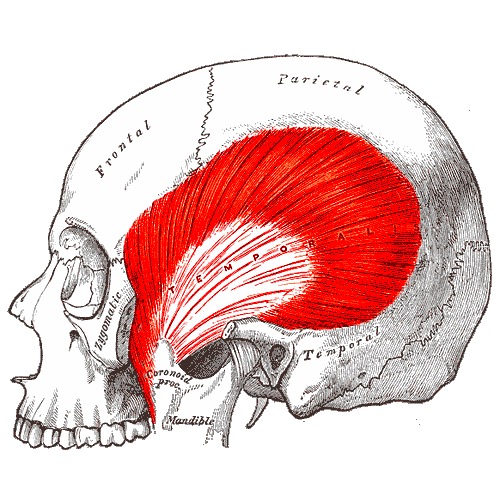 The temporalis muscle, covering the temple and extending down to the lower jaw (Henry Vandyke Carter, Gray's Anatomy, public domain)
If Your Head Feels Tight 15 or More Days a Month
By clinical criteria, tension-type headache is classified as chronic when it persists for more than 3 months and occurs on average 15 or more days per month (Ashina S et al., 2021). If it occurs on 1 to 14 days per month and persists for 3 months or longer, it falls under frequent episodic tension-type headache (Ashina S et al., 2021).
When headaches move from an occasional stage to a chronic one, a change called central sensitization takes place in the body (Ashina S et al., 2021). In this phenomenon, pain stimuli that start around the neck and head travel without pause to the spinal cord and brain, and the central nervous system becomes excessively sensitive to pain (Ashina S et al., 2021). Once this stage is reached, even slight muscle tension gets registered by the brain as much larger, harder-to-tolerate pain. A meta-analysis pooling 12 studies with a total of 1,083 participants also found that patients with chronic primary headache showed a markedly more forward-tilted head posture than people without headaches or those with intermittent episodic headaches.
If a tightening headache every late afternoon disrupts your routine after work, or if the pain even interferes with sleep at night, you should see a doctor even without having reached the 15-days-a-month threshold. That said, if you experience an extreme headache unlike anything you've felt before that strikes suddenly like a bolt of lightning, or if it comes with weakness in the arms or legs, slurred speech, blurred vision, or a stiff neck along with high fever, you should suspect a cerebrovascular or infectious condition rather than simple muscle tension. In that case, seek emergency care right away.
Besides Painkillers, How Does THE WELLS Nowon Treat It?
If you get through the afternoon by habitually taking painkillers, the pain can return every time the medication wears off, or it can even lead to medication-overuse headache. At THE WELLS Nowon, we do not rely on painkillers alone; we objectively examine the structural neck problems and muscle tension that cause the headache. We then palpate the muscles around the neck directly to assess their tension, and use a cervical X-ray to check precisely the alignment of the neck bones and how far the forward head posture (turtle neck) has progressed.
When a structural alignment problem is confirmed, we use cranial nerve relaxation correction therapy to correct the forward-tilted turtle neck and help each cervical segment regain its normal movement. If the strong joint friction or pressure of hands-on correction is a burden for you, we apply Sigma Tapping correction. A computer-controlled device lightly and rhythmically taps only the problem spinal segments to correct spinal alignment with precision.
For the nape of the neck and the trapezius area that have stiffened over a long period, we apply WINBACK radiofrequency therapy. It delivers radiofrequency energy down to the deep tissue to reduce fascial tension in the tightly knotted back of the neck and shoulders, and comfortably widens the range of motion of a stiffened neck. In the early stage, when the pain is so severe that even routine work is difficult, we perform a nerve block. It calms the excessive inflammatory response around the nerves that transmit pain, bringing the pain signal under control quickly.
If central sensitization has progressed and headaches keep recurring chronically, we proceed to TMS (transcranial magnetic stimulation) therapy as the next step after cervical correction treatment. TMS therapy is a non-invasive treatment that delivers a magnetic field to the surface of the head to modulate the activity of the cerebral cortical neural networks involved in pain regulation.
Sungjin Park · Medical Director · THE WELLS Nowon
References
- Ashina S, Mitsikostas DD, Lee MJ (2021). Tension-type headache.. Nat Rev Dis Primers. PMID: 33767185
- Kim BK, Chu MK, Lee TG (2012). Prevalence and impact of migraine and tension-type headache in Korea.. J Clin Neurol. PMID: 23091530
- Kikuchi H, Yoshiuchi K, Yamamoto Y (2012). Diurnal variation of tension-type headache intensity and exacerbation: An investigation using computerized ecological momentary assessment.. Biopsychosoc Med. PMID: 22943264
- Fernández-de-las-Peñas C, Alonso-Blanco C, Cuadrado ML (2006). Trigger points in the suboccipital muscles and forward head posture in tension-type headache.. Headache. PMID: 16618263
- Voß LC, Basedau H, Svensson P (2024). Bruxism, temporomandibular disorders, and headache: a narrative review of correlations and causalities.. Pain. PMID: 38888745
- Elizagaray-Garcia I, Beltran-Alacreu H, Angulo-Díaz S (2020). Chronic Primary Headache Subjects Have Greater Forward Head Posture than Asymptomatic and Episodic Primary Headache Sufferers: Systematic Review and Meta-analysis.. Pain Med. PMID: 33118601
Frequently Asked Questions
Q. How should I adjust monitor height and sitting posture to reduce afternoon headaches?
Position the monitor so the top of the screen is level with or slightly below eye height, and adjust the font size so you don't have to lean your head forward to read it. Keep your back against the chair's backrest, plant your feet flat on the floor or a footrest, and keep the keyboard and mouse close enough that your shoulders don't tense up. So that you do not hold the same posture for long, get up in the middle of your work and move around lightly.
Q. If my neck stiffens and a headache starts during work, is it okay to stretch or apply a warm compress?
Light stretching and warm compresses may help reduce tension and discomfort around the neck. Move your neck slowly, and stop if the pain clearly worsens. Apply a warm compress at a temperature that is not hot, with a towel between the compress and your skin, to prevent skin burns.
Q. How can I notice and reduce the habit of clenching my teeth while working?
When you send an email or switch tasks, check whether your upper and lower teeth are touching and whether your jaw is tensed. If you are clenching, separate your upper and lower teeth slightly, release the tension in your jaw and shoulders, and breathe slowly. If jaw stiffness keeps recurring, cut back on gum chewing, and keep a record of whether it comes with jaw pain or limited mouth opening so you can share it with your doctor.