
Last updated: 2026-09-21
How Do Trigeminal Neuralgia Symptoms Differ from Toothache?
Some people are stopped mid-motion by a jolt of pain that shoots from the cheek to the gums while washing their face in the morning. The same pain returns with brushing or cold air, yet dental exams and X-rays show nothing wrong. Sharp, stabbing attacks that flare on one side of the face with light touch are a warning sign that points first to trigeminal neuralgia (Cruccu Giorgio et al., 2020). Attacks usually last from a few seconds to two minutes at most. Between attacks there is a pain-free interval until the next episode (Maarbjerg Stine et al., 2017). In some people, a dull, aching pain lingers between the sharp attacks (Maarbjerg Stine et al., 2017).
Toothache often comes from lesions such as pulpitis or periodontal disease. Cold water or hot food makes the pain linger for a while before it gradually fades, and chewing or lightly tapping the tooth brings the ache back. The trigeminal nerve divides into three branches: the first branch runs across the forehead and around the eye, the second branch serves the cheek and upper gums, and the third branch serves the jaw and lower gums. Pain is common in the second and third branches, the cheek and jaw. Trigger points form around the lips, beside the nose, and on the gum mucosa, where very light touch sets off pain (Zakrzewska Joanna M et al., 2014). That is why the pain is easily mistaken for a tooth problem, and some people end up with repeated extractions or root canal treatments without the cause ever being identified (Zakrzewska Joanna M et al., 2014).
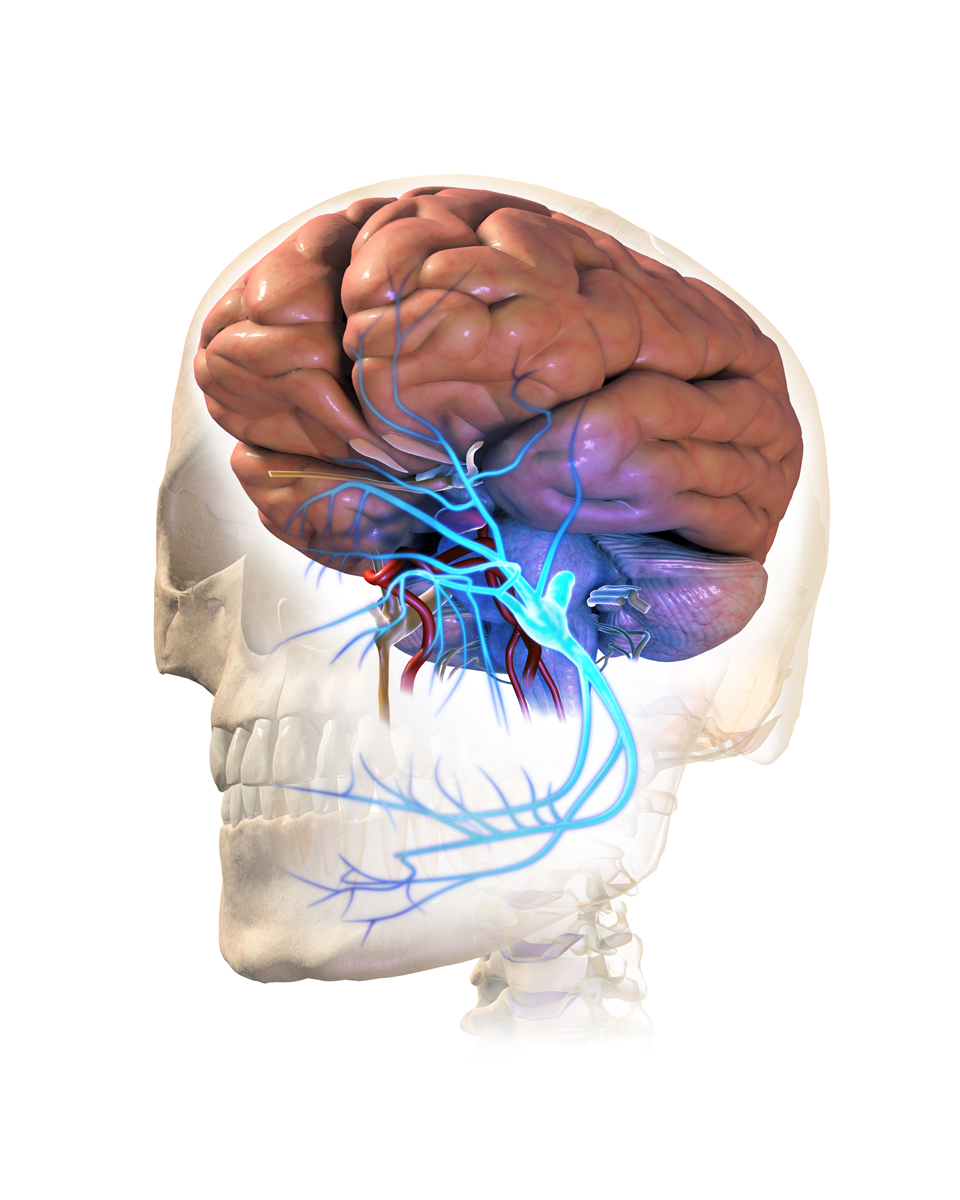
Pathway of the trigeminal nerve dividing into three branches across the forehead, cheek, and jaw (Wikimedia Commons, CC BY-SA 4.0)
Trigeminal neuralgia can also follow a course of frequent attacks lasting weeks to months, followed by a remission period in which attacks become less frequent (Maarbjerg Stine et al., 2017). Even after the pain subsides, the same triggers can bring it back, such as a minor touch or a change of season. Telling it apart from other causes therefore comes down to how the pain starts and how long it lasts.
Why Do Light Touches Like Washing Your Face or Brushing Your Teeth Cause Pain?
Classical trigeminal neuralgia often begins when a nearby blood vessel presses on the trigeminal nerve root as it enters the brainstem (Maarbjerg Stine et al., 2017). Where a pulsating vessel keeps pressing on the same spot, the myelin sheath that wraps and protects the nerve fibers is stripped away (Maarbjerg Stine et al., 2017). When the myelin is damaged, signals get mixed up between the fibers that carry light touch and vibration and the fibers that carry pain. So simple touches, such as washing your face, brushing your teeth, or a breeze across your face, turn into strong, electric-shock-like pain signals in the brain (Maarbjerg Stine et al., 2017).
Contact between a vessel and the trigeminal nerve shows up on MRI even in healthy people with no pain (Antonini Giovanni et al., 2014). So a vessel lying near the nerve alone does not establish the cause of pain. Compared with contact alone, vessel compression that comes with atrophy, where the pressed nerve becomes thinner, or displacement, where the nerve's course is bent, is strongly associated with nerve changes on the side where the patient feels pain (Antonini Giovanni et al., 2014). Reported frequencies of these shape changes on imaging vary from study to study, so clinicians do not make a diagnosis from a single ratio. They match the imaging findings against the symptoms and the area of pain.
Besides vessel compression, other conditions that affect the trigeminal nerve pathway can also cause pain, including demyelinating diseases such as multiple sclerosis and benign tumors in the cerebellopontine angle (Bendtsen Lars et al., 2019). Doctors call this secondary trigeminal neuralgia. Pain on both sides of the face or dulled sensation are clues that suggest a secondary cause. Even when these signs are not obvious, an underlying condition may be present, so imaging is done to look for structural lesions (Bendtsen Lars et al., 2019).
How Do You Tell It Apart from TMJ Pain and Postherpetic Neuralgia?
Pain from the TMJ and masticatory muscles comes on as a dull heaviness in the joint in front of the ear and in the muscles around the jaw, typically when the mouth is opened wide or tough food is chewed. On examination, pressing with a finger on the area around the TMJ or on a masticatory muscle such as the masseter reproduces the same soreness the patient usually feels. The jaw may click when it moves, but a sound alone does not pin the cause on the joint. TMJ pain tracks with the load placed on the musculoskeletal system.
Chewing loads the TMJ and also touches the gums and the inner lining of the cheek, so it triggers pain in both trigeminal neuralgia and TMJ disorders (Zakrzewska Joanna M et al., 2014). The two conditions differ in the shape of their pain. When a paroxysm lasting a few seconds, like an electric shock, hits at the moment of chewing, clinicians first suspect abnormal pain signaling in the nerve. If pain changes with how wide the mouth opens and closes, and pressing the jaw muscles reproduces a dull, squeezing ache, clinicians examine the masticatory muscles and the joint (Zakrzewska Joanna M et al., 2014).
Other nerve pains in the face also need to be told apart. Postherpetic neuralgia is preceded by an episode of blisters and rash along one trigeminal branch on one side of the face. Even after the skin heals, a burning or searing pain remains, along with touch hypersensitivity, where even a light brush across the skin stings (Maarbjerg Stine et al., 2017). When severe pain around the eye and forehead comes with autonomic symptoms such as eye redness, tearing, or nasal congestion, autonomic headaches such as SUNCT or cluster headache also need to be ruled out (Maarbjerg Stine et al., 2017). Tearing can also occur in trigeminal neuralgia during severe attacks, so the distinction rests on attack length and on whether autonomic signs such as a runny nose or conjunctival redness accompany the pain.
What Does THE WELLS Jamsil Use to Assess It, and What Does It Do?
At THE WELLS Jamsil, we first ask in detail about the shape of the pain (Cruccu Giorgio et al., 2020). We ask how many seconds each episode lasts, whether it feels burning or sharp like an electric shock, and whether actions such as washing the face, brushing teeth, cold wind, or chewing set it off (Cruccu Giorgio et al., 2020). We also check for trigger points that set off pain around the lips or gums, and whether the patient remains fully comfortable and pain-free after an attack passes. The examination assesses trigeminal nerve function by checking whether skin sensation is preserved across the three branches running to the forehead, cheek, and jaw, and whether muscle function and reflexes are unchanged. The length of an attack and the way it is triggered are the items we always check in headache care.
Next, we perform an NCV test and an EMG test. Nerve conduction and electromyography tests check whether the loss of facial sensation comes from another nerve problem, such as peripheral neuropathy or facial nerve palsy. The nerve conduction and EMG results alone do not confirm or rule out trigeminal neuralgia; they are read together with the physical examination. For brain MRI, which looks at the degree of vascular compression at the brainstem, nerve deformation, and secondary causes such as brain tumors or multiple sclerosis, we refer patients to an outside radiology facility (Bendtsen Lars et al., 2019).
If the examination shows imbalance in the temporomandibular joint and upper cervical spine, or if the masticatory muscles around the jaw and the neck fascia are markedly stiff, we perform TMJ cranial nerve manual therapy. This treatment realigns the misaligned jaw joint and neck vertebrae and relaxes the surrounding muscles, reducing the mechanical tension and irritation directed at the branches of the trigeminal nerve. WINBACK radiofrequency is used alongside it to loosen deep muscles and stiff fascia, lowering the tension in the neck and jaw area that provokes pain attacks. The role of this manual therapy and radiofrequency treatment is to reduce the musculoskeletal stimulation that aggravates the attacks.
When Do We Discuss Medication and Surgery?
For patients confirmed to have classical trigeminal neuralgia, the first-line treatment recommended in the literature is an anticonvulsant that suppresses signal transmission from overexcited nerve cells (Bendtsen Lars et al., 2019). Carbamazepine or oxcarbazepine is the first choice, and depending on how well pain is controlled and the patient's condition, lamotrigine, gabapentin, or baclofen is used alone or in combination (Bendtsen Lars et al., 2019). Anticonvulsants can cause dizziness, unsteady gait, and severe drowsiness, and they can cause hyponatremia, a drop in blood sodium levels, so the course is monitored regularly (Cruccu Giorgio et al., 2020). For acute attacks that are not controlled by medication, the literature describes giving intravenous fosphenytoin or lidocaine in a medical facility under monitoring.
When pain is not controlled even at adequate doses, or side effects make it hard to continue the medication, the discussion moves to surgery (Bendtsen Lars et al., 2019). For classical trigeminal neuralgia with a clear finding of a blood vessel compressing the nerve at the brainstem, microvascular decompression, which relieves the pressure by placing a cushioning material between the nerve and the blood vessel, is considered first (Bendtsen Lars et al., 2019). For patients whose general health makes craniotomy difficult or who do not want it, or when the vascular compression finding is not clear, percutaneous neurodestructive procedures that selectively block pain fibers, or radiosurgery such as Gamma Knife, are considered as alternatives (Cruccu Giorgio et al., 2020). Nerve block, which uses a local anesthetic to temporarily calm nerve excitability, and neurodestructive procedures, which damage nerve fibers with heat or chemicals, are different approaches. Neurodestructive treatment can leave facial numbness or abnormal sensations after the procedure, and microvascular decompression carries the systemic burden and complication risks of brain surgery, so the decision is made by weighing the patient's overall health. The WINBACK radiofrequency that THE WELLS Jamsil uses for myofascial relaxation is a physical treatment that warms and loosens stiff tissue. Its purpose and method differ from radiofrequency equipment that directly coagulates nerves for neurodestructive procedures.
Managing trigeminal neuralgia starts with controlling the everyday stimuli that trigger pain. When washing your face, gently wipe the skin with lukewarm water, and when going outside, use a mask or scarf so cold wind does not hit the face directly. If pain worsens again or the response to medication changes, we re-examine the neurological status. Between medication and surgery, THE WELLS Jamsil takes on these lifestyle adjustments, management of jaw joint and neck tension, and re-examination when symptoms recur.
Jumin Kim · Medical Director · THE WELLS Jamsil
References
- Cruccu Giorgio, Di Stefano Giulia, Truini Andrea (2020). Trigeminal Neuralgia.. N Engl J Med. PMID: 32813951
- Zakrzewska Joanna M, Linskey Mark E (2014). Trigeminal neuralgia.. BMJ. PMID: 24534115
- Maarbjerg Stine, Di Stefano Giulia, Bendtsen Lars (2017). Trigeminal neuralgia - diagnosis and treatment.. Cephalalgia. PMID: 28076964
- Antonini Giovanni, Di Pasquale Antonio, Cruccu Giorgio (2014). Magnetic resonance imaging contribution for diagnosing symptomatic neurovascular contact in classical trigeminal neuralgia: a blinded case-control study and meta-analysis.. Pain. PMID: 24785270
- Bendtsen Lars, Zakrzewska Joanna M, Abbott Jan (2019). European Academy of Neurology guideline on trigeminal neuralgia.. Eur J Neurol. PMID: 30860637
Frequently Asked Questions
Q. Can trigeminal neuralgia and dental disease coexist?
People with trigeminal neuralgia can also develop cavities or gum disease. Even when a dental problem is found, it does not fully explain the shooting pain in the face, so dental pain and nerve pain are distinguished and treated separately.
Q. Should I move up my appointment if pain makes it hard to brush my teeth or eat?
If pain often makes you skip brushing your teeth or meals, we move up your appointment and set a plan for managing the pain. If you cannot drink enough water, or if you pass less urine and feel dizzy, you may become dehydrated, so we see you the same day.
Q. What should I do if I suddenly develop facial paralysis or slurred speech along with facial tingling?
Sudden facial paralysis or slurred speech can be a sign of stroke, so call 119 immediately. Get an emergency evaluation even if the symptoms go away shortly afterward.
Q. Can I stop my anticonvulsant on my own once the pain eases?
Do not stop taking your anticonvulsant on your own just because the pain has eased, and do not take it only when you are in pain. If you stay pain-free for an extended period, the prescribing medical institution decides whether to reduce the dose and how quickly to do so. When it is time to stop, the dose is also tapered gradually.