
Last updated: 2026-11-12
My Heart Tests and Chest X-ray Are Normal, But My Side Still Stings
A 40-something office worker feels a sharp, stinging pain in the left side whenever they twist their body or take a deep breath. The pain runs from the side toward the back in a band that follows a single rib. Worried that something might be wrong with the heart, the patient had an EKG and a chest X-ray taken at an internal medicine clinic, but was told both tests came back normal. Even so, the skin at that spot still stings at the slightest touch of a shirt, and a cutting pain in the side continues every time they breathe in deeply.
When heart and lung test results are normal but the side and back still sting, the first condition to suspect is intercostal neuralgia, which comes from the intercostal nerves running along the underside of the ribs. Even without any structural abnormality in the internal organs, irritation of the peripheral nerves that carry sensation from the trunk can produce a clearly defined band of pain along the space between the ribs, and the skin can sting at the slightest touch. For this intercostal neuralgia, we perform an ultrasound-guided injection: we use ultrasound to locate the intercostal nerve at the level where the pain occurs and inject around that spot.
When organ tests come back normal, patients can easily end up moving from one department to another without finding the cause of the pain right away. In fact, one study analyzed 28 patients in the United States who underwent MR neurography on suspicion of intercostal neuralgia. In this study, patients had experienced pain for an average of 36.9 months before undergoing the test, and had seen an average of five doctors in that time (Chalian M et al., 2021). If the heart and lungs show no abnormality, the path along which the pain spreads and any change in skin sensation should be examined to determine whether the problem is neurological.
Where Does the Intercostal Nerve Run to Cause This Band-Like Pain?
The pain follows a half-circle shape along the space between the ribs because the nerve's anatomical path matches the area where the pain occurs. The intercostal nerve exits through an opening between the thoracic vertebrae in the back, runs along the lower edge of each rib around the flank, and extends forward all the way to the front of the chest and abdomen. One nerve runs between the ribs on each side at every thoracic level, and the skin area that a single nerve supplies wraps horizontally around the trunk like a belt.
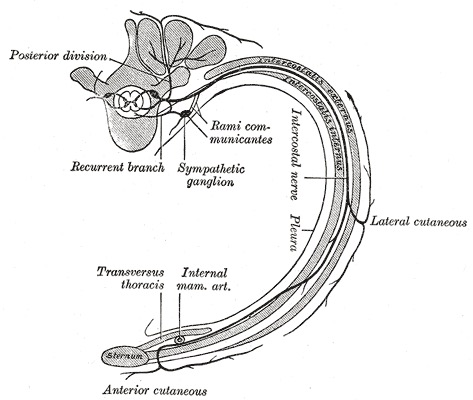
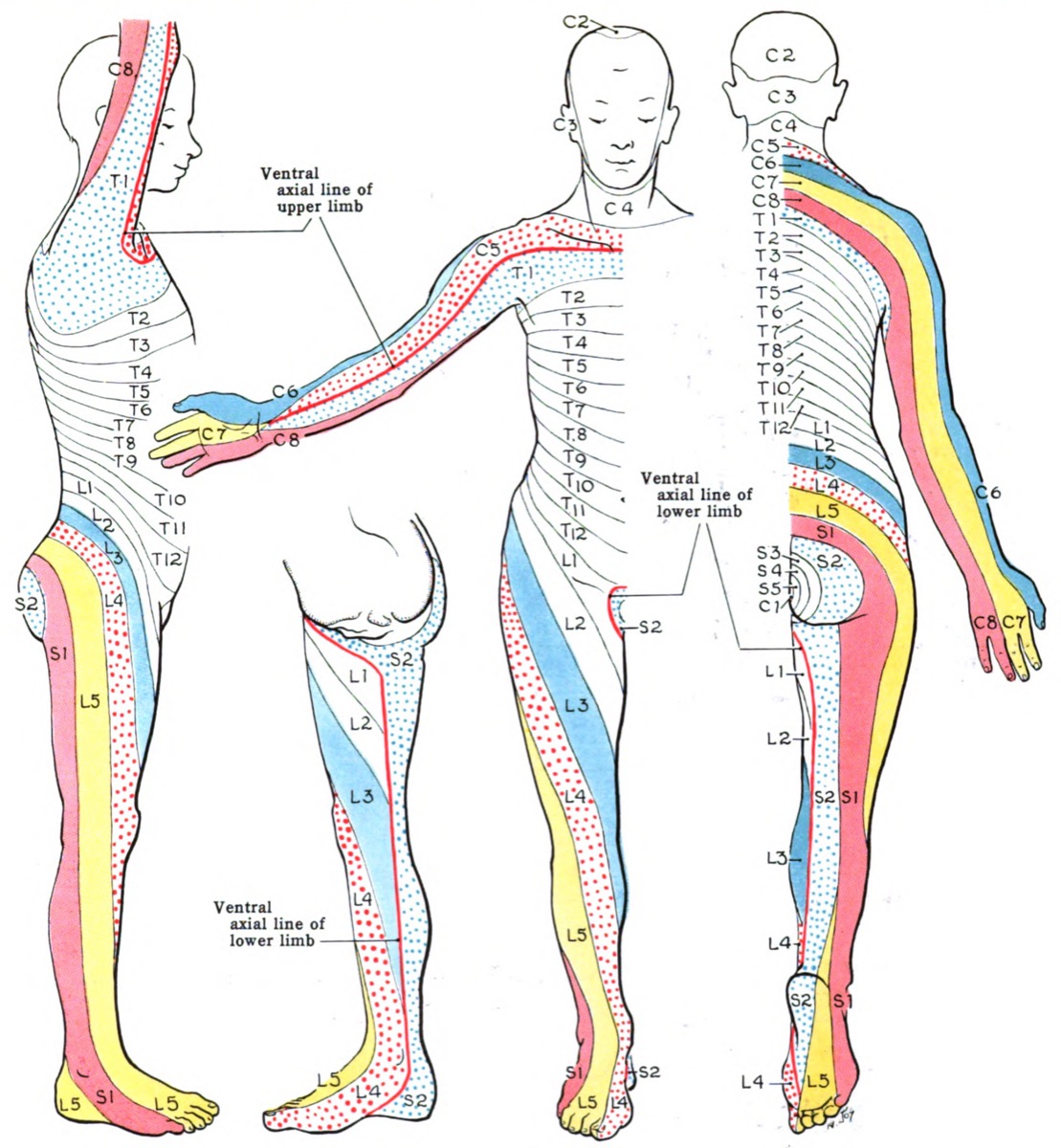
Because of this structure, when a single intercostal nerve at a specific level becomes irritated or damaged, the pain also wraps around one side of the trunk like a band, radiating from the back through the flank to the front of the chest or abdomen. The pain can present as sharp stabbing, burning, or electric shock-like sensations, sometimes accompanied by numbness or tingling in the skin (Fazekas D et al., 2023). When asked to point to the painful area, patients often trace a line along the course of a rib rather than pointing to a broad, vague region.
The pain can come and go briefly, or it can persist continuously even at rest. Taking a deep breath, coughing, sneezing, or twisting the trunk while sitting all move the space between the ribs, which irritates the nerve further and intensifies the pain. Intercostal neuralgia can arise from several causes, including nerve damage after chest surgery, shingles, or structural problems around the thoracic spine. In some cases, however, the pain lingers for a long time even after the original irritating cause has resolved, or no clear preceding cause can be found.
Why It's Easily Confused with Shingles and Thoracic Compression Fractures
When pain develops in the chest or flank, the first step is to rule out life-threatening emergency conditions. Chest pain is a common reason for emergency room visits. For this reason, the 2021 American guideline on chest pain evaluation recommends stratifying patients by risk level first and then deciding on the necessary tests accordingly (Gulati M et al., 2021). If you have a strong squeezing or crushing pain in the center of your chest along with cold sweats, shortness of breath, or lightheadedness, go to the emergency room immediately, before considering whether the pain is nerve-related.
If it isn't an emergency condition, the next step is to distinguish, one by one, pain coming from the muscles, bones, or skin of the chest wall. A German study that analyzed 1,212 patients with chest pain who visited local primary care clinics found that 46.6% of all patients had pain originating from the chest wall. Checking four features—whether a muscle is knotted in one spot, whether the pain feels like stabbing, whether pressing on the area with your hand reproduces the usual pain, and whether a cough is absent—can help identify chest wall pain (Bösner S et al., 2010). Myofascial pain syndrome, commonly described as a muscle "knot," is marked by pain when pressing on a knotted spot in the muscle that radiates to the surrounding area, whereas intercostal neuralgia is distinguished by pain that spreads in a band along a nerve pathway, together with sensory changes such as numbness or tingling of the skin.
Shingles occurs when the varicella virus, dormant in a nerve ganglion, reactivates, and in some cases the affected nerve area feels stinging or shooting pain for several days before blisters appear on the skin. So if new flank pain develops, check whether red spots or a band of blisters appear along the painful path (Fazekas D et al., 2023). A Chinese study analyzing patients with osteoporotic thoracic compression fractures also found that the narrower the nerve opening in the injured vertebra and the more severe the fatty degeneration of the back muscles, the higher the likelihood of developing intercostal neuralgia (Liu ZG et al., 2025). Therefore, if you are older or have osteoporosis, or if the pain began after a fall or impact, an X-ray is taken first to check for thoracic compression fractures and rib fractures, and if weakness or numbness develops in the legs, or bladder and bowel control becomes difficult, the thoracic spine needs to be checked right away for compression of the spinal cord.
How to Find and Inject the Nerve Beneath the Rib Using Ultrasound
Once other causes of chest pain have been ruled out and irritation of the intercostal nerve is confirmed, we begin treatment to calm the excitation and inflammatory response around the nerve. For intercostal neuralgia, we perform ultrasound-guided injection. During the procedure, we use ultrasound at the level where the pain occurs to locate the rib and the intercostal nerve along its lower edge, then inject around the intercostal nerve while watching the needle tip go in.
Because of the anatomy around the ribs, injections there are given under direct visualization for safety. The intercostal nerve runs alongside blood vessels in a narrow groove along the lower edge of the rib, and just beneath it lies the pleura, the thin membrane that envelops the lung. In the past, physicians relied only on palpating external anatomical landmarks before inserting the needle, which carried a higher risk of touching nearby structures and more complications. Visualizing the nerve and pleura directly with ultrasound or CT while injecting greatly reduces complications (Kannan A et al., 2026).
Nerve injections reduce pain signal transmission from the irritated nerve and may create a pain-free period lasting from days to weeks, or in some cases even months (Kannan A et al., 2026). In the U.S. study mentioned above, among 19 patients with intercostal nerve abnormalities confirmed by MR neurography, 9 received perineural injections, and 6 of them reported improvement in symptoms after the first injection (Chalian M et al., 2021). The pattern of pain reduction after the injection can also help confirm whether the intercostal nerve at that level was indeed the source of the pain (Fazekas D et al., 2023). However, because the lung lies directly adjacent to the inner surface of the rib, pneumothorax can rarely occur after the injection, so if sudden shortness of breath or a new chest pain unlike before develops after the procedure, patients should let the clinic know right away (Fazekas D et al., 2023).
If Your Back Still Feels Stiff After the Pain Subsides
Even after an injection near the nerve calms the sharp, stabbing acute pain, the back can still feel achy, or the space between the ribs can stay stiff when you twist your torso. The intercostal nerves exit through openings between the thoracic vertebrae on the back. So if the spine—the passage where the nerve emerges—stays stiff, or tension remains in the surrounding tissue, discomfort tends to come back during everyday movements.
When back pain is present and movement in the spinal segments is stiff, we perform thoracic spine correction. If the alignment keeps shifting back out of place even after the thoracic spine is corrected, we also check the alignment of the upper cervical spine and jaw joint above it and provide TMJ cranial nerve manual therapy alongside the correction. This is because the spine forms one connected axis from top to bottom: if the upper axis—the upper cervical spine and jaw joint—stays misaligned, the thoracic spine below will drift out of place again even after it has been corrected on its own. We do not end this correction process after one or two sessions; we continue it steadily to restore balance to a torso that has been stiff for a long time.
If prolonged pain has left the muscles and fascia of the flank and back broadly stiff, we use WINBACK radiofrequency to generate heat in the deeper layers and gently loosen the hardened fascia and muscle. Because WINBACK radiofrequency delivers deep heat without using needles, we apply it to patients who feel burdened by injection treatment or who have widespread muscle tension. We first calm the sensitized nerve pain with ultrasound-guided injection, and then restore movement in the stiffened thoracic spine and fascia in turn. Only then can the patient take a deep breath and turn the body naturally without a sharp twinge in the flank.
Related Articles
- Myofascial Pain Trigger Points and Recurrence: From Diagnosis to Managing the Underlying Cause
- Fibromyalgia Symptoms: Waking Up Tired with Pain Throughout the Body
- Intercostal Neuralgia Medical Information (Linkare Knowledge)
References
- Chalian M, Hoang D, Rozen S, Chhabra A (2021). Role of magnetic resonance neurography in intercostal neuralgia; diagnostic utility and efficacy.. Br J Radiol. PMID: 33960822
- Fazekas D, Doroshenko M, Horn DB (2023). Intercostal Neuralgia. StatPearls. PMID: 32809700
- Gulati M, Levy PD, Mukherjee D, Amsterdam E, Bhatt DL, Birtcher KK (2021). 2021 AHA/ACC/ASE/CHEST/SAEM/SCCT/SCMR Guideline for the Evaluation and Diagnosis of Chest Pain: A Report of the American College of Cardiology/American Heart Association Joint Committee on Clinical Practice Guidelines.. Circulation. PMID: 34709879
- Bösner S, Becker A, Hani MA, Keller H, Sönnichsen AC, Karatolios K (2010). Chest wall syndrome in primary care patients with chest pain: presentation, associated features and diagnosis.. Fam Pract. PMID: 20406787
- Liu ZG, Yang F, Li PF, Song Q, Wang G, Zhang BY (2025). Analysis of factors associated with intercostal neuralgia after osteoporotic thoracic spine fracture and construction of a prediction model.. BMC Musculoskelet Disord. PMID: 39901110
- Kannan A, Srinivasan S (2026). Image-Guided Interventions for Intercostal Neuralgia: What the Radiologist Needs to Know.. J Med Imaging Radiat Oncol. PMID: 42690176
Frequently Asked Questions
Q. If intercostal neuralgia is suspected, should I also get an X-ray or MRI?
X-rays and MRI are used not so much to diagnose intercostal neuralgia itself, but to find causes that irritate the nerve, such as a rib fracture or a thoracic spine lesion. THE WELLS asks about the distribution of the pain and whether there was any trauma, examines the tender area, and then decides whether additional tests are needed.
Q. Can one side of the flank hurt even before shingles blisters appear?
Shingles can cause a burning or tingling sensation on one side of the flank for several days before blisters appear. Record the date the pain started, watch for any skin changes, and if a rash or blisters develop, see a doctor without delay so they can determine whether antiviral treatment is needed.
Q. How long does pain relief last after an ultrasound-guided injection?
How long pain relief lasts depends on the medication used in the injection, the underlying cause of the nerve irritation, and how long the symptoms had been present beforehand. Keeping track of how much the pain eased after the injection, when it started to return, and which movements still felt uncomfortable can help in deciding the type and interval of further treatment.
Q. My pain decreased after the injection, but my back still feels stiff. Do I need additional treatment?
If stiffness remains, whether additional treatment is needed depends on how much the range of trunk rotation and the discomfort during daily movements have improved. THE WELLS examines the area of remaining pain and evaluates thoracic spine range of motion and the tension in the surrounding muscles to decide on follow-up treatment, such as thoracic spine correction.
Medical review: Jumin Kim · Medical Director · THE WELLS