
Last updated: 2026-10-09
When I Stand for a Long Time, My Upper Body Leans Forward and My Lower Back Won't Fully Straighten
If your upper body leans forward when you stand for a long time and your lower back won't straighten all the way, it's worth checking whether these are symptoms of a flat back. A flat back is a condition in which the gentle C-shaped curve of the lower back, seen from the side, is reduced. In flatback syndrome, the trunk tilts forward and standing upright becomes difficult.
When you stand for a long time, for example while washing dishes in the kitchen, working at a store checkout counter, or viewing an exhibition, your lower back gradually stiffens and your upper body tends to tilt forward. In this state, an aching pain around the lower back and buttocks often gets worse after you stand or walk for a long time, and it is common for the left and right sides of the pelvis to sit at different heights.
Medically, when the lower back loses its normal forward curve (lordosis), the upper body's center of gravity shifts forward and the trunk tilts. Resisting this tilt puts excessive tension on the erector spinae muscles of the lower back, producing the pattern of flatback syndrome in which standing upright becomes difficult (Lu Daniel C et al., 2007). In fact, a study of 105 patients with degenerative lumbar kyphosis also consistently observed, along with long-standing lower back pain, a clinical pattern in which patients always walked bent forward in daily life or their upper body bent noticeably forward once fatigue built up (Takemitsu Y et al., 1988).
When the Lumbar Curve Flattens, the Pelvis and Knees Take Over the Strain
Lumbar lordosis is shaped by a combination of factors: pelvic incidence, which reflects the shape of the pelvis; the tension of the muscles around the spine; the wedge shape of the vertebrae themselves; and the elasticity and height of the discs (the cartilage between the vertebrae). As the discs thin and degenerative changes set in with age, the forward curve of the lower back naturally decreases while the backward curve of the thoracic spine gradually increases (Sparrey Carolyn J et al., 2014).
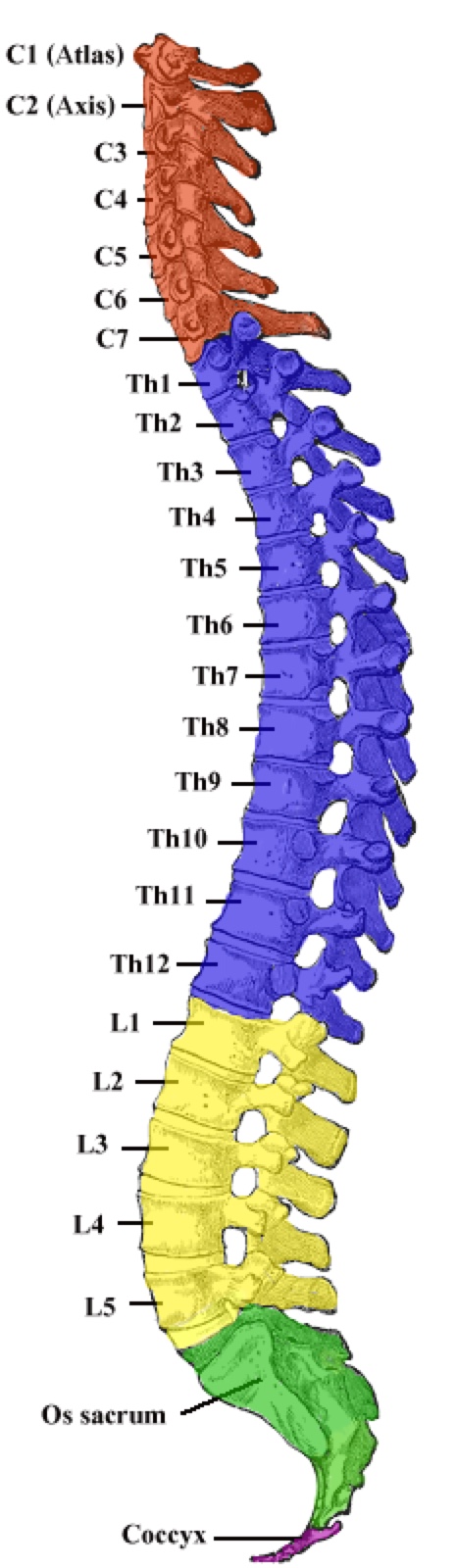 Side view of the spine. The cervical, thoracic, and lumbar vertebrae form alternating curves, and the yellow lumbar vertebrae curve gently forward (Henry Vandyke Carter, Gray's Anatomy, public domain)
When the normal curve of the lower back decreases and the center of gravity shifts forward, the body begins to compensate on its own to keep from losing balance. At first, it tries to keep the upper body upright by adjusting the flexion of neighboring lumbar segments or by temporarily reducing the backward curve of the thoracic spine. But as muscle fatigue builds up and degeneration continues, the body ends up tilting the pelvis backward and extending the hip joints backward to hold itself up, and the burden of holding this position increases sharply (Boody Barrett S et al., 2017). When the pelvis rotates excessively backward in this process, the buttocks look flat and droopy, forming what is called a flat pelvis, and a vicious cycle follows in which the lower back curve flattens even further.
With flatback, people walk or stand with their hip joints and knees slightly bent to keep the upper body from tipping forward. When this posture continues for a long time, the muscles at the front of the thigh stay tense, which can lead to an aching pain in the front of the thigh (Lu Daniel C et al., 2007). A study analyzing patients with degenerative lumbar kyphosis found that the extensor muscles, which straighten the lower back by bending the upper body backward, were markedly weaker than the flexor muscles, which bend the upper body forward (Takemitsu Y et al., 1988). Working while squatting on the floor for long hours, a floor-sitting lifestyle, and atrophy of the back muscles that hold the spine upright are major causes that accelerate sagittal imbalance of the spine (Lee Chang-Hyun et al., 2017).
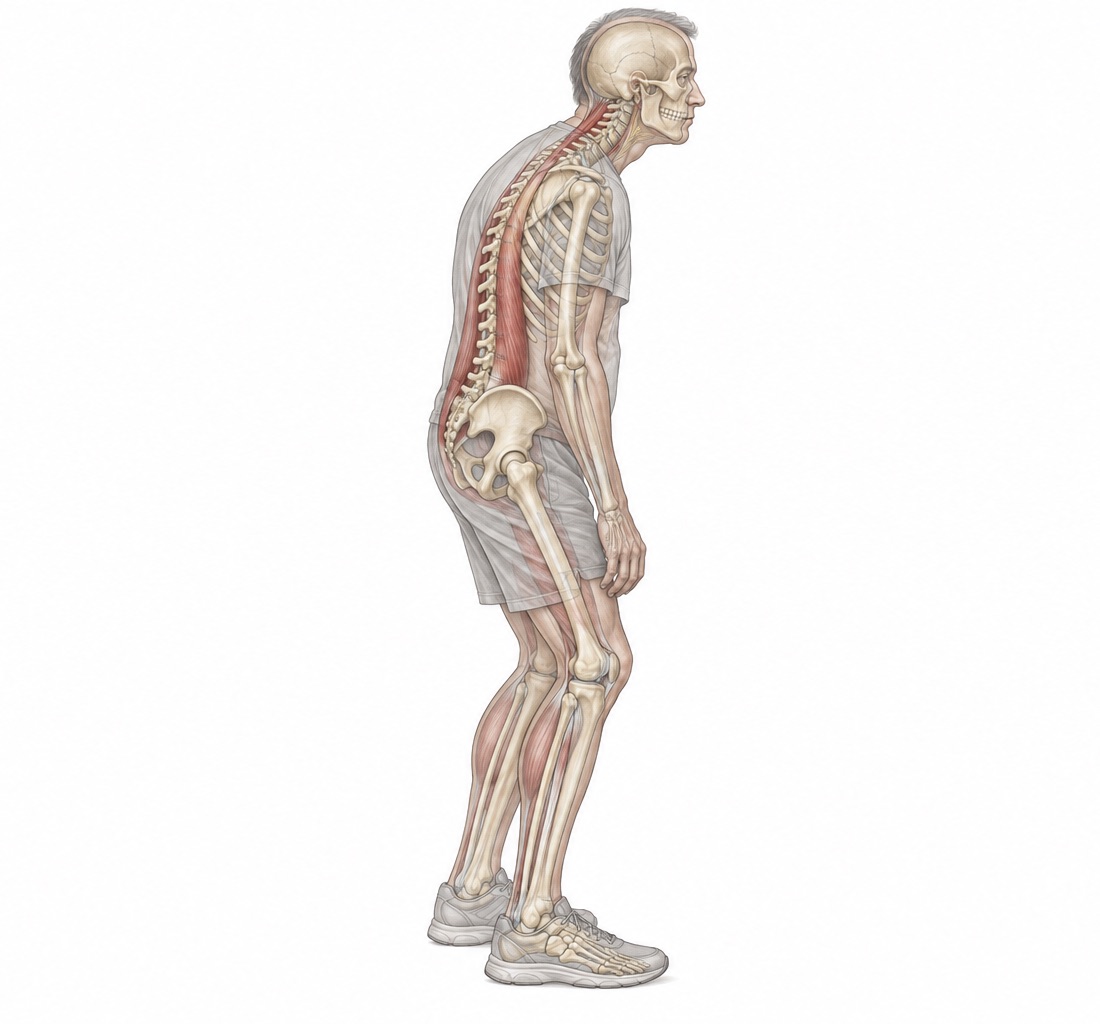 Side view showing how, as the lower back curve decreases and the upper body tilts forward, the pelvis tilts backward and the knees bend to compensate (AI-generated illustration)
What Does a Standing Lateral X-ray Show?
To objectively assess a flat back, we need to check the spine while it actually bears body weight, rather than relying on imaging taken while lying down. When you lie down, the effect of gravity is spread out, so the spine may temporarily straighten or look different from its natural curve. For this reason, we take a lateral X-ray while you stand upright on both feet and support your body weight, to check the actual curve of the lumbar spine and its overall alignment.
Literature on evaluating iatrogenic flatback deformity likewise explains that a full-spine lateral X-ray should be taken with the knees and hip joints fully extended. Only then can the compensation that appears when the patient bends these joints be excluded, so that the spine's true tilt can be assessed accurately (Wiggins Gregory C et al., 2003).
We check where the range of motion becomes limited as you move your lower back forward, backward, and side to side, and we feel the muscles around the pelvis and the erector spinae of the lower back by hand to assess their tension and find the areas that have stiffened. We also measure whether a difference in leg length has tilted the pelvis to one side and whether the left and right sides of the pelvis are asymmetric in height.
If You Have to Stop and Rest Because Your Legs Go Numb While Walking
If numbness and pain running from the buttocks through the thigh and calf gradually worsen while you stand or walk, then settle down once you bend forward at the waist or squat down to rest, and the same discomfort returns as soon as you start walking again, this is typical neurogenic intermittent claudication. This is not simple muscle tightness but a classic sign of lumbar spinal stenosis, in which the inside of the spinal canal narrows and the nerves are compressed.
If your legs suddenly give out while you are walking and you sink to the ground, if paralysis makes your ankle drop so that you drag your foot when you walk, or if the sensation that tells you when you need to urinate or move your bowels becomes dull so that controlling them becomes difficult, it means the nerves are being severely compressed. In that case, you need to see a doctor immediately, without delay.
How Does THE WELLS Jamsil Correct a Flat Back?
Correcting a flat back involves more than simply bending or straightening the single lumbar segment where pain appears; it requires restoring the three-dimensional sagittal balance of the entire spine, from the pelvis to the neck. Literature on degenerative spinal imbalance also holds that curve problems of the spine should be approached from the perspective of overall body balance. For this reason, it recommends conservative treatment, such as structured exercise and physical therapy, as the first treatment (Lee Chang-Hyun et al., 2017).
The director personally evaluates misalignment of the upper cervical spine, where the spine begins, and of the jaw joint, and then performs whole-spine correction by hand that extends through the thoracic spine, the lower back, and the pelvis. Because alignment does not settle into place overnight, we continue treatment steadily while confirming that the body's movement is recovering, rather than setting a fixed number of sessions.
Alongside this, we use manual therapy to relax the buttock muscles that pull the pelvis backward and the tense tissue around the lower back, and to correct the left-right imbalance of the pelvis. We also guide exercise therapy so that patients learn to use the erector spinae and deep core muscles, which are essential for holding the spine upright, correctly on their own. Once joint range of motion has been secured by hand, patients need to build the strength to support the spinal curve with their own muscles, because that is what reduces the tendency of the upper body to collapse forward while standing. We also help correct daily habits that put unnecessary load on the lower back, such as slouching or crossing your legs, so that the corrected alignment stays stable in everyday life.
Jumin Kim · Medical Director · THE WELLS Jamsil
References
- Lu Daniel C, Chou Dean (2007). Flatback syndrome.. Neurosurg Clin N Am. PMID: 17556130
- Takemitsu Y, Harada Y, Iwahara T (1988). Lumbar degenerative kyphosis. Clinical, radiological and epidemiological studies.. Spine (Phila Pa 1976). PMID: 2974629
- Sparrey Carolyn J, Bailey Jeannie F, Safaee Michael (2014). Etiology of lumbar lordosis and its pathophysiology: a review of the evolution of lumbar lordosis, and the mechanics and biology of lumbar degeneration.. Neurosurg Focus. PMID: 24785474
- Boody Barrett S, Rosenthal Brett D, Jenkins Tyler J (2017). Iatrogenic Flatback and Flatback Syndrome: Evaluation, Management, and Prevention.. Clin Spine Surg. PMID: 28266956
- Lee Chang-Hyun, Chung Chun Kee, Jang Jee-Soo (2017). 'Lumbar Degenerative Kyphosis' Is Not Byword for Degenerative Sagittal Imbalance: Time to Replace a Misconception.. J Korean Neurosurg Soc. PMID: 28264231
- Wiggins Gregory C, Ondra Stephen L, Shaffrey Christopher I (2003). Management of iatrogenic flat-back syndrome.. Neurosurg Focus. PMID: 15347226
Frequently Asked Questions
Q. Is a flat back the same as flatback syndrome?
A flat back refers to an alignment in which the lumbar curve is reduced, while flatback syndrome is a term that also covers the functional problem of the trunk tilting forward so that standing upright becomes difficult. So when we tell the two terms apart, we check not only the shape of the curve but also whether it is difficult to keep a standing posture.
Q. What movements does exercise therapy for a flat back aim for?
Rather than focusing only on bending the lower back backward, exercise therapy aims to increase the movement of the stiffened hip joints and thoracic spine and to build the ability to support the trunk stably. We set the range of exercise by checking the joints' range of motion and the movements that cause pain, and we adjust any movement that causes numbness in the legs.
Q. What does the length of flat back correction treatment depend on?
The length of treatment depends on how long the symptoms have lasted, the degenerative changes in the discs and joints, and how much the lower back straightens when the patient changes position. During treatment, we record pain scores and how long the patient can stand or walk comfortably, and we adjust the number of treatment sessions and the exercise plan according to the change in function compared with the start.
Related Articles
- Sacroiliac Joint Syndrome Symptoms: How Pain Behind the Pelvis Differs from a Herniated Disc
- Lumbar Disc Herniation Causes and Symptoms: From Leg Numbness to Step-by-Step Treatment
- Reverse Cervical Curve: What Research Shows About the Actual Correlation Between X-ray Angle and Neck Pain
- THE WELLS Jamsil Flat Back & Pelvis Treatment Guide
- Flat Back (Flatback Syndrome) Medical Information