
Last updated: 2026-09-11
If One Side of the Back of Your Pelvis Twinges When You Stand Up from Sitting
If one side of the back of your pelvis feels a sharp twinge the moment you rise from a chair or turn over in bed, and pressing on a specific point on the sacrum hurts, sacroiliac joint syndrome may be a possibility. To distinguish this from pain originating in the lower back or hip joint, the location of the pain and the findings on physical examination need to be checked together. The sacroiliac joint is where the weight of the upper body transfers to the legs, and when the load on one side increases, pain can develop in the joint and the surrounding ligaments.
The same spot may hurt the moment you put weight on one leg while climbing stairs, or discomfort felt on standing up may ease after a few steps of walking. Because this area sits close to the lower back, it's easy to assume the problem lies there, but the sacroiliac joint and surrounding tissue also need to be examined.
About 15-30% of patients with chronic low back pain that does not radiate down the leg have been reported to have pain originating from the sacroiliac joint.(Cohen SP et al., 2013)
Why Does Sacroiliac Joint Pain Occur on Only One Side?
The sacroiliac joint connects the sacrum at the base of the spine to the ilium bones on either side of the pelvis. It has only a small range of motion, but it transfers the weight of the upper body onto the two legs and absorbs the shifting forces that occur when the trunk and legs move in different directions. Strong ligaments around the joint hold this area together, so repeated strain on the joint or the surrounding ligaments may be associated with pain.(Gartenberg A et al., 2021)
Everyday habits can also concentrate load on one side. Standing with your weight on one leg, crossing your legs, carrying a bag on only one shoulder, sitting at an angle on a low sofa, and shifting your weight onto one hip while driving are examples of this, so it's worth checking whether these habits make your usual pain worse.
A leg length difference can also create one-sided load. This may involve an actual difference in bone length, or a pelvis that is rotated so that one leg only appears shorter — in the latter case, the measured difference can vary depending on posture and pelvic alignment.
Ligament laxity around pregnancy and childbirth, as well as a fall onto the buttocks or a car accident, can also cause pain in this joint. Nighttime pain and prolonged morning stiffness are clues that point toward checking for inflammatory arthritis such as ankylosing spondylitis. If fever is also present, infection needs to be ruled out as well.
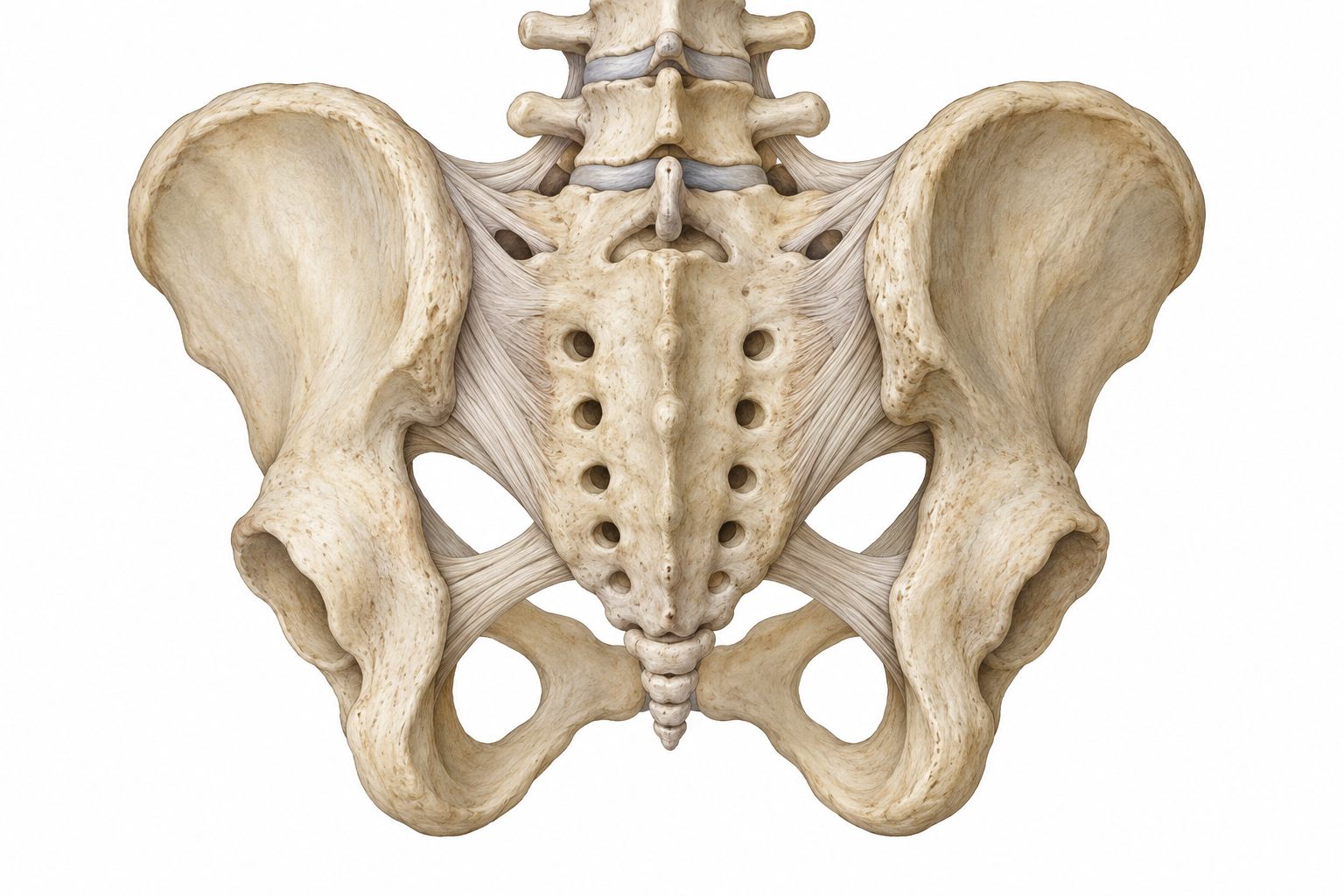
Posterior view of the pelvis. The sacroiliac joint lies between the sacrum in the middle and the ilium bones on either side. AI-generated medical illustration
How Is It Different from a Herniated Disc?
When a herniated lumbar disc compresses a nerve, pain and tingling extend down below the knee, often accompanied by numbness or weakness, and the symptoms worsen with coughing or bending forward. Sacroiliac joint pain, by contrast, is usually tender at one point on the back of the pelvis and often spreads to the buttock, groin, or thigh, and it may worsen when standing on one leg or turning over in bed. Because it can sometimes extend below the knee as well, the location of the pain alone does not distinguish between the two causes. (Gartenberg A et al., 2021)
During the physical exam, the clinician asks about the movement that triggered the pain and the path it spreads along, then uses provocation tests—such as the compression test, distraction test, thigh thrust test, Gaenslen's test, and FABER test—that apply force to the joint from different directions to see whether the patient's usual pain is reproduced. If several of these tests reproduce the usual pain, the sacroiliac joint becomes the leading suspect. If most of the test results are negative, a sacroiliac origin becomes less likely, and other causes are investigated. (Saueressig T et al., 2021)
The exam also checks sensation, muscle strength, and reflexes in the leg. If the abnormalities follow a nerve distribution pattern, a nerve problem is considered; if the inside of the sacroiliac joint is suspected, the clinician gives an image-guided diagnostic injection and determines the cause by checking how much the usual pain and the previously painful movements change afterward.
What Does THE WELLS Jamsil Check, and in What Order Does It Treat?
THE WELLS Jamsil first determines which is the main problem in sacroiliac joint syndrome: pain inside the joint, pain in the posterior ligaments, or muscle tension with restricted movement. The clinic compares the left-right height of the pelvis and leg length measured while lying down, examines muscle tension, and observes sitting and standing posture. It measures the resistance of the pelvic and lumbar spinal segments using Sigma spinal segment stiffness testing, and checks pelvic alignment with X-ray.
If numbness is also present, the clinic adds a nerve conduction study (NCS), guided by the distribution of the numbness and the neurological exam, to check whether a peripheral nerve problem is also involved. If a nerve problem is confirmed, treatment matched to its cause is added.
If the pain is severe and originates inside the joint, the clinic first reduces pain with a block injection that delivers medication into the sacroiliac joint under C-arm image guidance. How much the usual pain decreases after the local anesthetic injection serves as a clue for judging whether the cause lies inside the joint. Injections given for treatment purposes are used to reduce pain and inflammation, and the drug composition is set according to the purpose.(McCormick ZL et al., 2025) Sensation in the area may be dulled for a few hours after the injection, so driving should be avoided on the day of the procedure.
Once the pain comes down, the clinic corrects pelvic alignment and posture through cranial nerve relaxation correction and Sigma Tapping correction to reduce the load concentrated on one side, and compares how the leg length difference changes. Muscle soreness may occur for a day or two after the correction.
If the stretched posterior ligament keeps hurting, ultrasound-guided prolotherapy and ozone injections are used to trigger a healing response in the ligament. Among prolotherapy studies, one randomized study of patients injected inside the joint reported that pain relief lasted longer compared with steroid injection.(Kim WM et al., 2010) The area may feel stiff for several days after the injection, so exercise and alcohol should be avoided on the day of the procedure, and a doctor should be seen right away if swelling or fever develops.
If the fascia in the buttocks and lower back is tight, Winback radiofrequency therapy is used to release fascial adhesions, and manual therapy and exercise therapy balance the muscles around the pelvis to correct standing with weight shifted to one side and poor sitting posture. A meta-analysis reports that manual therapy improves functional impairment in sacroiliac joint pain.(Trager RJ et al., 2024) Muscle soreness may occur for a day or two after manual therapy, and sauna use should be avoided on the day of receiving Winback treatment.
What should you change to prevent the pain from coming back after it improves?
Even after the pain improves, you still need to adjust movements that concentrate load on one side. When standing, distribute your weight evenly between both feet. When sitting, support your body on both ischial tuberosities (sit bones) rather than leaning to one side. Alternate the shoulder you use to carry a bag, and correct the habit of sitting tilted to one side in the driver's seat.
When turning over in bed, twisting the trunk first and letting the pelvis follow afterward twists the joint, so roll the shoulders and pelvis together as one unit. Keep doing the pelvic muscle exercises you learned in physical therapy, adjusting them according to how your pain responds.
If pain continues at night or morning stiffness lasts a long time, inflammatory arthritis needs to be ruled out, and if fever develops, infection needs to be ruled out. New numbness or weakness in the leg, or pain that suddenly worsens after a fall, are changes that call for seeing a doctor again.(Gartenberg A et al., 2021)
References
- Cohen SP, Chen Y, Neufeld NJ (2013). Sacroiliac joint pain: a comprehensive review of epidemiology, diagnosis and treatment.. Expert Rev Neurother. PMID: 23253394
- Gartenberg A, Nessim A, Cho W (2021). Sacroiliac joint dysfunction: pathophysiology, diagnosis, and treatment.. Eur Spine J. PMID: 34272605
- Saueressig T, Owen PJ, Diemer F (2021). Diagnostic Accuracy of Clusters of Pain Provocation Tests for Detecting Sacroiliac Joint Pain: Systematic Review With Meta-analysis.. J Orthop Sports Phys Ther. PMID: 34210160
- McCormick ZL, Hurley RW, Anitescu M (2025). Consensus practice guidelines on sacroiliac joint complex pain from a multispecialty, international working group.. Pain Med. PMID: 41318933
- Kim WM, Lee HG, Jeong CW (2010). A randomized controlled trial of intra-articular prolotherapy versus steroid injection for sacroiliac joint pain.. J Altern Complement Med. PMID: 21138388
- Trager RJ, Baumann AN, Rogers H (2024). Efficacy of manual therapy for sacroiliac joint pain syndrome: a systematic review and meta-analysis of randomized controlled trials.. J Man Manip Ther. PMID: 38353102
Frequently Asked Questions
Q. If pelvic pain and leg numbness occur together, could two different causes be overlapping?
Sacroiliac joint pain and a problem with the lumbar nerves or peripheral nerves can occur at the same time. Your doctor will ask when the pelvic pain and numbness each began and which movements make them worse, then check sensation and muscle strength, and use a nerve conduction study if needed to distinguish between the two.
Q. If the X-ray is normal, do I need further tests?
Even when an X-ray shows no abnormality in the bone, the sacroiliac joint and its ligaments can still be a source of pain. If provocation tests and a neurological exam point to the inside of the sacroiliac joint, an image-guided diagnostic injection can help confirm the cause by checking whether the pain changes afterward.
Q. If pain decreases after a diagnostic injection, is the cause confirmed?
A marked reduction in the usual pain supports the likelihood that the inside of the injected joint is the source. To decide on the next treatment, the degree of pain reduction, how long the relief lasts, and whether movements that used to hurt have become easier are checked together with the exam findings.
Q. How should I adjust exercise intensity when pain persists?
If pain clearly worsens during exercise, or if the worsening continues even after exercise, reduce the intensity and range of motion of that movement. Start with gentle movements that don't cause pain, and if you newly develop leg weakness or numbness, stop exercising and see a doctor.