
Last updated: October 22, 2026
My Jaw Clicks When I Open My Mouth, and the Front of My Jaw Feels Hot
If your jaw clicks when you open your mouth and the jaw on the same side feels tight or hot, it is worth looking into temporomandibular disorder (TMD), in which pain develops in the chewing muscles and the jaw joint. Quite a few office workers hear a click in front of the right ear when they yawn in the morning or take a big bite of a hamburger, and then, by the afternoon, are bothered by a stiff, pulling feeling and a sense of heat in the jaw on the same side.
Temporomandibular disorder is an umbrella term for a group of conditions that cause pain and dysfunction in the masticatory muscles, which we use to chew food, and in the temporomandibular joint (TMJ) itself (List Thomas et al., 2017). The temporomandibular joint sits just in front of each ear and connects the lower jawbone to the skull, acting as a lever when you speak or chew. Inside this joint, an articular disc sits between the head of the mandible and the skull, absorbing shock and helping the joint move smoothly.
When the articular disc sits further forward than usual and then, partway through opening the mouth, regains its normal position relative to the head of the mandible, a click is heard in front of the ear. This condition is called disc displacement with reduction (Naeije M et al., 2013). Besides the joint sound, when the masseter or temporalis, the muscles that generate force when you chew, or the tissues around the jaw joint become overloaded and painful, patients often describe the front of the jaw or the area around the cheek as feeling tight or hot.
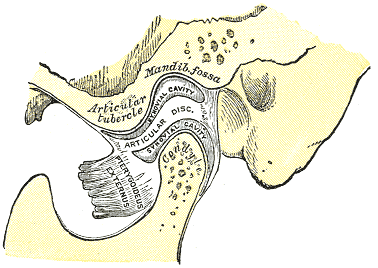 Cross-section of the temporomandibular joint viewed from the side. The articular disc sits between the head of the mandible (mandibular condyle) and the socket in the skull (Henry Vandyke Carter, Public domain)
If There Is Only a Sound and No Pain, Can I Just Leave It Alone?
When the joint only makes a sound as the mouth opens, without pain or a feeling that the jaw catches, we watch how it progresses rather than starting active treatment right away. A meta-analysis of studies in the general population estimated the prevalence of intra-articular temporomandibular disorders in adults at 31.1%, and the prevalence of disc displacement with reduction, the type that makes a sound when the mouth opens, at 25.9% (Valesan Lígia Figueiredo et al., 2021). Another systematic review also shows that disc displacement is common enough to be reported in 18–35% of the general population. In particular, disc displacement with reduction generally does not worsen significantly and follows a stable natural course when it is not accompanied by pain (Naeije M et al., 2013).
In some people, however, the condition progresses to a non-reducing state, in which the forward-displaced disc no longer returns to its place even when the mouth opens. At this stage, some people experience limited mouth opening, in which the mouth no longer opens as wide as before. Pain from this kind of disc displacement, or locking in which the jaw catches, also tends to ease gradually over several months, but whether to seek care depends on how much discomfort it causes in daily life. So we decide whether to treat a temporomandibular disorder based not simply on whether there is a sound, but on whether there is pain, whether chewing is uncomfortable, and whether limited mouth opening gets in the way of daily life.
If your mouth suddenly will not close, or will not open wide enough to fit even one finger, you need to see a doctor promptly, without delay. If the area under the jaw or in front of the ear swells noticeably and you also have a fever, it needs prompt evaluation to determine whether this is an infection rather than a joint problem. In addition, if you suddenly lose sensation in your face or one side of your face becomes weak, emergency evaluation is needed to distinguish conditions such as a central nervous system disorder.
If My Jaw Hurts, Why Do You Also Check My Upper Neck?
When we examine patients who come in because one side of the jaw feels tight and painful, we also check the movement and tension of the upper neck, because the jaw and neck are anatomically and neurologically interlocked in how they move. The jaw joint rotates near the upper cervical spine, which is made up of the first cervical vertebra, the atlas (C1), which supports the skull, and the second cervical vertebra, the axis (C2). When you open your mouth wide, not only does the lower jawbone move down, but the head and neck also tilt back slightly. For this reason, when the bite is misaligned, the force on the cervical spine during jaw movement goes off balance, so the cervical spine can be compressed and the space the nerves pass through can narrow.
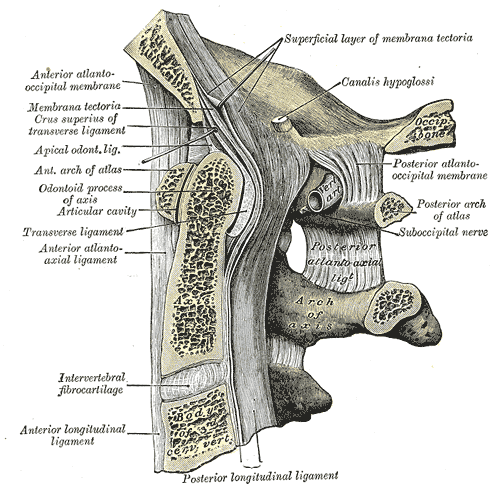 A midsagittal section through the base of the skull and the first and second cervical vertebrae (the atlas, C1, and the axis, C2). The joints and ligaments of the upper cervical spine that support the weight of the head are concentrated here (Henry Vandyke Carter, Public domain)
Because the movements of the jaw and neck are connected in this way, when the muscles of both the jaw and the neck tense up together, opening the mouth or turning the head feels stiff and uncomfortable. In terms of nerve pathways, too, sensory information from the jaw joint and the chewing muscles is carried by the trigeminal nerve, a cranial nerve. Signals from this trigeminal nerve system and sensory signals rising from the upper cervical spine meet and interact in neural circuits of the brainstem and upper spinal cord. On top of this, when jaw joint pain lasts a long time, a process in which the central nervous system becomes sensitized and amplifies the pain signals it receives may be involved (List Thomas et al., 2017).
Because the neural circuits are connected and the muscles move together in this way, people with temporomandibular disorder commonly experience not only discomfort around the jaw but also headaches in the temple area and aching pain in the back of the neck and shoulders.
Does Your Mouth Open as Wide as Three Fingers?
A common way to gauge how far your mouth opens on your own is to stack three of your fingers vertically and place them in your mouth. Finger thickness varies from person to person, though, so this serves only as a rough reference. Following the international diagnostic criteria, DC/TMD, we take a detailed history of your symptoms and perform a standardized physical examination to check the condition of the jaw joint. In a validation study of adult patients, DC/TMD showed high performance in diagnosing common painful temporomandibular disorders, with a sensitivity of 0.86 or higher and a specificity of 0.98 or higher (Schiffman Eric et al., 2014).
When we examine how wide the mouth opens, we measure the distance between the upper and lower front teeth precisely, in millimeters. Under the DC/TMD criteria, disc displacement without reduction with limited opening is classified by whether the assisted maximum opening is less than 40mm. Assisted maximum opening is the value measured when the clinician opens the mouth a little further by hand, and it includes the vertical overlap of the front teeth. Along with this, we watch which way the lower jaw deviates as you slowly open and close your mouth and at what point during opening the joint makes a sound, and we press on the masseter, the temporalis, and the jaw joint area with steady pressure to check whether the pulling or hot pain you usually feel appears in the same way.
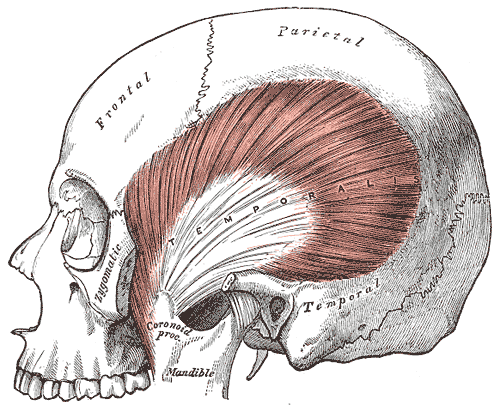 The temporalis muscle fans out over the temple. It attaches to a bony projection at the front of the lower jawbone and works as a chewing muscle that generates force when closing the mouth (drawn with the zygomatic arch and masseter removed) (Henry Vandyke Carter, Public domain)
At THE WELLS, we take X-rays of the jaw joint and cervical spine and closely examine jaw movement and the bite, and a neurologist personally assesses the alignment of the jaw joint and the upper cervical spine where their axis has shifted. A dull ache in front of the ear and behind the cheek, with pain that changes in intensity when you chew food or open your mouth, is an important clue that points to a temporomandibular disorder. By contrast, if a particular tooth is sensitive to cold water or sweets and hurts when tapped, dental care comes first. If ear fullness or hearing loss comes with ear discharge or fever, you should have your ear examined first, and if brief, sharp pain that feels like an electric shock keeps recurring with even light skin stimulation, such as washing your face or brushing your teeth, trigeminal neuralgia needs to be distinguished.
How Does TMJ Manual Therapy Relax the Jaw and Neck?
When the jaw joint hurts, THE WELLS provides TMJ manual therapy based on the results of the evaluation described above. TMJ manual therapy is a treatment in which the director personally eases excessive tension in the muscles around the jaw by hand and stimulates the cranial nerves connected to the jaw joint, helping the brain recognize the body's current state anew. In this way, we correct sensory input and movement control around the jaw, and if the neck also has dysfunction, we perform upper cervical spine correction as well to restore balance to the misaligned axis of the jaw joint and upper cervical spine. If the fascia around the back of the neck and shoulders is tense as well, we add myofascial release therapy and focus on reducing tension in the jaw and neck and restoring comfortable movement.
A systematic review that pooled 8 randomized controlled trials in people with signs and symptoms of temporomandibular disorder reported that applying certain manual therapy techniques to the chewing muscles and the cervical spine may reduce pain and improve the range of mouth opening. However, the level of evidence differed by technique, ranging from low to high (Calixtre L B et al., 2015). In addition, a meta-analysis of 7 randomized studies in adults with muscular temporomandibular disorder found that after cervical rehabilitation interventions, jaw pain decreased in the short term and the pressure pain threshold, the pressure at which pressing on the masseter and temporalis first starts to hurt, rose (Bednarczyk Victoria et al., 2024).
In the same meta-analysis, cervical manual therapy applied alone or together with neck exercises clearly reduced pain.
References
- List Thomas, Jensen Rigmor Højland (2017). Temporomandibular disorders: Old ideas and new concepts.. Cephalalgia. PMID: 28068790
- Naeije M, Te Veldhuis A H, Te Veldhuis E C, Visscher C M, Lobbezoo F (2013). Disc displacement within the human temporomandibular joint: a systematic review of a 'noisy annoyance'.. J Oral Rehabil. PMID: 23199296
- Valesan Lígia Figueiredo, Da-Cas Cecília Doebber, Réus Jéssica Conti, Denardin Ana Cristina Scremin, Garanhani Roberto Ramos, Bonotto Daniel (2021). Prevalence of temporomandibular joint disorders: a systematic review and meta-analysis.. Clin Oral Investig. PMID: 33409693
- Schiffman Eric, Ohrbach Richard, Truelove Edmond, Look John, Anderson Gary, Goulet Jean-Paul (2014). Diagnostic Criteria for Temporomandibular Disorders (DC/TMD) for Clinical and Research Applications: recommendations of the International RDC/TMD Consortium Network* and Orofacial Pain Special Interest Group†.. J Oral Facial Pain Headache. PMID: 24482784
- Calixtre L B, Moreira R F C, Franchini G H, Alburquerque-Sendín F, Oliveira A B (2015). Manual therapy for the management of pain and limited range of motion in subjects with signs and symptoms of temporomandibular disorder: a systematic review of randomised controlled trials.. J Oral Rehabil. PMID: 26059857
- Bednarczyk Victoria, Proulx François, Paez Arsenio (2024). The effectiveness of cervical rehabilitation interventions for pain in adults with myogenic temporomandibular disorders: A systematic review and meta-analysis.. J Oral Rehabil. PMID: 38454576
Frequently Asked Questions
Q. If my mouth opens wide enough but chewing still hurts, do I need an evaluation?
If pain keeps coming back when you chew even though your mouth opens wide enough, your jaw joint and chewing muscles need to be evaluated.
Q. How many sessions of TMJ manual therapy do I need?
We decide the number of sessions based on how long the pain has lasted, how limited mouth opening is, and whether neck dysfunction is also present.
Q. If I have a temporomandibular disorder, can I also get headaches in the temple area or pain in the back of the neck?
If you have a temporomandibular disorder, headaches in the temple area and aching pain in the back of the neck and shoulders commonly come with it. This is because the trigeminal nerve system, which carries sensation from the jaw joint and the chewing muscles, and sensory signals from the upper cervical spine meet and influence each other in neural circuits of the brainstem and upper spinal cord. Along with TMJ manual therapy, THE WELLS adds upper cervical spine correction and myofascial release therapy depending on any neck dysfunction and the tension in the back of the neck and shoulders, to ease tension in the jaw and neck.
Q. If the clicking in my jaw has stopped but my mouth opens less, does that mean it is getting better?
If the clicking stops and your mouth no longer opens as wide as before, it may mean that, rather than improving, the condition has progressed to a non-reducing state in which the articular disc does not return to its place. Under the DC/TMD criteria, limited mouth opening is defined as an assisted maximum opening of less than 40mm, measured when the clinician opens the mouth a little further by hand and including the vertical overlap of the front teeth. Pain or locking from disc displacement sometimes eases gradually over several months, but if limited opening or discomfort when chewing gets in the way of daily life, you should see a doctor.