
Last updated: 2026-10-16
When Eyelid Twitching Spreads to the Cheek and Corner of the Mouth
When eyelid twitching spreads to the cheek and corner of the mouth on the same side and continues even during sleep, hemifacial spasm is the first condition to suspect. Hemifacial spasm is a condition in which the facial muscles controlled by one facial nerve contract repeatedly, regardless of the person's will (Lu A Y et al., 2014).
One office worker in their 40s began having twitching in the lower left eyelid a few months ago, and recently the cheek on the same side has started to twitch, with the corner of the mouth pulling toward the ear. Family members say the left side of this worker's face twitches even during sleep. As in this case, the spasm typically starts around the eye and, over time, tends to spread downward to the cheek, mouth area, and neck muscles under the jaw on the same side (Lu A Y et al., 2014).
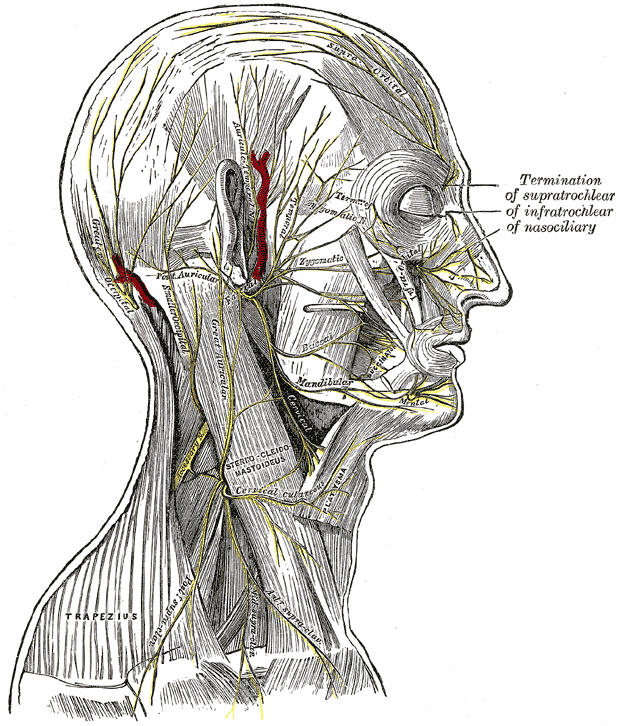 Nerves of the face and neck. Branches of the facial nerve that split in front of the ear extend to the muscles of the forehead, eye area, cheek, mouth area, and neck (Henry Vandyke Carter, Public domain)
According to the literature, the prevalence of hemifacial spasm is about 9.8 per 100,000 people, and the average age of onset is 44 (Lu A Y et al., 2014). During a spasm, a characteristic sign may appear: the eye on the twitching side closes while the eyebrow on the same side rises at the same time. Spasms become more frequent with accumulated fatigue, psychological tension, or when facial muscles move during conversation.
Fatigue-related eyelid twitching is common; it usually affects only part of the lower eyelid muscle and tends to resolve on its own within days to weeks. In contrast, when the muscles around both eyes tighten together and cause the eyes to close, this is classified separately as blepharospasm.
Why the Twitching Doesn't Stop Even During Sleep
The motor nerve fibers of the facial nerve exit the brainstem—the lower part of the brain—and extend to each region of the face, moving the facial muscles. Hemifacial spasm usually begins when a nearby artery compresses the root of the facial nerve as it emerges from the brainstem (Rosenstengel C et al., 2012). When a pulsating blood vessel presses on the nerve root, abnormal electrical signals unrelated to the person's will are generated, and these signals travel along the nerve straight to the facial muscles and make them contract.
When a cerebral blood vessel compresses the nerve in this way, the condition is classified as primary hemifacial spasm; when the facial nerve is damaged by some other cause, it is classified as secondary (Lu A Y et al., 2014). This condition is a structural problem in which electrical signals arise at the nerve root near the brainstem. Therefore, nerve stimulation continues not only while you are awake but also during sleep.
In fact, in a study that performed polysomnography on 12 patients with hemifacial spasm, facial spasms during sleep were observed in all 12 participants (Incirli S U et al., 2019). The frequency of spasms during sleep decreased compared to while awake but did not stop completely, and the patients in the study woke up an average of 5.9 times during the night, with their sleep disrupted as a result (Incirli S U et al., 2019). Based on these findings, the researchers concluded that sleep quality should also be assessed when treating these patients (Incirli S U et al., 2019).
If the Twitching Side of the Face Feels Weak or the Ear Feels Blocked
Even without vascular compression, a tumor, or facial nerve damage that remains after recovery from a past facial palsy, can cause secondary hemifacial spasm (Lu A Y et al., 2014). In particular, during recovery from facial palsy, damaged nerve fibers may regenerate and connect to muscles different from their original targets, which can produce synkinesis, in which the eye closes along with movements of the mouth.
If facial twitching is accompanied by weakness or dulled skin sensation on the same side of the face, or by a blocked feeling in one ear with dizziness, prompt medical evaluation is needed to look for other neurological causes. If the spasm does not stay on one side but appears on both sides of the face together, other facial movement disorders must be ruled out as well.
According to the diagnostic literature, clinical neurological examination is combined with electromyography (EMG) to confirm abnormal signal transmission in the facial nerve and distinguish it from other facial movement disorders (Lu A Y et al., 2014). MRI is also used to evaluate whether a blood vessel is compressing the facial nerve root near the brainstem, or whether some other structural cause is compressing the nerve (Lu A Y et al., 2014).
Can Hemifacial Spasm Stop and Then Come Back?
Once hemifacial spasm begins, it generally becomes a chronic condition, and spontaneous resolution without treatment is rare. The medical literature describes botulinum toxin injection as the standard symptom-control treatment for hemifacial spasm (Rosenstengel C et al., 2012). According to this literature, 85-95% of patients showed moderate or greater improvement in symptoms after botulinum toxin injection (Rosenstengel C et al., 2012). However, as the injection's effect wears off over time, muscle contraction reappears, so repeat treatment is generally needed at 3-4 month intervals (Rosenstengel C et al., 2012). In other words, if twitching reappears after injection treatment, this can be understood as the effect simply wearing off rather than the condition itself newly recurring.
Microvascular decompression surgery, by contrast, is a surgical treatment that relieves compression by separating the blood vessel pressing on the facial nerve root near the brainstem from the nerve (Lu A Y et al., 2014). A meta-analysis combining 6,249 patients from 39 studies found that 90.5% of all patients showed resolution of spasm at an average follow-up of 1.25 years after microvascular decompression, and patients undergoing their first surgery were more likely to achieve spasm resolution than those undergoing repeat surgery (Holste K et al., 2020).
An analysis of 1,105 patients whose spasm initially resolved after microvascular decompression found recurrence in 64 patients, or 5.7% (Menna G et al., 2022). The same analysis showed that a shorter duration of symptoms before surgery was associated with lower recurrence, while recurrence was more common when the lateral spread response—an abnormal signal on electromyography—remained present immediately after surgery (Menna G et al., 2022).
What Treatments Does THE WELLS Jamsil Offer?
At THE WELLS Jamsil, a neurologist examines each patient with hemifacial spasm in person to assess how far the symptoms extend and whether there are accompanying neurological signs. Along with the examination, we take X-rays of the temporomandibular joint (TMJ) and cervical spine to check the balance of the jaw joint and the alignment of the upper cervical spine, which supports the head.
Anatomically, the facial nerve exits the brainstem, passes through a small opening at the base of the skull, travels past the parotid gland just behind the temporomandibular joint, and then branches out to the facial muscles. In addition, the muscles that move the jaw and bite down are controlled by the motor fibers of the trigeminal nerve, one of the cranial nerves. The upper cervical spine—the first and second cervical vertebrae—sits at the junction where the skull meets the neck, placing it in close contact with the surrounding muscles and nervous system.
One observational study examined the relationship between jaw-use habits and facial spasm. It found that patients with hemifacial spasm clenched their teeth more often than the control group, and in both groups, stress was associated with the occurrence of teeth grinding (Ella B et al., 2017). This suggests that the discomfort and tension caused by repeated twitching on one side of the face may be linked to excessive contraction of the muscles around the jaw.
Accordingly, at THE WELLS Jamsil we perform TMJ cranial nerve manual therapy, which releases abnormal tension in the muscles around the jaw directly by hand. TMJ cranial nerve manual therapy stimulates the cranial nerves connected to the jaw to calm overexcitation of the nervous system. Alongside it, we also provide corrective treatment that realigns a misaligned upper cervical spine by hand.
Jumin Kim · Medical Director · THE WELLS Jamsil
References
- Lu A Y, Yeung J T, Gerrard J L, Michaelides E M, Sekula R F Jr, Bulsara K R (2014). Hemifacial spasm and neurovascular compression.. ScientificWorldJournal. PMID: 25405219
- Rosenstengel C, Matthes M, Baldauf J, Fleck S, Schroeder H (2012). Hemifacial spasm: conservative and surgical treatment options.. Dtsch Arztebl Int. PMID: 23264807
- Incirli S U, Yilmaz R, Akbostanci M C (2019). Hemifacial spasm in sleep - A polysomnographic study.. J Clin Neurosci. PMID: 30902436
- Holste K, Sahyouni R, Teton Z, Chan A Y, Englot D J, Rolston J D (2020). Spasm Freedom Following Microvascular Decompression for Hemifacial Spasm: Systematic Review and Meta-Analysis.. World Neurosurg. PMID: 32305605
- Menna G, Battistelli M, Rapisarda A, Izzo A, D'Ercole M, Olivi A, Montano N (2022). Factors Related to Hemifacial Spasm Recurrence in Patients Undergoing Microvascular Decompression-A Systematic Review and Meta-Analysis.. Brain Sci. PMID: 35624968
- Ella B, Guillaud E, Langbour N, Guehl D, Burbaud P (2017). Prevalence of Bruxism in Hemifacial-Spasm Patients.. J Prosthodont. PMID: 26588188
Frequently Asked Questions
Q. If eyelid twitching spreads to the cheek and corner of the mouth, which department should I see?
Start by having a neurologist examine your facial movements and any accompanying neurological symptoms. Before your appointment, write down where the twitching first started and the order in which it spread, and prepare a short video recorded while the spasm is occurring — this will help when you describe your symptoms to the doctor.
Q. What should I record before my appointment if the twitching comes back after treatment?
Record the date of your injection or surgery, how long the spasms eased, and the date and location where the twitching started again. After an injection, it helps to describe how long the effect lasted; after surgery, it helps to make clear whether the spasm stayed the whole time or disappeared for a while and then came back.
Q. What symptoms besides facial spasm should I report when receiving treatment for the jaw joint and upper cervical spine?
Also describe any teeth-clenching habit, pain when you move your jaw, and neck stiffness or restricted neck movement. When recording how treatment progresses, separating changes in facial spasm frequency from changes in jaw and neck discomfort helps you compare how each symptom shifts over time.