
Last updated: 2026-09-11
If your lower eyelid has been twitching for weeks and magnesium hasn't helped
If eyelid twitching that started during a stretch of late nights is still present after three weeks — even after a weekend of rest and taking magnesium — it makes more sense to see a doctor and identify the cause than to keep supplementing.
The key factors are not how long the twitching has lasted, but the extent of the movement, how much the eye closes, and whether it affects one or both sides. Whether only a small part of the eyelid moves subtly, whether the movement extends to the same side of the face, or whether both eyes close involuntarily and become hard to open — these details determine which condition may be involved and what the next step should be.
Whether magnesium seems to help is not, by itself, a reliable way to determine if you have a deficiency. Understanding the actual pattern of movement and the circumstances around when the symptom began is necessary to identify the cause.
How is fatigue-related eyelid twitching different from hemifacial spasm or blepharospasm?
Benign eyelid myokymia (involuntary rippling movement of the eyelid) usually involves a small area of the lower eyelid on one side twitching in a wave-like pattern. Even though the twitching sensation can be bothersome, it is distinct from a strong, forceful contraction of the entire eyelid that closes the eye. If the twitching is confined to the lower eyelid and the ability to open the eye is unaffected, this pattern is more consistent with benign, fatigue-related twitching.
Fatigue, lack of sleep, caffeine intake, and stress are associated with this type of twitching. It's worth checking whether the onset of symptoms overlaps with a period of insufficient sleep or increased coffee intake. Whether your eyes feel tired or dry after long periods of screen use is also relevant.
Hemifacial spasm is a condition in which the facial muscles controlled by one facial nerve contract involuntarily. An important clue is when movement that begins around the eye spreads to the cheek and corner of the mouth on the same side. Compression of a blood vessel near the facial nerve is a common associated finding, and this condition needs to be distinguished from other causes of one-sided facial spasm (Yaltho TC et al., 2011).
Even with hemifacial spasm, movement may initially appear only around the eye, and the rate at which it spreads to the lower face can vary between individuals. So even when the twitching is limited to under one eye, it's important to assess whether it involves a narrow area of fine twitching or a more pronounced contraction around the eye, and whether the affected area changes over time.
Blepharospasm is a focal dystonia (involuntary muscle contraction affecting a specific body region) that usually develops in adulthood, and centers on repeated contraction of the muscles around both eyes, causing the eyes to close involuntarily (Defazio G et al., 2017). This goes beyond a bothersome twitch — it can become difficult to open and keep the eyes open. It's also worth checking for increased light sensitivity and whether frequent eye closure interferes with reading or driving. If you find your eyes closing involuntarily while driving, you should stop driving and get evaluated.
Medications you're taking are also relevant to interpreting the symptom. Eyelid myokymia has been reported in patients taking topiramate for migraine treatment, so it's worth noting whether the twitching began around the time the medication was started or changed (Medrano-Martínez V et al., 2015). If you are taking this medication, discuss your symptoms with the prescribing doctor and decide together whether a change is needed.
If the movement stays limited to a subtle eyelid twitch and the ability to open the eye is preserved, it may be reasonable to monitor the symptom while adjusting triggering factors. If facial muscles contract noticeably or the eye becomes difficult to open, don't wait several weeks — get evaluated.
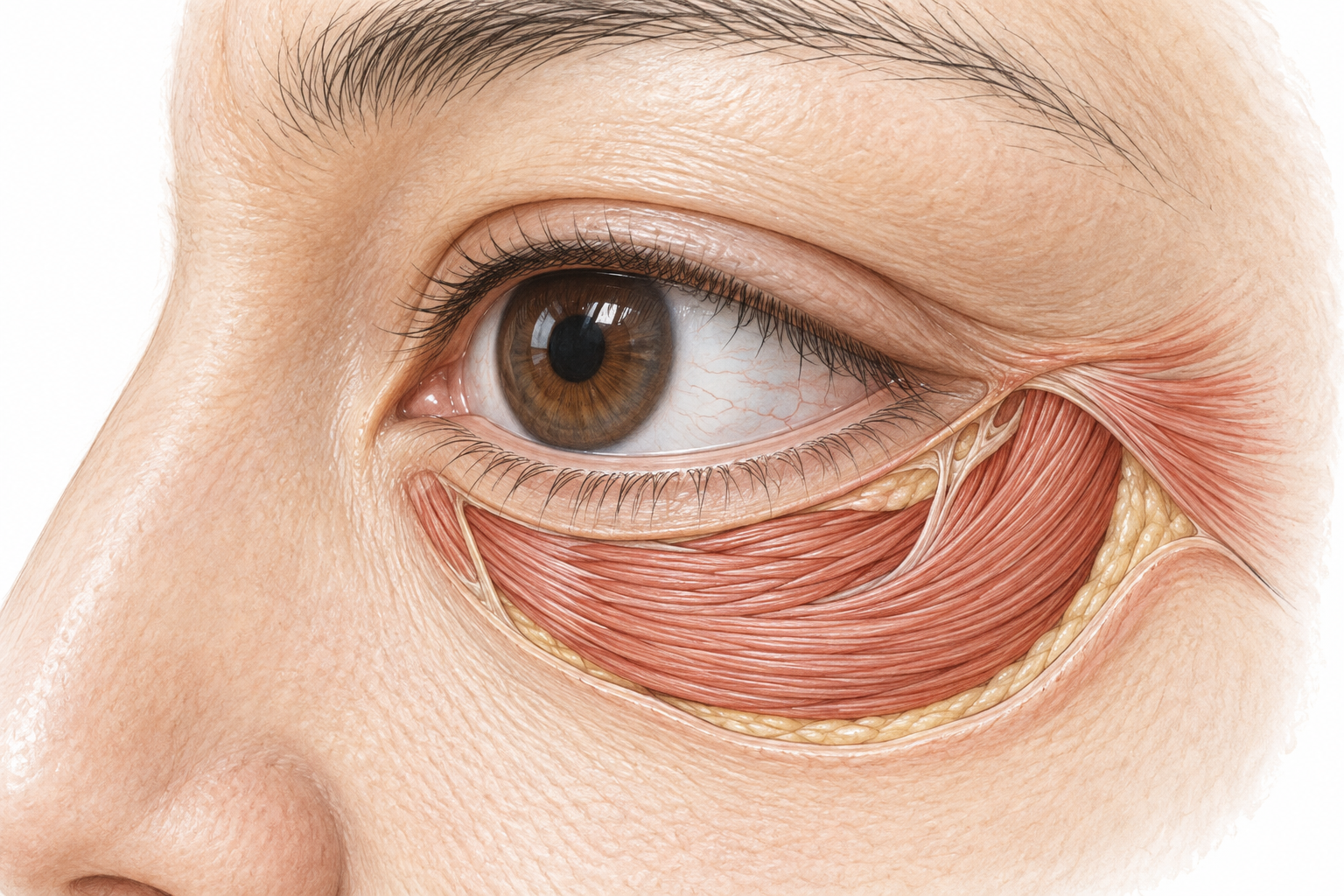
Location of the orbicularis oculi muscle surrounding the eyelid and eye area. AI-generated medical illustration
How are the neck and jaw related to eyelid twitching?
At The Wells Jamsil, before the neurological exam, we ask about when the symptom first started and what your sleep, workload, and caffeine intake were like at that time, as well as when any medications were started or changed. Whether the twitching is constant or intermittent, and what circumstances make it worse, are also clues for interpreting the movement pattern.
Because the twitching often stops by the time you're in the exam room, a video showing the whole face while the twitching is happening can help assess the extent of the movement. Facial muscle strength, sensation, and eye movements are also examined to assess nerve function.
Sudden facial paralysis, double vision, slurred speech, difficulty swallowing, or a sudden and severe headache are not symptoms to wait out until your next scheduled visit. Even if you've had eyelid twitching for a while, if any of these new symptoms appear, seek care that same day.
At The Wells Jamsil, we also examine upper cervical spine and jaw joint alignment along with muscle tension around the base of the skull. The spinal nucleus of the trigeminal nerve, which carries facial sensation, extends down to the upper cervical spine level, and the facial nerve, which controls the muscles around the eye, passes through the base of the skull before reaching the face. We check whether neck and jaw discomfort and muscle tension are present in this area to help determine the treatment plan. Autonomic nervous system (HRV) mapping is also used to assess autonomic responses.
When hemifacial spasm is suspected, imaging is used to check whether a blood vessel is compressing the nerve. Because certain movement disorders caused by other conditions, such as facial nerve damage, can resemble one-sided facial spasm, findings that deviate from the typical pattern also need to be identified (Yaltho TC et al., 2011). Triggering factors are adjusted based on the pattern of twitching observed during the exam. If neck and jaw tension is present, manual therapy may be used to correct upper cervical spine and jaw joint alignment and release tight muscles.
How is treatment approached?
For fatigue-related benign twitching, treatment starts with addressing identified triggering factors. If sleep has been insufficient, prioritize getting enough rest; if caffeine intake has increased, cut back; if screen time is long, build in breaks to rest the eyes. If eye surface irritation or dryness is found, that issue is treated directly. Magnesium is supplemented only when an actual deficiency has been confirmed.
For symptom management of hemifacial spasm and blepharospasm, botulinum toxin injections and medication are recognized as standard treatments (Defazio G et al., 2017).
For eyelid twitching lasting several weeks or longer, if neck and jaw tension is also found, The Wells Jamsil addresses this tension as the first line of treatment. Using Sigma computerized alignment equipment, we measure the facial skeleton and jaw joint/upper cervical spine status, then perform gentle percussive alignment, combined in the same session with manual jaw joint and cranial nerve therapy to release tight muscles at the base of the skull and neck. For patients where autonomic mapping and history suggest autonomic regulation issues, or where sleep deprivation or stress recurs alongside the twitching, a Nerve Spa program is added. Autonomic balance, nerve circulation/lymphatic care, neck-shoulder pain reset, and TMS brain care stages are individually tailored based on exam findings.
What if the twitching stops and then comes back?
Fatigue-related twitching usually resolves within days to weeks with adequate sleep and reduced caffeine, and it's common for it to recur during periods of late nights or exam stress — this is consistent with the same underlying pattern. Comparing how sleep, workload, caffeine intake, and medications changed between the period when symptoms were absent and when they returned can reveal the recurring trigger.
If the twitching returns with a wider extent — spreading to the cheek or mouth — or if the eye closes involuntarily, or if one side of the face becomes weak, this represents a different symptom pattern than before and needs a new evaluation.
If lack of sleep or stress keeps recurring, those triggering factors are addressed together. At The Wells Jamsil, when twitching recurs, we assess neck and jaw tension along with sleep status, and adjust manual therapy and Nerve Spa programs as needed.
References
- Yaltho TC, Jankovic J (2011). The many faces of hemifacial spasm: differential diagnosis of unilateral facial spasms. Mov Disord. PMID: 21469208
- Defazio G, Hallett M, Jinnah HA (2017). Blepharospasm 40 years later. Mov Disord. PMID: 28186662
- Medrano-Martínez V, Pérez-Sempere A, Moltó-Jordá JM (2015). Eyelid myokymia in patients with migraine taking topiramate. Acta Neurol Scand. PMID: 25828425
Frequently Asked Questions
Q. Does everyone with eyelid twitching need to be tested for magnesium deficiency?
Not everyone with eyelid twitching needs a magnesium test. Testing is appropriate when there is a poor diet or accompanying symptoms/medications that raise suspicion of a deficiency.
Q. If eyelid twitching started after changing medication, should I stop taking it?
Even if the timing of a medication change lines up closely with when the twitching started, this does not necessarily mean the medication caused it. Don't stop the medication or reduce the dose on your own — inform the prescribing doctor of the medication name and the date it was changed, and discuss together whether a change in type or dosage is needed.
Q. Is it safe to keep driving while my eyes are closing involuntarily?
If your eyes are closing involuntarily and you're having trouble maintaining your field of vision, you should not continue driving. If symptoms occur while driving, pull over safely, and only resume driving once the symptoms are controlled and you've confirmed you can open and keep your eyes open.