
Last updated: 2026-10-15
What Does the NK Cell Activity Number on Your Test Report Measure?
If an unfamiliar number on your NK cell activity test report is bothering you, start by understanding that this value represents the amount of interferon-gamma released when the blood drawn from you is stimulated. When a checkup shows no particular problems but fatigue just won't go away, an office worker in their 40s might get an additional blood test and, faced with a number they have never seen before on the report, naturally wonder what it means.
NK (natural killer) cells are lymphocytes responsible for innate immunity in the body (Lee S B et al., 2014). They can recognize and eliminate virus-infected cells even without prior exposure to the same pathogen. In doing so, NK cells release interferon-gamma, a signaling molecule that promotes the response of nearby immune cells.
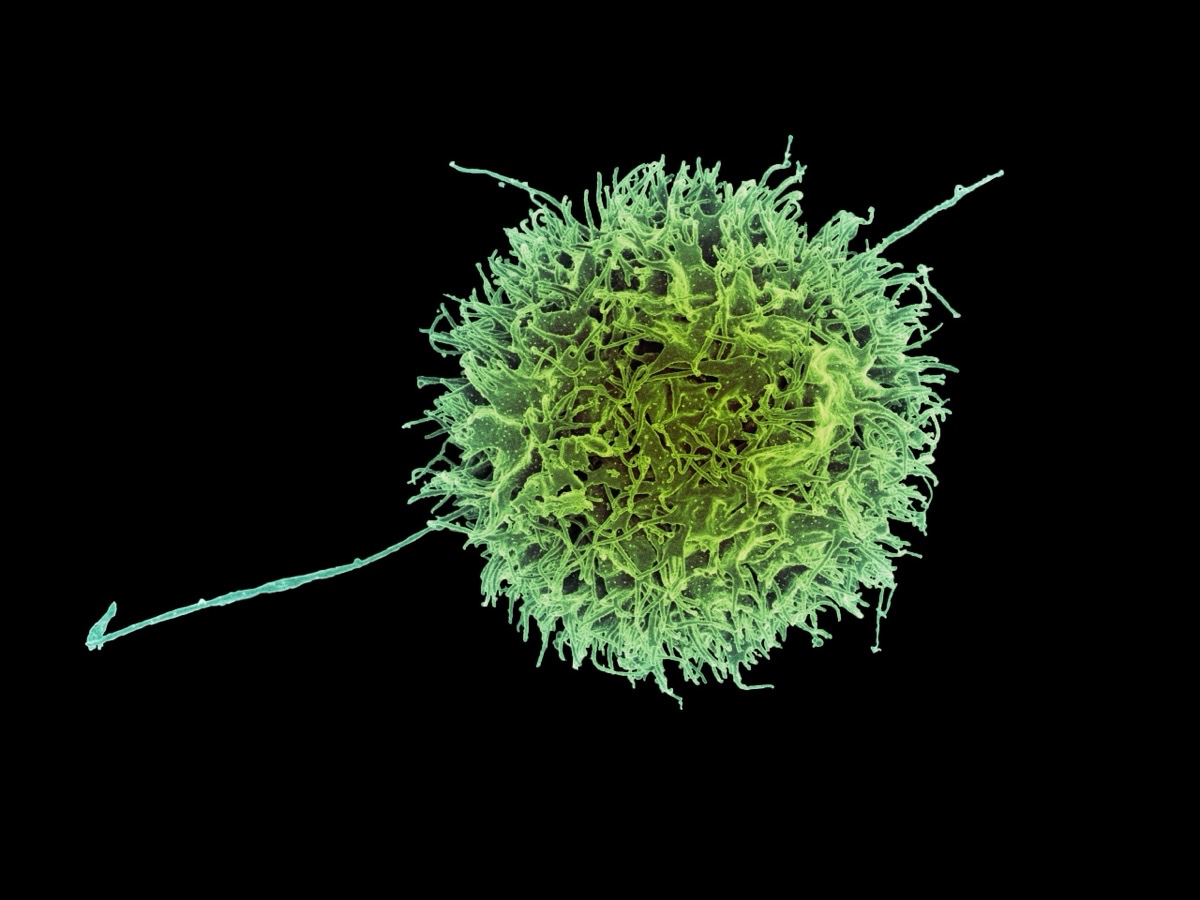 Colorized scanning electron microscope image of an NK cell obtained from human blood (NIAID, Wikimedia Commons, CC BY 2.0)
So, within the same testing method, a higher number on the report means a larger interferon-gamma release response to stimulation, while a lower value means a relatively smaller response. The test doesn't simply count how many cells are present in the blood; it measures how actively those cells actually release signaling molecules when stimulated.
A Test That Activates NK Cells in Drawn Blood and Measures Their Response
Conventional NK cell function tests used in the past required a complicated process of separating mononuclear cells or NK cells from the blood. Some of these earlier methods also used radioactive isotopes to check the cells' response.
The whole-blood stimulation method, by contrast, uses the entire drawn blood sample as is, culturing it outside the body together with an NK cell stimulant. The amount of interferon-gamma secreted into the blood after stimulation is then measured using ELISA, an enzyme-linked immunosorbent assay (Lee S B et al., 2014). Using whole blood this way cuts down on the cumbersome cell-separation process, making it easier to test many samples at once. At THE WELLS Nowon, we also quantify interferon-gamma secretion after the blood draw when we test NK cell activity.
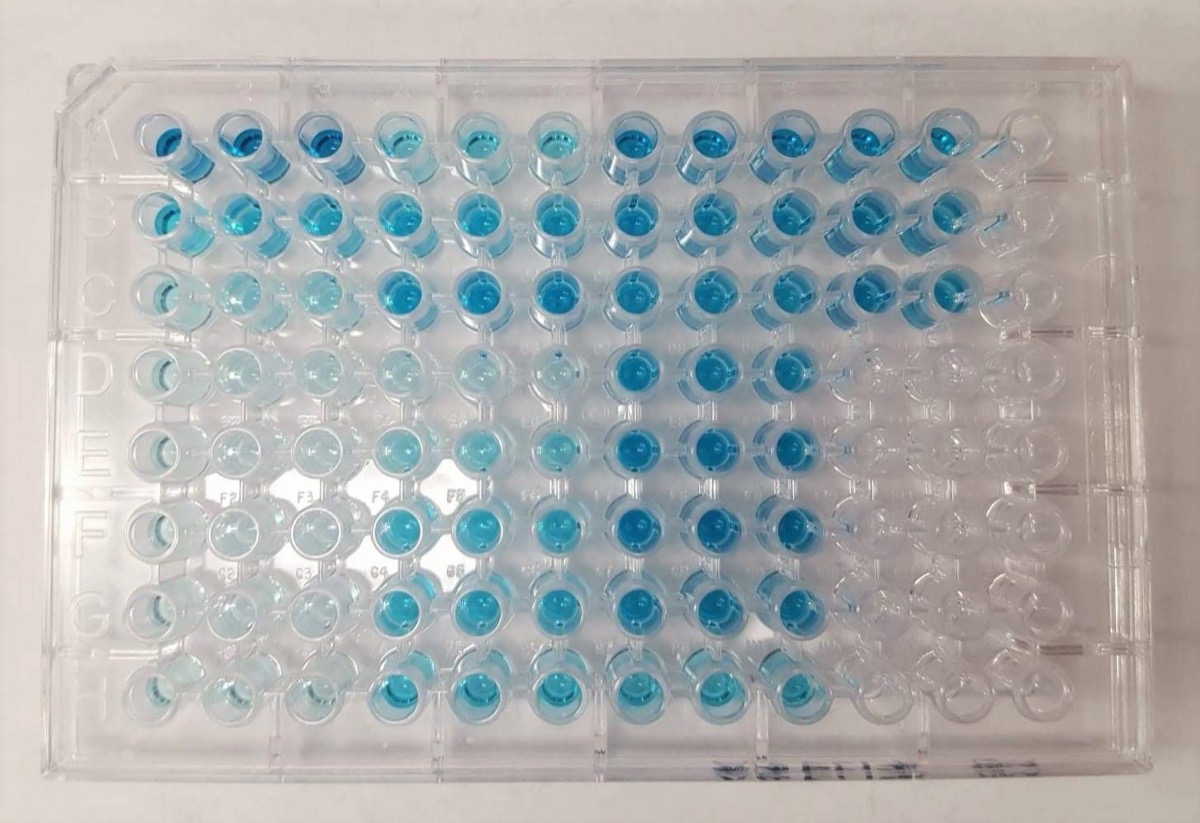 A test plate used for enzyme-linked immunosorbent assay (ELISA). The darker the blue in a well, the greater the amount of substance captured (Ajpolino, Wikimedia Commons, CC0)
Meanwhile, one study recruited 106 healthy Korean adults and analyzed their lymphocyte subtypes. In this study, no clear association was found between participants' blood NK cell counts and their activity as assessed by interferon-gamma secretion (Kim B R et al., 2019).
Why the Numbers Vary So Widely Even Among Healthy People
In the study that measured 106 healthy Korean adults, NK cell activity varied widely from person to person even among those with no particular illness (Kim B R et al., 2019). In the same study, female participants showed higher NK cell activity than male participants, and participants with a higher neutrophil-to-lymphocyte ratio in their white blood cell makeup had lower NK cell activity. NK cell activity also differed depending on the range of CRP (C-reactive protein), a marker that reflects inflammatory response.
Because baseline values vary so widely from person to person, it's more useful to follow your own changes over time than to simply compare your numbers with someone else's. In fact, in a study that tested 45 healthy women twice, about a month apart, the differences between individuals were so large that between-person comparisons and within-person change analyses produced different results (Shakhar K et al., 2007). When the same study tracked changes within each individual, NK cell activity rose markedly as sleep increased and fatigue decreased.
Blood Drawn During a Week of Poor Sleep May Show Lower Values
How you slept right before a blood draw, along with everyday stress, also directly affects the results. In a study of 42 healthy men, NK cell activity decreased the day after sleep was restricted to the hours between 10 p.m. and 3 a.m. (Irwin M et al., 1996). However, in the same study, after participants got a full night of recovery sleep and were measured again, NK cell activity returned to the level seen before the sleep restriction. Another study, of 36 healthy adults, also found that when participants slept less than 7 hours the previous night, NK cell activity was 30% lower than when they had slept 7–9 hours (Fondell E et al., 2011).
Sustained psychological or environmental strain also lowers the responsiveness of immune cells. A study examining the stress of unemployment found that, while unemployment continued, participants' NK cells had a lower ability to eliminate target cells than those of employed individuals (Cohen F et al., 2007). In the same study, though, once participants successfully found new jobs, their ability to eliminate target cells rose again from its level during unemployment. The figures reported in these sleep and stress studies come from each study's own NK cell function assay.
Interpreting the immune response captured at the time of a blood draw also requires knowing what infection, if any, you recently had and when you recovered from it. If a fever lasts for several days or infections keep recurring, we do not write it off as a simple dip in your condition; we examine you to find the cause and decide whether further testing is needed.
How Does THE WELLS Nowon Use a Low Result?
At THE WELLS Nowon, we use NK cell activity testing as a diagnostic item in our anti-aging and chronic fatigue program, which includes nutrient IV therapy and NAD+ IV therapy. The program mainly serves people in their 40s to 60s whose fatigue persists even when general test results come back normal. People who often catch colds or develop shingles and worry about their immune status, and those who felt that the changes after a previous garlic injection or vitamin injection lasted only a short time, are also candidates for a consultation about the program.
Once the diagnostic results are in, we design a combination of vitamins, minerals, and amino acids tailored to each person's condition. In particular, when the report shows low NK cell activity, we adjust the IV formula by adding immune-boosting ingredients. The basic schedule is a customized vitamin IV once or twice a week and an NAD+ IV once every two weeks. On top of that, we adjust each person's IV management schedule based on their NK cell activity result.
The attending medical team first reviews your underlying conditions, current medications, and liver and kidney function, then adjusts the formula and infusion rate within a safe range.
Sungjin Park · Medical Director · THE WELLS Nowon
References
- Lee S B, Cha J, Kim I K, Yoon J C, Lee H J (2014). A high-throughput assay of NK cell activity in whole blood and its clinical application.. Biochem Biophys Res Commun. PMID: 24561245
- Kim B R, Chun S, Cho D, Kim K H (2019). Association of neutrophil-to-lymphocyte ratio and natural killer cell activity revealed by measurement of interferon-gamma levels in a healthy population.. J Clin Lab Anal. PMID: 30105845
- Shakhar K, Valdimarsdottir H B, Guevarra J S, Bovbjerg D H (2007). Sleep, fatigue, and NK cell activity in healthy volunteers: significant relationships revealed by within subject analyses.. Brain Behav Immun. PMID: 16859893
- Irwin M, McClintick J, Costlow C, Fortner M, White J, Gillin J C (1996). Partial night sleep deprivation reduces natural killer and cellular immune responses in humans.. FASEB J. PMID: 8621064
- Fondell E, Axelsson J, Franck K, Ploner A, Lekander M, Bälter K, Gaines H (2011). Short natural sleep is associated with higher T cell and lower NK cell activities.. Brain Behav Immun. PMID: 21496482
- Cohen F, Kemeny M E, Zegans L S, Johnson P, Kearney K A, Stites D P (2007). Immune function declines with unemployment and recovers after stressor termination.. Psychosom Med. PMID: 17401058
Frequently Asked Questions
Q. Can NK cell activity results be compared with results from another testing institution?
To compare your results with those from another institution, you should first confirm whether the test method, reporting units, and reference range are the same. Preparing your previous and most recent result reports together, and noting the blood draw dates and any differences in your health at the time, helps you interpret changes in the values.
Q. What information do the medications you take provide when interpreting NK cell activity results?
The names, dosages, and duration of any medications you are taking provide information needed to understand your underlying conditions and treatment status. Also note the dates you recently started a medication or changed its dose. Rather than stopping a medication on your own in order to get retested, check the instructions for taking your medication before the test.
Q. If NK cell activity comes back high but fatigue persists, what evaluation is needed?
An evaluation needs to look at when the fatigue began, how long it has lasted, any accompanying symptoms, sleep patterns, and medications currently being taken. We also check whether earlier tests already covered things like anemia or thyroid function, and choose additional tests based on your symptoms and previous test results.
Q. Before choosing an IV, what medical history and ingredients should be checked?
Drug allergies, past adverse reactions after injections, any history of kidney or heart disease, and the medications and supplements you currently take need to be checked. We confirm the name and dose of each ingredient to be given and whether any of them overlap with medications or supplements you already take, and then set the formula and administration plan.