
Last updated: 2026-11-05
I Woke Up With a Drooping Mouth Corner and an Eye That Won't Close
If the corner of the mouth droops but forehead wrinkles still form on both sides, or if the arms and legs weaken, or speech becomes slurred, suspect stroke first and call 119 (the emergency number in Korea). If the forehead on the same side also fails to wrinkle and there are no other neurological symptoms, peripheral facial palsy is more likely, and even then you should be seen the same day. For example, an office worker in their 40s is brushing their teeth one morning and notices that the rinse water leaks from one corner of the mouth. Then, looking in the mirror, this person notices that the eye on the same side does not close fully.
As in this example, facial palsy refers to a sudden weakening or loss of movement in the facial expression muscles, extending from the forehead and around the eyes to the cheeks and mouth. The facial nerve, the seventh cranial nerve, carries commands directly from the brain to the facial muscles. Among these cases, peripheral facial palsy occurs when this facial nerve itself stops working properly.
The facial nerve starts in the brainstem, which acts as the pillar of the brain, passes through a narrow, long bony canal inside the temporal bone behind the ear, and then spreads out widely, like the branches of a tree, to the muscles of the forehead, eyelids, cheeks, and corners of the mouth. If the nerve becomes inflamed or swollen inside this narrow bony canal, the pressure has nowhere to escape and directly compresses the nerve fibers. That is why movement across one entire side of the face drops overnight. When one facial nerve suddenly becomes paralyzed, the most common diagnosis is Bell's palsy. (Baugh RF et al., 2013)
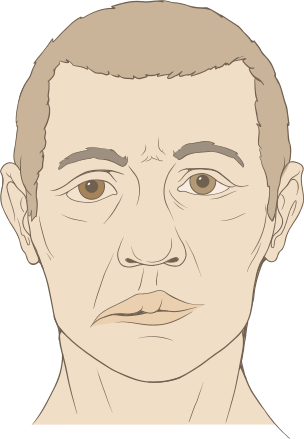 One side of the face with the corner of the mouth and the muscles around the eye drooping from Bell's palsy (Patrick J. Lynch et al., CC BY 2.5)
How Do Forehead Wrinkles and Limb Strength Help Distinguish Stroke?
Clinicians distinguish peripheral facial palsy from central facial palsy by checking whether the patient's forehead still wrinkles normally. If the lower corner of the mouth droops but both sides of the forehead still wrinkle, clinicians suspect stroke first. If the arms or legs weaken or speech becomes slurred, stop looking in the mirror and call 119 right away.
This difference arises because the nerve pathway that moves the forehead muscles receives signals from both cerebral hemispheres at the same time. Central facial palsy results from a lesion in one cerebral hemisphere, but because the opposite hemisphere still sends signals to the forehead, forehead movement is usually preserved, and only the area below the eye and around the mouth droops on one side. Peripheral facial nerve palsy, by contrast, involves damage to the facial nerve trunk after it exits the brainstem, so the route to the forehead is blocked as well. As a result, movements of the forehead, eyelid, and mouth on the same side weaken at the same time.
For this reason, when examining facial movement, clinicians ask the patient to raise the eyebrows as high as possible, close the eyes tightly, and then smile broadly while showing the teeth, comparing each movement in turn to see whether both sides move symmetrically. In the neurological examination that follows, clinicians also test strength and skin sensation in the arms and legs on both sides, the clarity of speech, any visual field loss, and balance while walking or standing, to confirm whether the problem is limited to the face. If sudden facial palsy comes with weakness or numbness in the arm and leg on one side, slurred speech, visual disturbance, severe dizziness that makes the body stagger, or a sudden severe headache that feels like being struck by a hammer, the patient should call 119 without delay and go to the emergency room.
Even when facial palsy is first noticed on waking in the morning, the patient needs emergency evaluation right away if these signs suggesting stroke are also present. When symptoms began during sleep and the exact moment of onset is unknown, the emergency treatment plan is decided based on the time the patient was last normal before falling asleep the previous night and the time the symptoms were first noticed in the morning.
However, patients should not reassure themselves just because the forehead fails to wrinkle. This is because, in rare cases, cerebral infarction (ischemic stroke) also appears as peripheral-type facial palsy, with forehead movement weakened as well. In fact, a case has been reported of a 61-year-old woman who showed only a typical peripheral-type facial palsy pattern with no other accompanying neurological symptoms, but whose brain MRI revealed a cerebral infarction.(Yan Y et al., 2026)
If Blisters Appear on the Ear, Is It Bell's Palsy or Shingles?
If there are no clues pointing to an emergency cerebrovascular condition, the next step is to distinguish whether it is Bell's palsy, which has no specific underlying cause, or a condition in which the varicella-zoster virus has invaded the nerve. Bell's palsy is acute, one-sided facial nerve paralysis of unknown cause. For this reason, clinicians diagnose it only after ruling out all other causes, such as tumor, trauma, or infection, through a detailed history and physical examination.(Baugh RF et al., 2013)
On the other hand, when small red blisters appear on the auricle or inside the mouth along with peripheral facial palsy, this is Ramsay Hunt syndrome.(Sweeney CJ et al., 2001) The geniculate ganglion, located partway along the facial nerve, lies deep within the temporal bone in very close contact with the eighth cranial nerve, which is responsible for hearing and balance. Because of this anatomical arrangement, when viral inflammation spreads to the surrounding area, it can produce not only facial paralysis but also tinnitus (ringing in the ear), hearing loss (difficulty hearing), nausea and vomiting, and dizziness that makes the world seem to spin.
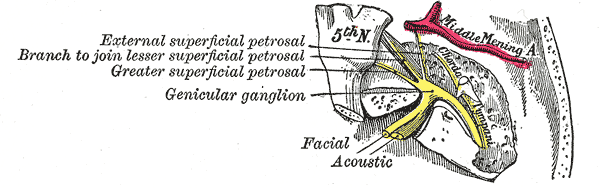 The facial nerve passing through the temporal bone. The geniculate ganglion sits at the point where the nerve bends like a knee, with the auditory nerve running alongside it just below (Henry Vandyke Carter, Public domain)
When examining the ear and mouth, clinicians check whether small blisters or a red rash are hidden in the folds of the auricle, inside the external auditory canal, or on the oral mucosa around the palate and tongue. Notably, a prospective study described in the literature found that in 14% of patients with Ramsay Hunt syndrome, the blisters appeared only after the facial paralysis had already begun.(Sweeney CJ et al., 2001) So even if there was no skin change at all at the first visit, new ear pain or small blisters appearing within the following days are an important clue for re-diagnosing the condition as shingles-related palsy.
Clinical guidelines recommend against routine blood tests and imaging for newly developed Bell's palsy.(Baugh RF et al., 2013) Clinicians diagnose typical Bell's palsy based on history and physical examination.(Baugh RF et al., 2013) If there are ear blisters, hearing loss, or atypical examination findings, clinicians decide separately whether testing is needed.
When Should Treatment Start, and With What?
Clinical practice guidelines for Bell's palsy recommend starting oral steroids within 72 hours of symptom onset for patients aged 16 or older.(Baugh RF et al., 2013) A pooled analysis of 895 patients across seven clinical trials found that the rate of incomplete recovery of facial movement 6 months after onset was 17% in the steroid group versus 28% in the control group.(Madhok VB et al., 2016)
In actual practice, clinicians first check underlying conditions, such as diabetes, in which blood sugar can rise, or gastrointestinal disease, along with the risks that come with taking the medication, before deciding whether to prescribe steroids and at what dose. Even if a patient arrives more than 72 hours after onset because of a busy schedule or because the early symptoms were mistaken for something else, clinicians evaluate the course so far and the current severity of the facial palsy and set a treatment plan that fits.
The guidelines recommend against prescribing an antiviral medication alone. They list adding an antiviral to steroids within 72 hours as an option. In a systematic review, the group that received antivirals alone showed no clear difference from the placebo group.(Gagyor I et al., 2019) In the same review, the group that received both medications together experienced fewer sequelae, such as synkinesis and crocodile tears, than the group that received steroids alone.(Gagyor I et al., 2019) Synkinesis is a symptom in which the eye closes as well when you move your mouth, and crocodile tears is a symptom in which tears flow while eating. When blisters in the ear raise suspicion of Ramsay Hunt syndrome, clinicians decide quickly whether to use an antiviral together with a steroid.
Keeping the eye that does not close safe from the very first day is just as important as taking medication.(Baugh RF et al., 2013) When the eyelid does not close all the way, the tear film cannot spread evenly with each blink. As a result, the eye's surface can dry out and the cornea can be scratched or damaged. Therefore, during waking hours, preservative-free artificial tears are applied frequently to keep the eye's surface moist. During sleep, the eye stays half open and exposed for long stretches, so the eye is protected physically in a way that suits its condition, for example by applying eye ointment before bed and keeping the eyelid closed with medical tape or something similar.
THE WELLS treats facial palsy with medication in its early stage. Our clinicians also perform TMJ cranial nerve manual therapy. In this treatment, our clinicians use their hands to release excessive tension in the muscles around the jaw and stimulate the cranial nerves connected to the temporomandibular joint (TMJ).
The facial nerve exits through an opening just behind the temporomandibular joint, passes through the parotid gland, and spreads across the face. And the trigeminal nerve is in charge of the chewing muscles and of sensation in the temporomandibular joint.
How Long Does It Take for the Face to Start Moving Again?
A Copenhagen study followed 2,570 cases of peripheral facial nerve palsy without treatment for 25 years.(Peitersen E, 2002) As a result, facial function returned within 3 weeks in 85% of patients, and in the remaining patients it returned 3 to 5 months later.(Peitersen E, 2002) Overall, 71% of patients regained normal facial expression.(Peitersen E, 2002)
Also, the point when recovery first begins, as the muscles that had stopped moving start to twitch faintly, and the point when facial function returns completely to normal, with both sides symmetrical again, are two different markers of progress. So even after the first movement appears, the face goes through a process of gradually regaining strength over weeks to months.
As the nerve regenerates, the damaged nerve fibers grow back and sometimes send branches to a neighboring muscle instead of the muscle they were originally meant to connect to. As a result, other facial muscles move unintentionally along with a movement you intend, for example the eye on the same side closing by itself when you purse your lips or smile. This is called synkinesis.
Bell's palsy clinical guidelines recommend re-examination if recovery remains incomplete 3 months after symptom onset.(Baugh RF et al., 2013) Patients are also re-examined if new eye symptoms develop, such as eye pain or vision changes.(Baugh RF et al., 2013) Patients are re-examined if new neurological symptoms appear or symptoms worsen. For complete paralysis, in which the eye and mouth do not move at all, clinicians may choose electrodiagnostic testing, and they do not perform it for incomplete paralysis.(Baugh RF et al., 2013) If a recovering face worsens again or paralysis recurs on the same side, clinicians look again for a cause other than Bell's palsy.
References
- Baugh RF, Basura GJ, Ishii LE, Schwartz SR, Drumheller CM, Burkholder R (2013). Clinical practice guideline: Bell's palsy.. Otolaryngol Head Neck Surg. PMID: 24189771
- Yan Y, Luo L, Zhang Z (2026). Supranuclear infarction mimicking Bell's palsy: a case report of splenial infarction.. BMC Neurol. PMID: 42420904
- Sweeney CJ, Gilden DH (2001). Ramsay Hunt syndrome.. J Neurol Neurosurg Psychiatry. PMID: 11459884
- Madhok VB, Gagyor I, Daly F, Somasundara D, Sullivan M, Gammie F (2016). Corticosteroids for Bell's palsy (idiopathic facial paralysis).. Cochrane Database Syst Rev. PMID: 27428352
- Gagyor I, Madhok VB, Daly F, Sullivan F (2019). Antiviral treatment for Bell's palsy (idiopathic facial paralysis).. Cochrane Database Syst Rev. PMID: 31486071
- Peitersen E (2002). Bell's palsy: the spontaneous course of 2,500 peripheral facial nerve palsies of different etiologies.. Acta Otolaryngol Suppl. PMID: 12482166
Frequently Asked Questions
Q. Do I need same-day care if only my face is paralyzed but my arms and legs move normally?
If one side of your face suddenly becomes paralyzed, you should get a same-day evaluation even if the strength in your arms and legs is normal. The cause is not decided from forehead or limb movement alone, and if slurred speech, double vision, or difficulty walking comes with it, you should call 119 immediately.
Q. How is the onset time determined for facial paralysis that occurs during sleep?
You should report two times separately: the last time before falling asleep when your facial movement was normal, and the time you first noticed the paralysis in the morning. Also telling the medical team whether anything was wrong when you woke during the night helps in deciding the timing of emergency evaluation and treatment.
Q. What should I do if 72 hours have already passed before starting treatment for Bell's palsy?
Even if 72 hours have already passed, do not put off seeing a doctor, and tell them when your symptoms started and how the paralysis has progressed. The doctor decides whether to use medication after checking the degree of paralysis, any accompanying symptoms, and underlying conditions, and if the eye does not close fully, eye protection to prevent corneal damage is also needed.
Q. If facial paralysis occurs, is a CT or MRI scan always necessary?
When a case is diagnosed as typical Bell's palsy, CT or MRI scans are not taken as a blanket rule. If a stroke is suspected, if the paralysis progresses gradually, or if it recurs on the same side, clinicians judge whether imaging is needed to look for other causes.
Medical review: Jumin Kim · Medical Director · THE WELLS