
Last updated: 2026-10-23
Every Time I Get Up From a Chair, I Reach for the Armrest
If you're in your 60s or older and now push off the armrest to get up from a chair, and your walking has slowed, you are experiencing a change in leg strength in daily life. So you should check for sarcopenia against three criteria (muscle strength, physical performance, and muscle mass) and set a direction for management. When you push against the chair with your arms, you are adding force to the thigh and hip muscles that lift your body weight.
It's common for a 72-year-old mother to push herself up with both hands on the armrests when rising from the sofa, or for a daughter who goes grocery shopping with her to notice that her mother now lags much farther behind than she used to. To stand up from a chair without using the arms, the muscles at the front of the thigh and the hip muscles have to produce enough force to lift the entire body weight on their own.
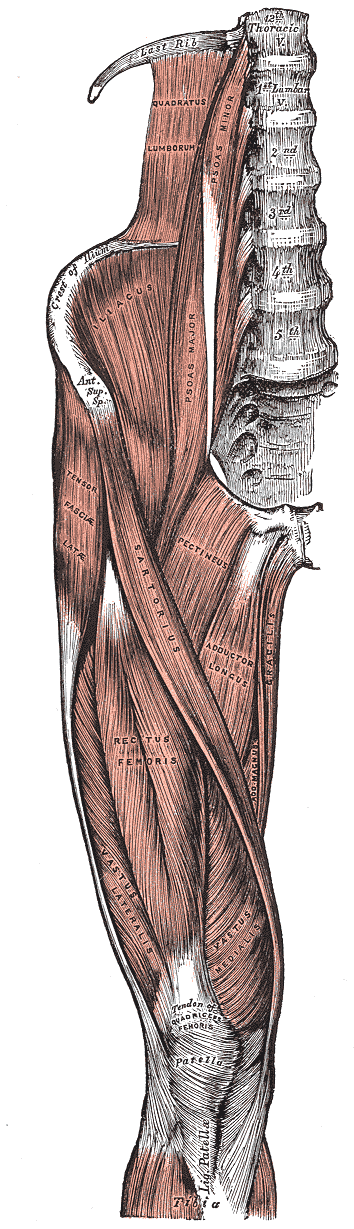 Front view of the pelvis and thigh muscles. The quadriceps femoris (rectus femoris, vastus lateralis, vastus medialis), which extends the knee to lift the body, covers the front of the thigh (Henry Vandyke Carter, Public domain)
Behind these everyday changes may lie sarcopenia, a muscle disease in which both muscle mass and muscle function decline together (Cruz-Jentoft Alfonso J et al., 2019). In a study that applied the Asian Working Group for Sarcopenia's AWGS 2019 criteria to 2,123 community-dwelling older adults aged 70–84 from the Korean Frailty and Aging Cohort Study, the prevalence was 21.3% in men and 13.8% in women (Kim Miji et al., 2020). The same study also found that the rate of severe sarcopenia, in which muscle strength, muscle mass, and physical performance all fall below the criteria, was 6.4% in men and 3.2% in women.
Is It Just Age, or Could It Be Your Knees or Back?
As muscle mass and strength decline with age, the strength needed to stand up and walk also decreases. If long periods lying in bed also reduce activity, muscle is lost even faster. Undernutrition from eating less and chronic disease also contribute to the development of sarcopenia (Cruz-Jentoft Alfonso J et al., 2019). Weakness from aging and inactivity usually progresses gradually and characteristically affects everyday movements of both legs across the board.
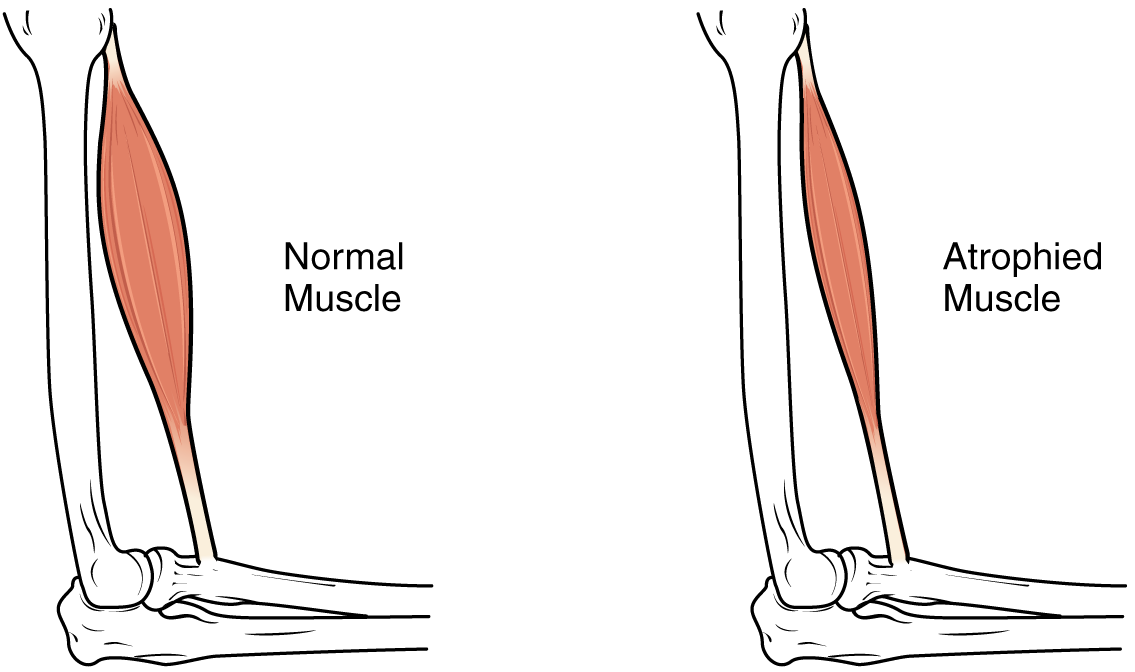 Normal muscle (left) and atrophied muscle (right). Even muscle attached to the same bone becomes noticeably thinner in volume when muscle mass decreases (OpenStax, CC BY 4.0)
On the other hand, joint, spinal, or nervous system conditions can cause similar difficulty with these movements, so the pattern of symptoms needs to be told apart. People with knee osteoarthritis support their body with their arms to reduce the weight on the knee, because of the knee pain that comes on when they stand up rather than because of the strength of the muscle itself. People with spinal stenosis find that the more they walk, the more their buttocks and legs go numb or feel a pulling sensation, and that the symptoms ease when they sit down to rest or bend forward at the waist.
Changes in gait can also stem from nervous system disorders. People with Parkinson's disease may walk more slowly with a narrower stride and show symptoms such as rigidity (stiffness) or hand tremor. If, instead of a gradual change, one arm or leg suddenly becomes weak or speech becomes slurred, you should suspect a stroke and get emergency care immediately. In addition, people who also have unintended weight loss for no particular reason need to see a doctor about their nutritional status and any hidden underlying disease, rather than treating it as simple aging.
If Standing Up Five Times Takes More Than 12 Seconds
The most recent Asian consensus, AWGS 2025, diagnoses sarcopenia when both muscle mass and muscle strength are low. It places physical performance as an indicator for evaluating actual functional status in activities such as walking and standing up, and for evaluating the results of management (PMID 41188603). The European criteria, EWGSOP2, treat low muscle strength as the key feature, confirm the diagnosis based on reduced muscle quantity or quality, and then use reduced physical performance to judge severity (Cruz-Jentoft Alfonso J et al., 2019).
AWGS 2019 lays out specific cutoff values for muscle strength, physical performance, and muscle mass, starting from risk-group screening (Chen Liang-Kung et al., 2020). For risk-group screening, the criteria used are a calf circumference under 34 cm in men and under 33 cm in women, a SARC-F questionnaire score of 4 or higher, and a SARC-CalF score (which adds calf circumference to the SARC-F) of 11 or higher. The SARC-F questionnaire scores difficulty carrying about 4.5 kg, walking across a room, rising from a chair or bed, and climbing 10 stairs, along with the number of falls in the past year, each on a 0-to-2-point scale.
After screening, three items are checked. Among them, the grip-strength cutoff for low muscle strength is under 28 kg in men and under 18 kg in women. The muscle mass index uses appendicular (limb) muscle mass divided by height squared. The AWGS 2019 cutoff for DXA is under 7.0 kg/m² in men and under 5.4 kg/m² in women, and the cutoff for BIA (bioelectrical impedance analysis) is under 7.0 kg/m² in men and under 5.7 kg/m² in women.
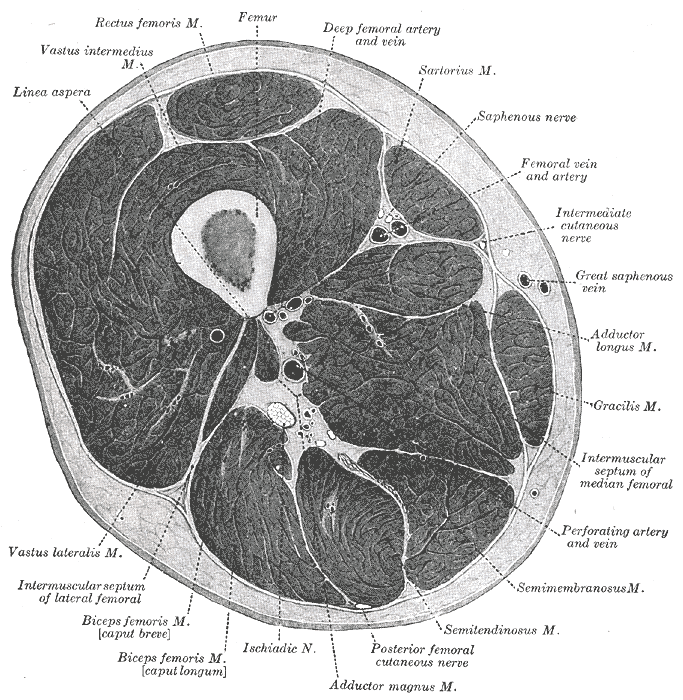 Cross-section through the middle of the thigh. The quadriceps femoris in front, the adductors on the inner side, and the hamstrings in back surround the femur, with muscle making up most of the thigh (Henry Vandyke Carter, Public domain)
Physical performance reflects daily movement, and it counts as low when any one of the following applies: a 6-meter gait speed under 1.0 m/s, a five-times chair-stand test of 12 seconds or more, or a Short Physical Performance Battery (SPPB) score of 9 or lower (Chen Liang-Kung et al., 2020). The five-times chair-stand test measures how long it takes to stand up five times following a set procedure, with both arms crossed over the chest; a result of exactly 12 seconds also falls under the low-physical-performance criterion. AWGS 2019 directs community and primary-care settings to classify people with low muscle strength or low physical performance as having possible sarcopenia and to begin lifestyle management. In the Korean Frailty and Aging Cohort Study, the proportion meeting this possible-sarcopenia criterion reached 20.1% in men and 29.2% in women (Kim Miji et al., 2020).
Can Muscle Still Grow Back With Exercise After Age Seventy?
Even after age seventy, muscle responds clearly to appropriate exercise and nutrition. A network meta-analysis pooling 42 randomized controlled trials involving 3,728 older adults with sarcopenia found a median participant age of 72.9 years and a median follow-up of 12 weeks (Shen Yanjiao et al., 2023). In this analysis, resistance exercise, in which muscles work against resistance, improved quality of life the most among the exercise interventions. In particular, when resistance exercise, balance exercise, and nutritional intervention were combined, grip strength was on average 4.19 kg higher than in the control group, and when resistance exercise and balance exercise were combined, usual walking speed was on average 0.16 m/s faster than in the control group (Shen Yanjiao et al., 2023).
Resistance exercise refers to movements in which muscles work against weight or resistance, such as sit-to-stand from a chair, heel raises while holding a support, or pulling an elastic band. The load of resistance exercise starts at a low level and is raised gradually, matched to current muscle strength, pain, and how stable the movement is. Adding balance exercises that train the body to hold itself steady, such as standing on one leg near a support or tandem (heel-to-toe) walking, helps with walking stability.
Maintaining and building the muscle stimulated by exercise requires adequate protein intake. The PROT-AGE study group recommends 1.0–1.2 g of protein per kg of body weight per day for adults over 65, and 1.2 g or more per kg of body weight per day for older adults who exercise regularly (Bauer Jürgen et al., 2013). However, patients with severe kidney disease who are not on dialysis need to adjust their protein intake according to their kidney function so as not to place extra strain on the kidneys.
THE WELLS manages muscle loss as part of its metabolic and muscle care. The goal of management is to slow muscle loss and restore strength balance so the body keeps a proper posture. When leg strength has dropped so much that patients find it hard to raise the exercise load on their own, THE WELLS performs EMS muscle strengthening. EMS muscle strengthening is a treatment that delivers stimulation to the muscle through a device to induce contraction and build strength. When the trunk muscles have stiffened and the balance of strength between the left and right sides has broken down, THE WELLS performs WINBACK core care, which uses WINBACK radiofrequency energy to release stiff trunk fascia and muscle and increase blood flow in deep tissue. THE WELLS provides EMS muscle strengthening and WINBACK core care together with resistance exercise and protein-rich meals to help patients recover the strength they need for daily movement.
Once You Have Fallen, You Walk Even Less
One key reason to manage sarcopenia promptly is the risk of falls and fractures. A meta-analysis of 33 studies in older adults, covering 45,926 people, confirmed a clear association between sarcopenia and falls and fractures (Yeung Suey S Y et al., 2019). Pooling the prospective studies that followed participants over time, people with sarcopenia had a fall odds ratio of 1.89 and a fracture odds ratio of 1.71 compared with those without sarcopenia (Yeung Suey S Y et al., 2019).
After a fall, even without injury, fear of falling again can lead a person to cut back on going outside and walking. When activity drops after a fall, the leg muscles waste further, and weaker legs raise the risk of falling again, creating a vicious cycle. In particular, if the hip is fractured in a fall, the person spends a long time lying in bed afterward without being able to stay active, and the leg muscles waste rapidly. As a result, walking again as before becomes very difficult.
We check whether daily function is recovering by looking at how well the patient stands up from a chair without help from the arms, and whether the distance they can walk outdoors without resting and their gait are improving. At follow-up visits, we also ask whether the patient has fallen recently and whether fear or pain after a fall has reduced their movement, and we adjust exercise intensity and the direction of management accordingly.
References
- Cruz-Jentoft Alfonso J, Bahat Gülistan, Bauer Jürgen (2019). Sarcopenia: revised European consensus on definition and diagnosis.. Age Ageing. PMID: 30312372
- Kim Miji, Won Chang Won (2020). Sarcopenia in Korean Community-Dwelling Adults Aged 70 Years and Older: Application of Screening and Diagnostic Tools From the Asian Working Group for Sarcopenia 2019 Update.. J Am Med Dir Assoc. PMID: 32386844
- Chen Liang-Kung, Hsiao Fei-Yuan, Akishita Masahiro (2025). A focus shift from sarcopenia to muscle health in the Asian Working Group for Sarcopenia 2025 Consensus Update.. Nat Aging. PMID: 41188603
- Chen Liang-Kung, Woo Jean, Assantachai Prasert (2020). Asian Working Group for Sarcopenia: 2019 Consensus Update on Sarcopenia Diagnosis and Treatment.. J Am Med Dir Assoc. PMID: 32033882
- Shen Yanjiao, Shi Qingyang, Nong Kailei (2023). Exercise for sarcopenia in older people: A systematic review and network meta-analysis.. J Cachexia Sarcopenia Muscle. PMID: 37057640
- Bauer Jürgen, Biolo Gianni, Cederholm Tommy (2013). Evidence-based recommendations for optimal dietary protein intake in older people: a position paper from the PROT-AGE Study Group.. J Am Med Dir Assoc. PMID: 23867520
- Yeung Suey S Y, Reijnierse Esmee M, Pham Vivien K (2019). Sarcopenia and its association with falls and fractures in older adults: A systematic review and meta-analysis.. J Cachexia Sarcopenia Muscle. PMID: 30993881
Frequently Asked Questions
Q. What care and management can I receive at THE WELLS if sarcopenia is suspected?
Through metabolic and muscle care, THE WELLS helps slow muscle loss and restore a strength balance that has broken down, so the body keeps a proper posture. When the legs have weakened considerably and it is hard to raise the exercise load on your own, we perform EMS muscle strengthening, which uses a device to induce muscle contraction. When the trunk has stiffened and the left-right balance has been lost, we apply WINBACK core care, which uses radiofrequency energy to increase blood flow in deep tissue. We carry out these treatments together with resistance exercise and protein-rich meals to help you recover the strength needed for everyday movements such as standing up and walking.
Q. How should resistance exercise be adjusted if you have knee pain?
For movements that trigger knee pain, reduce the resistance, the range of knee bending, and the number of repetitions to manage the strain. If swelling develops or bearing weight becomes difficult, stop that exercise and have your knee examined.
Q. My calves have gotten noticeably thinner. Could this be a warning sign of sarcopenia?
A smaller calf circumference is one of the screening criteria used to identify people at risk for sarcopenia. Under AWGS 2019, the Asian consensus criteria, a calf circumference below 34 cm in men or below 33 cm in women places a person in the at-risk group. This measurement is used together with the SARC-F questionnaire, which scores difficulty lifting about 4.5 kg, climbing 10 stairs, and rising from a chair, along with the number of falls over the past year. If the questionnaire score is 4 or higher, or if the SARC-CalF score, which combines the questionnaire with calf circumference, is 11 or higher, muscle strength, muscle mass, and physical performance should be examined closely to determine whether sarcopenia is present.
Medical review: Jumin Kim · Medical Director · THE WELLS