
Last updated: 2026-10-29
Deep Buttock Ache with Tingling Down the Back of the Thigh
If you have deep pain in the buttock along with a pulling or tingling sensation that travels down the back of the thigh, piriformis syndrome is worth knowing about. Piriformis syndrome occurs when the sciatic nerve is compressed or irritated around the piriformis, a deep muscle in the buttock (Probst D et al., 2019). Because the tingling radiates down the leg, people often suspect the lower back first, but in a good number of cases the pain actually starts in the muscles of the inner buttock and the passage the nerve runs through.
For example, an office worker in their 40s starts feeling a deep, aching pain in the center of the buttock the day after running on a hilly route over the weekend. At first they assume it's simple muscle soreness, but when they cross one leg over the opposite knee to put on socks in the morning, a heavy pulling sensation runs down the back of the thigh. When everyday movements that bend and rotate the hip cause a simultaneous pulling or tingling sensation deep in the buttock and down the back of the thigh, the area around the piriformis should be checked for a problem.
Buttock pain that worsens with prolonged sitting is a clinical feature commonly seen in piriformis syndrome (Hopayian K et al., 2018). This happens because body weight pressing into an office chair or car seat directly compresses the piriformis deep in the buttock and the nerve running beneath it.
How Does the Piriformis Compress the Sciatic Nerve?
The piriformis is a deep gluteal muscle that runs diagonally from the front of the sacrum to the greater trochanter on the outer side of the femur. When standing or walking, this muscle rotates the hip joint outward and balances the pelvis and leg joints. The sciatic nerve, meanwhile, is a thick nerve formed by the convergence of nerve roots from the lower back; it typically exits the pelvis and passes directly beneath this piriformis on its way down the back of the thigh.
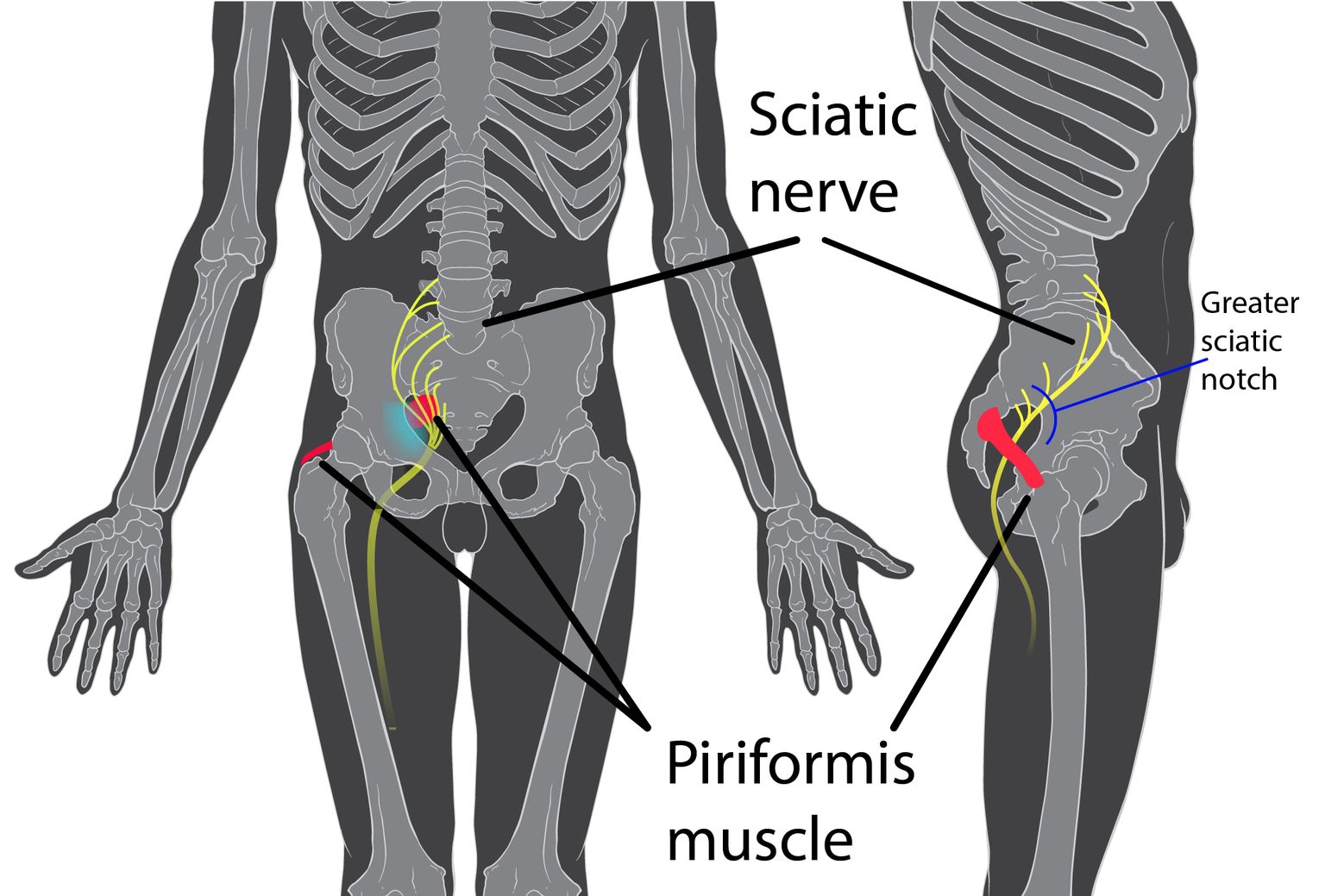 Location of the piriformis (red) deep in the buttock and the sciatic nerve (yellow) passing beneath it down into the leg (Patrick J. Lynch & KDS4444, CC BY-SA 2.5)
The point where the muscle and nerve meet varies in shape from person to person. A meta-analysis combining 44 cadaver studies found that the pooled rate of the typical pattern, in which the sciatic nerve passes undivided beneath the piriformis, was about 90%. In East Asian samples, the rate of anatomical variation between the sciatic nerve and the piriformis was observed at about 31% (Poutoglidou F et al., 2020). Here, the anatomical variation rate refers to the proportion of atypical nerve pathways, such as the nerve piercing through the muscle or splitting as it passes.
Because these two structures lie so close together, swelling and fibrosis in the piriformis following a direct impact to the buttock or repetitive strain can become a factor that compresses the nearby sciatic nerve. This anatomical relationship between the piriformis and the sciatic nerve provides the basis for understanding how the condition develops and how it is diagnosed (Probst D et al., 2019). Especially in activities such as running, soccer, or hiking, where you move forward while supporting your body on one leg, the piriformis is closely involved in rotating and stabilizing the hip, so increasing exercise volume without proper preparation can easily make the muscle overly tense and irritate the nerve.
What to Check When It's Hard to Distinguish from a Herniated Disc, Sacroiliac Joint Pain, or Hamstring Issues
Conditions in which a nerve is compressed deep in the buttock, causing pain in the back of the buttock that spreads down the leg, are grouped together as deep gluteal syndrome. This category includes piriformis syndrome and proximal hamstring syndrome, among others (Park JW et al., 2020). Because several of these conditions produce similar symptoms, identifying where the problem actually originates requires comparing the posture that triggers the pain, the exact location of the pain, and neurological signs, one by one.
A herniated disc occurs when the disc (the cartilage between the vertebrae) bulges out and irritates a nerve root in the lower back. When a nerve root is compressed in the lower back, coughing, sneezing, or bending forward at the waist may intensify the pain radiating down the leg. If sensation decreases along the skin area that a specific nerve root supplies, or if the ankle or toe muscles weaken, or if knee or ankle reflexes change, these are important examination findings for identifying a herniated disc.
On the other hand, the test of lying down and lifting the leg with the knee extended can produce pain and limited movement in both a herniated disc and piriformis syndrome. However, with piriformis syndrome, pressing near the greater sciatic notch deep in the buttock reveals clear tenderness, and whether the usual pain reappears when the hip is flexed, drawn inward, and rotated inward is an important diagnostic clue (Hopayian K et al., 2018).
Sacroiliac joint pain tends to be concentrated around the area below the belt line where the sacrum and pelvis meet. Proximal hamstring tendinopathy causes localized pain at the tendon attachment on the ischial tuberosity, the bone at the base of the buttock that contacts a chair when sitting, and accelerating while running or movements that load the tendon directly can trigger pain in the back of the thigh. Because the symptoms of piriformis syndrome overlap with these other conditions around the lower back and pelvis, careful differential diagnosis is needed (Probst D et al., 2019).
If leg strength progressively declines, or if foot drop develops, where the toes drag while walking, in addition to buttock and leg pain, this indicates severe nerve compression. In that case, prompt medical evaluation is necessary. In particular, if new bladder or bowel control problems develop, or if sensation decreases in the perineum (the region that would touch a saddle when seated), this requires immediate emergency care, so go to a hospital without delay.
What Ultrasound Shows Even When X-rays Look Clean
Patients who visit a hospital for tingling in the buttock and back of the thigh often hear that nothing unusual shows up on bone imaging. We first take X-rays to check the alignment of the lumbar spine, pelvis, and hip bones, along with joint space and bone spurs, to look for structural problems in the bones and joints themselves. However, an imaging test that shows only bone cannot directly reveal the condition of the muscles and nerves deep in the buttock. We therefore evaluate soft tissues such as the piriformis and sciatic nerve with musculoskeletal ultrasound.
With musculoskeletal ultrasound, we check the thickness and swelling of the piriformis in real time. We also use ultrasound to examine the condition of the tissue surrounding the sciatic nerve and the site where the hamstring tendon attaches to the ischial tuberosity, and to check whether another cause of the deep buttock pain is present. We observe not only while the patient lies still but also while rotating the patient's hip inward and outward, watching the muscle movement and the gliding around the nerve dynamically on ultrasound.
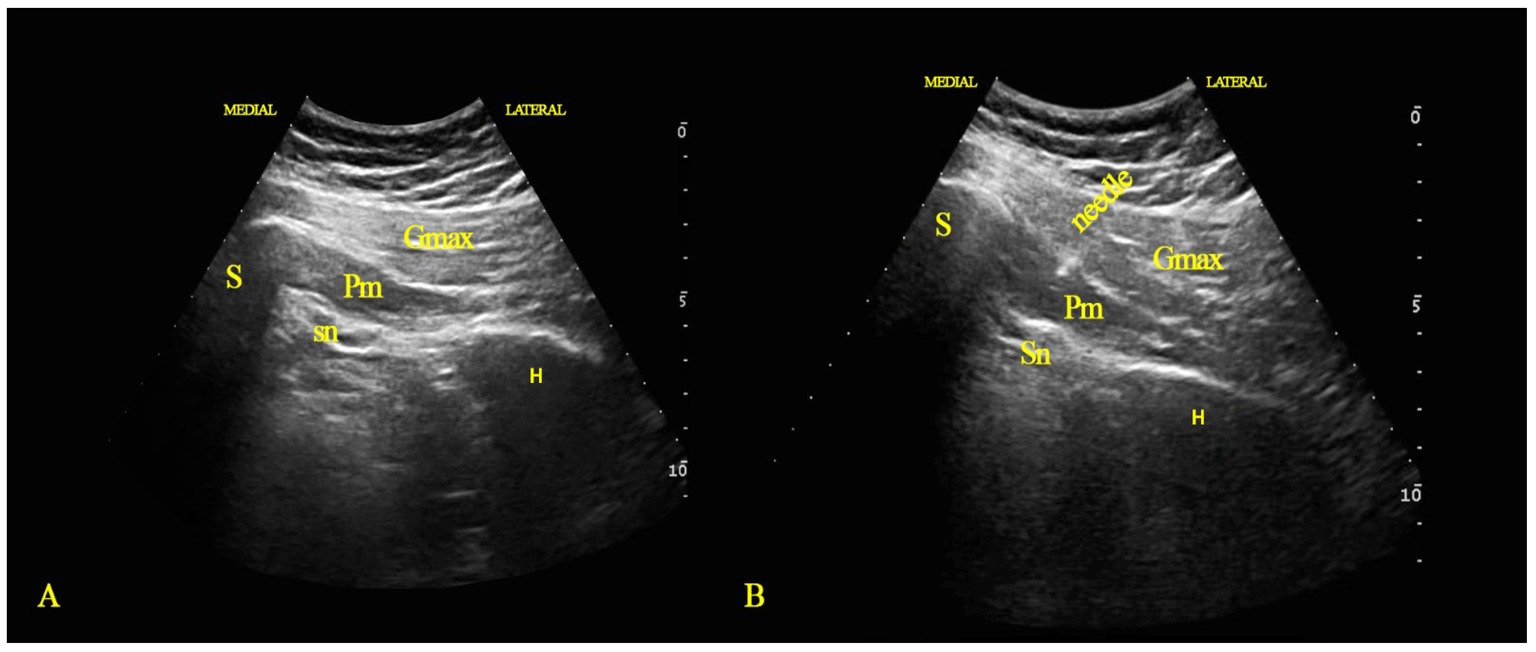 The piriformis muscle (Pm) and the sciatic nerve (sn) beneath it as seen on ultrasound; on the right, a needle is guided into the piriformis under ultrasound guidance (image from the study) (Elsawy AGS et al., CC BY 4.0)
In a study comparing 40 patients with piriformis syndrome to 40 healthy controls, the ultrasound-measured thickness of the piriformis on the symptomatic side and its elasticity values measured by shear-wave elastography were significantly higher than in the control group (Xu M et al., 2023). This means that the swelling and stiffening of the muscle can be observed on imaging. Diagnosing deep gluteal syndrome requires a detailed history, a physical exam including provocative tests, and imaging evaluation together (Park JW et al., 2020). We therefore determine the treatment site by comparing whether the location of the patient's symptoms and the physical exam findings match the changes observed on ultrasound.
How Is Non-Surgical Treatment Used to Release a Compressed Sciatic Nerve?
Initial treatment of piriformis syndrome starts with a conservative approach that reduces the load from pain-triggering activities while combining stretching and rehabilitation (PMID 37949567). This begins with getting up and walking periodically during long periods of sitting, and temporarily cutting back on activities that place repetitive impact on the gluteal muscles, such as running or hiking, until symptoms subside.
When an examination reveals clear tension around the piriformis and limited hip joint movement, we use WINBACK as an adjunct treatment at every session. WINBACK uses radiofrequency energy to ease stiff fascial adhesions and tension in the surrounding tissue, widening the joint's range of motion. The muscle needs to soften first so that stretching and rehabilitation exercises afterward can be performed without strain.
If pain persists at the piriformis attachment site or in the deep gluteal muscles, we apply extracorporeal shockwave therapy once or twice a week. A randomized clinical trial in 35 patients with piriformis syndrome compared a group that received three sessions of radial extracorporeal shockwave therapy with a group that received a single ultrasound-guided steroid injection. Both groups showed improvement in pain and quality-of-life measures compared to before treatment (Ahadi T et al., 2023). In that study, the shockwave group's pain decreased starting from the 1-week follow-up after treatment, and by the 12-week mark there was no statistically significant difference between the two groups.
If the ligaments or tendon attachments around the pelvis weaken and pain keeps recurring, we evaluate the condition and then use ultrasound-guided Prolozone injections. Prolozone combines prolotherapy, which induces regeneration and recovery of damaged ligament and tendon tissue, with ozone. As a standard, it is given 0.5 to 1 time per week for a total of 4 to 6 sessions, and we set the number of sessions and the interval according to the patient's symptoms and response to treatment.
Once treatment has eased the acute pain, we raise the intensity of piriformis stretching and gluteal strengthening exercises step by step to match the patient's symptoms. When returning to the running you used to enjoy, first check how much the buttock pain and leg tingling have settled during everyday walking and stair climbing. When returning to activity, starting with short distances on flat ground and gradually increasing the load helps prevent recurrence. If symptoms persist or repeatedly recur even after adequate conservative treatment, we re-examine whether the original diagnosis is correct and whether surgical decompression is needed; if imaging reveals a mass directly compressing the sciatic nerve, we discuss surgical treatment of the underlying lesion (Park JW et al., 2020)(PMID 34221947).
Sungjin Park · Medical Director · THE WELLS Nowon
References
- Probst D, Stout A, Hunt D (2019). Piriformis Syndrome: A Narrative Review of the Anatomy, Diagnosis, and Treatment.. PM R. PMID: 31102324
- Hopayian K, Danielyan A (2018). Four symptoms define the piriformis syndrome: an updated systematic review of its clinical features.. Eur J Orthop Surg Traumatol. PMID: 28836092
- Poutoglidou F, Piagkou M, Totlis T (2020). Sciatic Nerve Variants and the Piriformis Muscle: A Systematic Review and Meta-Analysis.. Cureus. PMID: 33354475
- Park JW, Lee YK, Lee YJ (2020). Deep gluteal syndrome as a cause of posterior hip pain and sciatica-like pain.. Bone Joint J. PMID: 32349600
- Xu M, Meng B, Geng Z (2023). A Case-Control Study of 40 Patients with Piriformis Muscle Syndrome to Evaluate Diagnostic Findings Using Two-Dimensional Ultrasound and Shear Wave Elastography.. Med Sci Monit. PMID: 37314972
- Hopayian K, Mirzaei M, Shamsi M (2023). A systematic review of conservative and surgical treatments for deep gluteal syndrome.. J Bodyw Mov Ther. PMID: 37949567
- Ahadi T, Yousefi A, Sajadi S (2023). Comparing radial extracorporeal shockwave therapy and corticosteroid injection in the treatment of piriformis syndrome: A randomized clinical trial.. J Bodyw Mov Ther. PMID: 36775517
- Vij N, Kiernan H, Bisht R (2021). Surgical and Non-surgical Treatment Options for Piriformis Syndrome: A Literature Review.. Anesth Pain Med. PMID: 34221947
Frequently Asked Questions
Q. Can using a cushion while sitting for long work hours reduce pain around the piriformis muscle?
Even with a cushion, sitting in the same position for a long time can lead to persistent deep pain in the buttocks. Compare the pain and tingling before and after using the cushion, and adjust your sitting posture and work duration so your hips do not tilt to one side.
Q. If leg tingling worsens during piriformis stretching, how should I adjust the exercise intensity?
If leg tingling worsens, stop that movement, and reduce the range of motion and hold time in the next exercise. If tingling still recurs at the reduced intensity or continues even after you finish exercising, you need to have your nerve function checked and change the exercise movement.
Q. When a herniated disc and piriformis syndrome occur together, how is the treatment area determined?
THE WELLS Nowon asks about the postures that trigger the pain and tests nerve function to distinguish which area is linked to the current symptoms. The treatment order is set based on the symptoms and examination findings, and after treatment, the location of any remaining pain and the extent of tingling are compared to decide whether another area needs treatment.
Q. What determines the treatment interval and total number of sessions for Prolozone?
The treatment interval and total number of sessions depend on how long the pain has lasted, the treatment site, and how symptoms change after the procedure. THE WELLS Nowon records the patient's pain score and changes in everyday movements such as sitting and walking, and checks whether discomfort persists after the procedure to decide the date of the next treatment and whether to continue treatment.
Related Articles
- Sciatica with a Normal MRI: Causes Beyond the Disc and How to Diagnose Them
- Lumbar Disc Herniation: Causes and Symptoms, From Leg Numbness to Stepwise Treatment
- Types of Sacroiliac Joint Injections and the Treatment Cycle From Nerve Block to Exercise Rehabilitation
- Hamstring Tendinopathy Treatment: Choosing Between Shockwave Therapy and Prolozone Injections in Samjeon-dong