
Last updated: 2026-11-05
The Left and Right Sides of My Face Look Different in Every Photo
Facial asymmetry that makes the left and right sides of the face look different from photo to photo appears when camera distance and head angle overlap with the actual left-right difference in the face. The causes of the jaw shifting to one side are the alignment of the temporomandibular joint and upper cervical spine, chewing habits, fascial tension in the jaw and neck, and left-right differences in the bone itself. That is why a single photo alone makes it hard to tell whether the bone is misaligned or whether the problem lies in the muscles and joints.
For example, if an office worker in their 30s places a smartphone selfie side by side with an ID photo taken at a photo studio, the right jawline might look longer in the selfie, while the tip of the chin might appear shifted to the left in the ID photo. Taking a photo at close range with an outstretched arm distorts perspective, making the parts closer to the lens look relatively larger. In fact, a study that used a mathematical model to analyze facial photos taken at short distances found that the nose appeared relatively larger as the camera moved closer, because of this perspective effect (Ward Brittany et al., 2018).
On top of this, when the head turns slightly or tilts to one side, the jawline facing the camera looks wider while the jawline on the opposite side looks shorter. Left-right differences in the face are common in people (Cheong You-Wei et al., 2011). In addition, lighting, gaze direction, and the angle at which the chin is tucked in or raised change with each shot, so this difference stands out in a different direction in every photo.
Why Does the Jaw Look Shifted Before the Eyes or Nose?
A study of 1,460 patients at a US dentofacial deformity clinic found visible facial asymmetry in 495 patients (34%). Among the patients with asymmetry, the jaw was off-center in 74%, the middle of the face including the nose in 36%, and the upper face in 5% (Severt T R et al., 1997). The mandible (lower jawbone) is the only bone of the skull that moves at a joint, so changes in its position show easily on the outside.
The position of the lower jaw is linked to the condition of the temporomandibular joint (TMJ, the jaw joint). A systematic review and meta-analysis of seven cross-sectional studies covering 621 people found that people with a TMJ disorder on one side had a chin that deviated more than controls (Marques Fernanda Blaudt Carvalho et al., 2021). Rotation of the jaw joint takes place near the upper cervical spine, which is made up of the first and second neck bones (C1, C2). When the bite is misaligned, the forces placed on the neck bones during jaw movement become uneven.
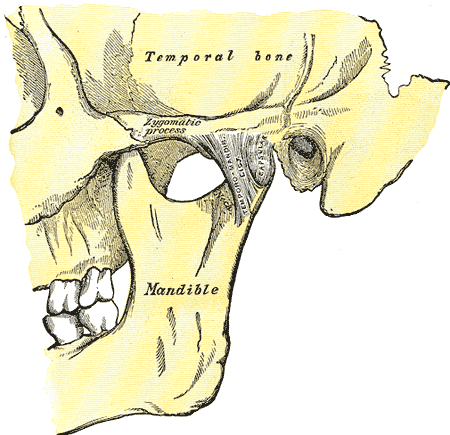 Side view of the temporomandibular joint. A joint capsule and ligaments surround the point where the temporal bone meets the head of the mandible (Henry Vandyke Carter, Public domain)
If you have a habit of clenching your teeth, tension in the masseter and temporalis, the muscles used for chewing, becomes different on the left and right. Muscles and fascia around the jaw that stay tense for a long time stiffen and restrict movement of the jaw and neck.
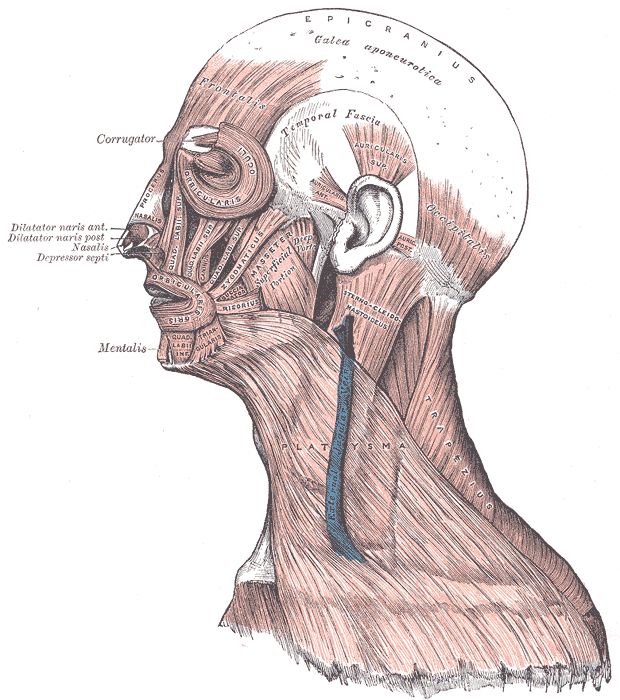 Side view of the muscles of the head and neck. The masseter runs down from in front of the ear to the lower jaw, with the temporal fascia above it and the neck muscles continuing below (Henry Vandyke Carter, Public domain)
Studies differ on how a habit of chewing on only one side affects the shape of the face. A twin study found greater volume in the chin area on the side opposite the main chewing side (Heikkinen Elina V et al., 2022). However, another study analyzing a large birth cohort found only that people who had lost teeth on one side tended to chew on the other side, and the statistical association between the main chewing side and facial asymmetry was not clear (Heikkinen Elina V et al., 2024). Beyond these functional factors in the muscles and joints, congenital differences, deformities during growth, trauma, and acquired diseases also cause asymmetry of the skeleton itself (Cheong You-Wei et al., 2011).
How Do You Tell Whether a Left-Right Difference Comes from the Skin, the Teeth, or the Bone?
Planning to correct facial asymmetry first requires determining whether a visible left-right difference comes from soft tissue such as skin and muscle, from how the teeth bite together, or from differences in the shape of the jawbone and skull. To do this, clinicians take a history, perform a physical examination, and obtain medical imaging as needed to assess how much the soft tissue, teeth, and skeleton each contribute (Cheong You-Wei et al., 2011).
First, the clinician watches the path of the chin as the patient slowly opens and closes the mouth: whether it drops straight down, or curves to one side and then returns. With the mouth closed, the clinician compares whether the midlines of the upper and lower teeth line up, and checks whether the occlusal plane where the molars on both sides meet is tilted or whether a malocclusion (bite misalignment) is also present. The clinician also asks specifically whether there is pain in the jaw joint or cheek muscle on one side when chewing food, and whether the patient has a habit of clenching the teeth while concentrating or during sleep.
At THE WELLS Jamsil, the first step of Facial Reset Fit is 3D facial analysis, which measures the left-right difference in the face, its contours, and muscle tone. Because 3D facial analysis measures the face as three-dimensional data, it is less affected by the head angle and camera distance of a single photo. When the left-right difference in the bone is large and a severe bite problem is also present, a dental or oral and maxillofacial surgery clinic plans orthodontic treatment together with orthognathic (jaw-correction) surgery (Cheong You-Wei et al., 2011).
The Jaw First, Then the Fascia and Skin
Unless the case has reached the stage of needing surgery that cuts and moves the skeleton itself, we first restore the balance of the joints and muscles that control movement of the lower jaw. Facial Reset Fit begins with Sigma spinal correction and temporomandibular joint treatment. It is a non-surgical course with no surgery or incisions, and the detailed composition of the course is decided after 3D facial analysis and consultation.
The Sigma ProAdjuster 360 we use at this stage is a device that measures subtle spinal misalignments by computer and corrects them with mechanical percussion, and for the jaw joint we fit a dedicated tip for treatment. For people whose jaw hurts or makes a sound when they open their mouth, we use manual therapy for the jaw joint that includes upper cervical correction. In the next step, tongue position stabilization, training that corrects the position of the tongue calms tension in the muscles around the jaw and mouth.
For people whose jaw muscles on one side have stiffened, we release the stiff fascia and muscle with WINBACK radiofrequency (TECAR). For people also concerned about a sagging jawline, we add HIFU, a procedure that tightens the loosened fascial layer with focused ultrasound, and extracorporeal shockwave therapy, a procedure that stimulates the deeper layers with REFTONE equipment. For people also concerned about skin texture, exosome care follows as the next step. The later part of the course continues with Lympha-TE circulation care and maintenance care tailored to the diagnostic results.
We assess jaw joint function by the pain the patient feels and how far the mouth opens, but we judge separately, with skeletal assessment data, whether the shape of the skeleton has changed. How quickly and how much things change after treatment depends on the individual's skeletal structure and how stiff the fascia is.
If Your Jaw Shifts More and More or One Side of Your Face Goes Weak
If one side of the face suddenly droops and speech becomes slurred, or the arm and leg on one side become weak, these are emergency signs of a stroke. In that case, the patient and the people nearby should call 119 (the emergency number in Korea) right away and go to the emergency room. Even without paralysis of the arm or leg or slurred speech, if one eye suddenly does not close well and the corner of the mouth droops, see a doctor that same day to check whether it is facial palsy.
If the tip of the chin visibly turns further and further to one side over several months, or the position where the upper and lower teeth meet changes, condylar hyperplasia may be suspected. Condylar hyperplasia is a condition in which the head of the jaw joint (the condyle) on one side grows excessively and facial deviation progresses, and it can come with bite problems and abnormal jaw joint function. Accordingly, a treatment plan that includes surgery and orthodontic treatment is set according to growth activity and the degree of deformity (Bi Ruiye et al., 2026). So when changes like these progress noticeably, you need to see a dentist or an oral and maxillofacial surgeon.
In other cases, if the head is always tilted to one side and turning the neck is difficult, first check whether it is torticollis. If asymmetry appeared after the face or jaw was hit, a jawbone fracture should be checked first, and if a hard lump can be felt on one side of the jaw or below the ear, structural lesions such as a salivary gland or bone tumor should be looked for.
Jumin Kim · Medical Director · THE WELLS Jamsil
References
- Ward Brittany, Ward Max, Fried Ohad (2018). Nasal Distortion in Short-Distance Photographs: The Selfie Effect.. JAMA Facial Plast Surg. PMID: 29494735
- Cheong You-Wei, Lo Lun-Jou (2011). Facial asymmetry: etiology, evaluation, and management.. Chang Gung Med J. PMID: 21880188
- Severt T R, Proffit W R (1997). The prevalence of facial asymmetry in the dentofacial deformities population at the University of North Carolina.. Int J Adult Orthodon Orthognath Surg. PMID: 9511487
- Marques Fernanda Blaudt Carvalho, de Lima Lílian Siqueira, Oliveira Pedro Lima Emmerich (2021). Are temporomandibular disorders associated with facial asymmetry? A systematic review and meta-analysis.. Orthod Craniofac Res. PMID: 32608091
- Heikkinen Elina V, Vuollo Ville, Harila Virpi (2022). Facial asymmetry and chewing sides in twins.. Acta Odontol Scand. PMID: 34619067
- Heikkinen Elina V, Vuollo Ville, Heikkinen Tuomo (2024). Chewing Side Preference, Facial Asymmetry and Related Factors in the Northern Finland Birth Cohort 1986.. Acta Odontol Scand. PMID: 39291747
- Bi Ruiye, Abotaleb Bassam M, Bai Xiaofeng (2026). Expert consensus on treatment of condylar hyperplasia and secondary dento-maxillofacial deformities.. Int J Oral Sci. PMID: 42243073
Frequently Asked Questions
Q. Does chewing on only one side make the face crooked?
The relationship between a one-sided chewing habit and facial asymmetry differs from study to study. A twin study found that chin volume was larger on the side opposite the habitual chewing side (Heikkinen Elina V et al., 2022). In contrast, an analysis of 748 people from a birth cohort found that chewing-side preference had no statistically significant effect on facial asymmetry (Heikkinen Elina V et al., 2024).
Q. If pain decreases after temporomandibular joint treatment but a jawline difference remains, what should be checked?
We record changes in pain and mouth-opening range separately from changes in facial contour. For a jawline difference that remains, we distinguish among left-right differences in the soft tissue, the bite of the teeth, and the shape of the jawbone, and then decide whether further treatment is needed and how far it should go.
Q. Does Facial Reset Fit require surgery or an incision?
Facial Reset Fit is a non-surgical course with no surgery or incisions, and its specific composition is decided after 3D facial analysis and consultation. When the left-right difference in the bone is large and a severe bite problem is also present, orthognathic surgery is discussed with a dentist or an oral and maxillofacial surgeon.
Q. Does everyone have to go through every step of Facial Reset Fit the same way?
The detailed composition of the course is decided after 3D facial analysis and consultation. We separate the areas that need improvement in pain and jaw movement from the areas that need fascia and skin care, and confirm the purpose and scope of each step.